By: | Published: June 27, 2026
TL;DR:
- Directional tree felling involves choosing a controlled fall path using precise notch and back cuts. It relies on mechanical principles, especially the hinge, to guide the tree safely during the fall. Proper hazard assessment, escape routes, and hinge thickness are essential for safe and effective operation.
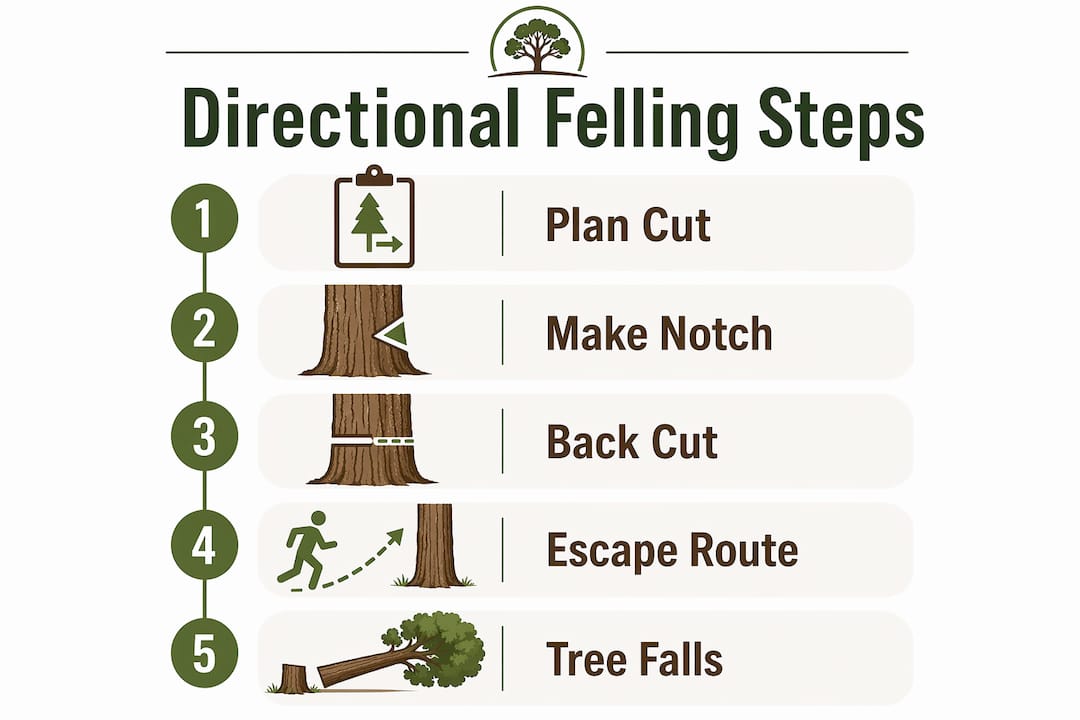
Directional tree felling is defined as the practice of cutting a tree so it falls in a predetermined, controlled direction using a sequenced series of notch and back cuts. The industry also calls this controlled tree felling, and both terms describe the same method. The technique relies on three physical elements: a directional notch (face cut), a back cut (felling cut), and a hinge of uncut wood that guides the fall like a mechanical pivot. The 2026 five-step felling plan from Clemson Extension Forestry and Wildlife sets the current standard, covering hazard evaluation, lean assessment, escape route planning, hinge thickness determination, and final cut execution. Understanding what is directional tree felling means understanding that physics, not force, does the work.
What is directional tree felling and how do the cuts work?
The three cuts in directional felling each serve a distinct mechanical role. The directional notch removes a wedge of wood from the side of the tree facing the intended fall direction. The back cut, made from the opposite side, releases the tree’s weight. The hinge, the uncut wood between the two cuts, controls the speed and path of the fall.
The open-face notch uses an angle of 70–90 degrees and a depth of 20–33% of the trunk’s diameter. That wide angle gives the tree more room to rotate before the hinge breaks, which translates directly into better directional control. A narrow notch closes quickly and can cause the tree to kick back or fall sideways before the operator moves clear.
| Notch type | Angle | Depth | Best use |
|---|---|---|---|
| Open-face notch | 70–90° | 20–33% DBH | Most felling situations; maximum control |
| Conventional notch | ~45° | 20–25% DBH | Smaller trees with predictable lean |
| Bore cut (plunge cut) | N/A | Full hinge zone | Trees with tension wood or heavy lean |
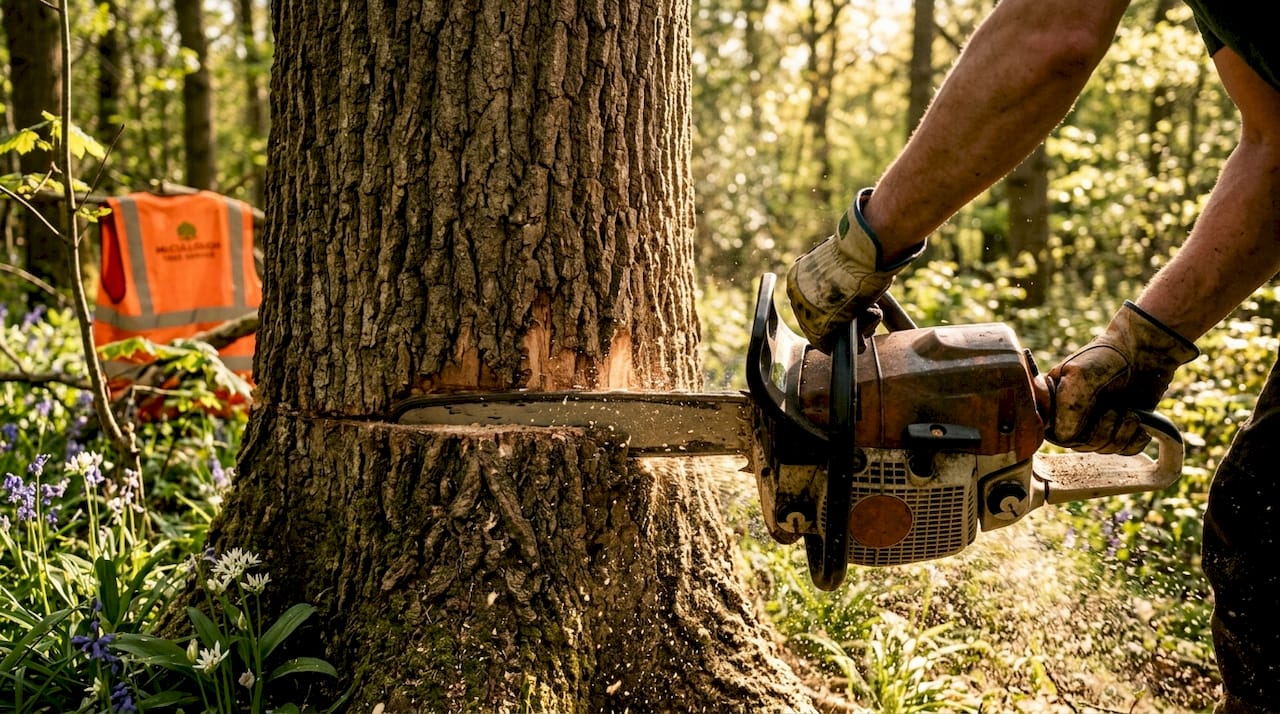
The back cut runs parallel to the top cut of the notch, leaving the hinge intact. Hinge thickness should be approximately 10% of the tree’s diameter at breast height (DBH). That number is not arbitrary. A thinner hinge snaps too early and surrenders control. A thicker hinge resists the fall and can cause the tree to barber-chair, splitting upward violently.
Pro Tip: Score the bark with your saw before making the notch cuts. Clear any root protrusions at the base so your footing is stable and your saw angle stays exact throughout the cut.
Hinge thickness also varies by species. Yellow pine has long, flexible fibers that hold well at 10% DBH. Oak has shorter, stiffer fibers that can fracture unpredictably, so experienced operators sometimes leave a slightly thicker hinge on large oaks. Knowing your species before you start is not optional.
How do hazard assessments shape a safe felling plan?
A thorough hazard evaluation is the first line of defense in any felling operation. PPE like hard hats and chainsaw chaps matters, but the California Department of Industrial Relations is clear: proper hazard evaluation comes first, and PPE is a supplementary layer. Relying on gear to compensate for a skipped site assessment is how operators get hurt.
The site evaluation covers several specific factors:
- Tree lean. Identify the direction and degree of lean before touching the saw. A tree leaning 5 degrees toward a fence line will fight every cut you make to redirect it.
- Wind load. Wind above 15 mph adds unpredictable lateral force. Schedule felling for calm conditions whenever possible.
- Drop zone clearance. The safe drop zone must extend at least twice the tree’s height in all directions. That radius keeps bystanders, vehicles, and structures outside the danger area.
- Overhead hazards. Dead branches, called widow-makers, can dislodge during the fall and travel far outside the expected drop zone.
- Ground conditions. Wet or uneven ground affects footing during the retreat. Walk the area before cutting.
A tree hazard evaluation in Florida also needs to account for root rot and storm damage, both of which compromise the wood’s fiber integrity and make hinge behavior unpredictable.
Pro Tip: Never assume a tree will fall where it leans. Working with the tree’s natural lean and wind load is the goal, but always verify with a plumb line or weighted string before committing to a fall direction.
Environmental factors change the plan. A tree near a power line may require a rigging system or aerial work before ground felling is safe. A tree on a slope falls faster than expected because gravity accelerates it the moment the hinge releases. These are not edge cases. They are standard conditions in residential and commercial tree removal across Central Florida.
What are best practices for escape routes and final cut execution?
Most felling accidents happen during the final phase, not during the notch cut. Operators must watch canopy movement and be ready to move the instant the tree begins to shift. The cutting technique gets you to that moment safely. What happens next depends entirely on preparation.
Follow these steps for safe escape route planning and final cut execution:
- Clear two escape paths. Both paths should run at 45-degree angles away from the intended fall line, one to the left and one to the right. Remove all debris, tools, and tripping hazards from both paths before starting the saw.
- Confirm the drop zone is clear. Walk the zone one final time. Bystanders and non-essential personnel must be at least twice the tree height away from the base.
- Make the back cut. Start the back cut slightly above the bottom of the notch. Leave the hinge intact. Do not cut through it.
- Insert a felling wedge if needed. On trees with back-lean, drive a plastic or aluminum felling wedge into the back cut to prevent the saw from pinching and to add mechanical push toward the fall direction.
- Retreat immediately. Move at least 20 feet down one of the escape paths the moment the tree begins to move. Keep your eyes on the canopy, not the stump.
- Watch for kickback. The butt of the tree can kick backward as it falls. Stay off the fall line entirely during retreat.
The escape route is not a formality. Two paths at 45-degree angles give you a fail-safe if the tree falls unpredictably. A single path directly behind the tree puts you in the most dangerous position possible if the fall direction shifts even slightly. For a detailed walkthrough of the full process, Mcculloughtreeservice publishes a guide on how to cut down a tree safely that covers these steps for homeowners and crews alike.
What situations benefit most from directional felling?
Directional felling is the right method whenever a tree’s fall path matters. That covers more situations than most property owners realize.
- Urban and suburban tree removal. Trees near homes, fences, driveways, or parked vehicles require a fall path accurate enough to avoid costly damage. Directional felling delivers that control where uncontrolled felling cannot.
- Trees near power lines. Utility proximity demands precision. Directional techniques allow crews to drop a tree away from energized lines without aerial rigging in many cases, though line proximity always requires a utility assessment first.
- Land clearing operations. When clearing a site for construction or agriculture, directional felling lets crews stack trees in a consistent direction. That speeds up the chipping and hauling process significantly. Mcculloughtreeservice covers the full scope of this work in its land clearing process guide.
- Hazard tree removal. Dead, diseased, or structurally compromised trees are unpredictable. Directional techniques, combined with a thorough hazard assessment, give operators the best chance of a controlled outcome even when the wood is compromised.
- Solar panel efficiency management. Trees that shade rooftop solar arrays need removal or heavy trimming. Directional felling lets crews drop overhanging trees without damaging the panels below. Mcculloughtreeservice offers tree trimming for solar panels as a specific service for this scenario.
The common thread across all these applications is the same: directional felling replaces guesswork with a plan. Uncontrolled felling in any of these settings risks property damage, injury, or both.
Key Takeaways
Directional tree felling requires a sequenced cutting plan, a properly sized hinge, a cleared drop zone, and two prepared escape routes to produce a safe and controlled outcome.
| Point | Details |
|---|---|
| Open-face notch standard | Cut at 70–90° and 20–33% of trunk diameter for maximum fall control. |
| Hinge thickness rule | Maintain hinge at approximately 10% DBH; overcutting causes loss of control. |
| Drop zone clearance | Clear a radius of at least twice the tree height before any cut begins. |
| Escape route requirement | Establish two debris-free paths at 45-degree angles away from the fall line. |
| PPE is supplementary | Hazard evaluation is the primary defense; gear supports it, not the other way around. |
Why the hinge is the most underrated part of the whole operation
Most beginners focus on the notch cut because it is the most visible part of directional felling. The hinge gets treated as an afterthought. That is exactly backwards. The hinge is the only thing keeping you in control of a several-ton object in motion.
I have seen operators cut a textbook open-face notch and then rush the back cut, slicing through the hinge entirely before the tree had committed to the fall direction. The result is a tree that pivots freely with no mechanical guide. At that point, wind, root structure, and internal tension decide where it goes. None of those forces care about your escape route.
The physics here are not complicated, but they are unforgiving. A hinge that is too thin breaks early and gives you no control. A hinge that is too thick resists the fall and can cause the trunk to split vertically, a phenomenon called barber-chairing that sends a slab of wood straight up and back toward the operator. The 10% DBH standard exists because it sits in the safe zone between those two failure modes.
Situational awareness matters more than cutting speed. Experienced operators treat every second after the back cut begins as a live situation. They are not thinking about the next tree. They are watching the canopy for the first sign of movement and mentally confirming which escape path they will take. Speed comes with practice. That habit of attention has to come first.
— Mcculloughtreeservice
Professional tree removal done right in Central Florida
Directional felling is a skill that takes time to develop, and the margin for error in residential and commercial settings is narrow.

Mcculloughtreeservice brings certified arborist expertise to every tree removal project in Orlando and Central Florida, applying the full five-step felling plan on every job. Whether you need a single hazard tree dropped safely away from your home or a full land clearing operation executed efficiently, the team handles the hazard assessment, escape planning, and cut execution so you do not have to. Contact Mcculloughtreeservice for a free estimate and get the job done safely the first time.
FAQ
What is the difference between directional and conventional tree felling?
Directional tree felling uses a wide open-face notch at 70–90 degrees to control the fall path with precision, while conventional felling uses a narrower notch that offers less rotational control. The directional method is the current industry standard for safe, controlled removal.
How thick should the hinge be when felling a tree?
The hinge should be approximately 10% of the tree’s diameter at breast height (DBH). Cutting through the hinge removes all directional control and creates an unpredictable and dangerous fall.
How far away should you stand when a tree falls?
Move at least 20 feet down one of your pre-cleared escape paths the moment the tree begins to move. Keep your eyes on the canopy during the retreat to watch for unexpected directional shifts.
Can directional felling work near power lines?
Directional felling can be used near power lines when the fall path is planned to move the tree away from the lines, but utility proximity always requires a hazard assessment and may require coordination with the utility provider before work begins.
Is directional felling suitable for beginners?
Directional felling for beginners requires supervised practice before solo work on any tree larger than a small diameter. The cutting sequence is learnable, but hazard assessment and situational awareness take time to develop and should not be skipped at any experience level.
Recommended
- Tree Trimming Safety Protocols to Remember
- Identify a Dangerous Tree: Signs & Solutions
- How to Cut Down a Tree Safely
- Safe Tree Removal Central Florida: 85% Injury Cut Guide