By: | Published: July 2, 2026
TL;DR:
- A commercial tree inventory is a systematic record of trees that supports maintenance, risk management, and compliance. Properly managed data and regular updates prevent liability and costly failures, while technology like LiDAR and open data formats enhance efficiency. Building a cycle of inventory, assessment, and maintenance ensures long-term asset management and safety.
A commercial tree inventory is a systematic process of identifying, measuring, and evaluating every tree on a commercial property to support maintenance decisions, risk management, and regulatory compliance. Property managers, land developers, and municipalities that skip this process expose themselves to liability claims that can exceed $10,000–$20,000 per incident. The industry standard framework comes from two authoritative sources: the ISA TRAQ methodology and the US Forest Service Urban FIA guidelines. Mcculloughtreeservice works with commercial clients across Orlando and Central Florida to build and maintain these records using current 2026 standards.
What are the essential components of a commercial tree inventory?
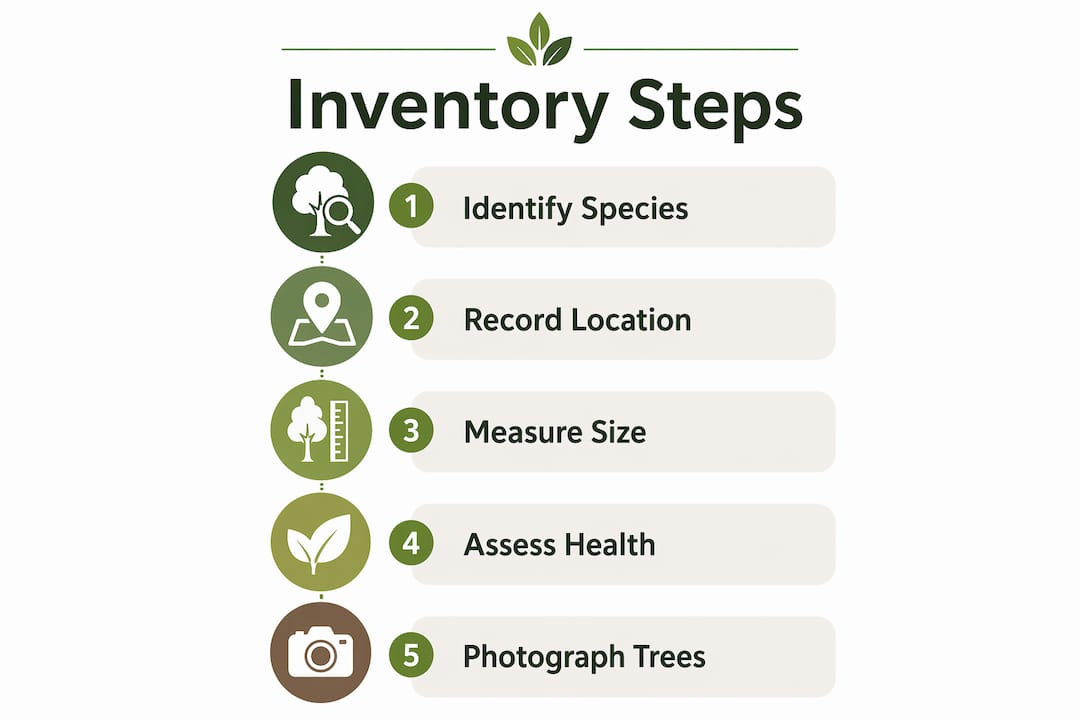
A commercial tree inventory guide starts with five core data points for every tree: species identification, GPS location, diameter at breast height (DBH), crown spread, and overall health condition. DBH is measured at 4.5 feet above ground and serves as the primary size metric across all professional inventory systems. Crown spread determines canopy coverage and shading impact. Together, these measurements create a baseline record that supports every future maintenance and risk decision.

The US Forest Service Urban FIA standard enables a one- or two-person crew to complete standard tree inventory measurements in less than one day on a typical commercial site. That efficiency is only possible when crews use standardized data codes and attribute definitions before entering the field. Without consistent definitions, two crews measuring the same trees will produce incompatible records.
Structural condition assessment goes beyond health ratings. Crews document visible defects including dead branches, root damage, trunk cavities, and co-dominant stems. Each defect gets coded using a standardized system so the data can feed directly into risk prioritization workflows. Quality control requires a supervisor to spot-check at least 10% of records before the dataset is finalized.
- Species and location: Record the scientific name and GPS coordinates for every tree.
- Size measurements: Capture DBH, total height, and crown spread using calibrated tools.
- Health and structure: Rate overall health and document visible structural defects using standardized codes.
- Site conditions: Note soil conditions, proximity to infrastructure, and any recent maintenance history.
- Data validation: Cross-check a sample of field records against photos before closing the dataset.
Pro Tip: Photograph each tree from two angles during data collection. Photos resolve disputes, support insurance claims, and make future re-assessments faster.
How do professional tree risk assessments integrate with commercial tree inventories?
A tree inventory and a formal risk assessment are not the same thing. Confusing the two leads to overpaying for diagnostics or, worse, underestimating actual risk. The inventory creates the asset record. The risk assessment uses that record to evaluate failure probability and consequence.
The ISA TRAQ methodology defines three assessment levels. Level 1 is a rapid visual screening from a moving vehicle or walking path, used to flag obvious hazards across large sites. Level 2 is a comprehensive ground-level evaluation by a qualified arborist, covering the full tree from roots to canopy. Level 3 uses advanced diagnostic tools such as sonic tomography and resistograph drilling to evaluate internal decay and structural integrity.
| Assessment level | Method | Typical cost | Reassessment frequency |
|---|---|---|---|
| Level 1 | Visual drive-by or walk-through screening | Included in inventory cost | Annually |
| Level 2 | Full ground-level arborist evaluation | $200–$400 per tree | Every 2–3 years (moderate risk) |
| Level 3 | Advanced diagnostics with specialized tools | $800–$1,500 per tree | Annually or bi-annually (high risk) |
Low-risk trees need formal evaluation every 5–7 years. High-risk trees require annual or bi-annual review. Scheduling assessments by risk category prevents unnecessary spending on low-priority trees while keeping high-hazard specimens under close watch.
The financial case for proactive assessment is clear. Emergency response, property damage, and legal liability from a single failed tree routinely exceed $10,000. A Level 2 assessment at $200–$400 per tree is a fraction of that exposure. Property managers who treat trees as managed assets rather than landscape features consistently avoid the largest costs.
Pro Tip: Use your inventory data to triage which trees need Level 2 or Level 3 assessments. Not every tree on a commercial property requires advanced diagnostics. Start with trees near buildings, parking areas, and pedestrian paths.
What are the latest technology trends in commercial tree data collection?
Hybrid inventory methods combining mobile LiDAR, 360° imaging, and arborist validation now represent best practice for large commercial sites and municipalities. LiDAR captures precise 3D point cloud data across entire streetscapes in a single pass. Automated feature extraction then identifies tree locations, canopy dimensions, and trunk positions from that data. A certified arborist reviews the output and adds species identification, health ratings, and structural notes that sensors cannot capture.
The speed advantage is significant. Traditional field surveys require crews to physically measure and record each tree individually. Hybrid methods collect raw spatial data for hundreds of trees in hours, then concentrate arborist time on interpretation and validation rather than measurement. That shift reduces total field hours without sacrificing data quality.
Software platforms like TreePlotter and OpenTreeMap translate raw inventory data into searchable, map-based management systems. Property managers can filter trees by species, risk rating, or maintenance due date. Work orders generate directly from the platform, and completed tasks update the tree record automatically. That closed-loop workflow is what separates a living inventory from a static spreadsheet.
Key technology considerations for property managers:
- Data format: Require delivery in open formats such as CSV, GIS shapefiles, or Excel. Proprietary formats create vendor lock-in and complicate future migrations.
- Integration: Confirm the platform connects with your existing maintenance or facilities management software.
- Scalability: Choose a system that handles your current tree count and can grow as your portfolio expands.
- Update workflow: Verify that maintenance activities automatically trigger record updates within the system.
Pro Tip: Before signing any inventory contract, ask the vendor to demonstrate a data export in CSV and GIS formats. If they hesitate, that is a warning sign.
How do you manage and maintain a commercial tree inventory over time?
A tree inventory loses value the moment it stops reflecting current conditions. Successful programs treat data collection as a cycle, not a one-time project. Every pruning visit, removal, or storm event should trigger an update to the affected tree records. That discipline keeps the dataset accurate and prevents the gradual drift that makes old inventories unreliable.
The practical mechanism is work order integration. When a crew completes a pruning job, the work order closes and the tree record updates with the date, scope, and crew notes. That connection requires upfront configuration but eliminates the manual data entry that most programs abandon within two years. Property managers who build this workflow from the start maintain accurate records indefinitely.
- Set a re-assessment schedule: Low-risk trees every 5–7 years, moderate-risk every 2–3 years, high-risk annually.
- Tie updates to work orders: Every maintenance activity should close with a record update in the inventory system.
- Audit annually: Pull a random sample of 50 records each year and verify them against current site conditions.
- Review after major events: Hurricanes, ice storms, and droughts change tree conditions rapidly. Schedule a site walk within 30 days of any significant weather event.
- Confirm data portability: Export a full backup of your inventory data at least once per year in an open format.
Data ownership matters more than most property managers realize. Platforms that store your data in proprietary formats hold your asset records hostage if you switch vendors. Open data formats protect your investment and allow future integration with municipal GIS systems, insurance platforms, or new management tools without migration costs.
Pro Tip: Schedule your annual inventory audit in late winter, before the growing season begins. Bare canopies make structural defects easier to spot, and you have time to schedule remediation work before summer storm season.
What are common challenges in commercial tree inventory projects?
Resource constraints are the most common reason inventory programs stall. Property managers often underestimate the time required for quality field data collection. Municipalities face budget cycles that fund the initial inventory but not the ongoing updates. Land developers frequently treat inventory as a one-time due-diligence task rather than a long-term asset management tool.
Practical solutions exist for each constraint:
- Limited budget: Start with a Level 1 screening across the full site, then prioritize Level 2 assessments for trees near high-occupancy areas. This concentrates spending where risk is highest.
- Staff expertise gaps: Engage a certified arborist for field validation even if internal staff handle data entry. Species identification and structural assessment require professional training.
- Regulatory compliance: Check local ordinances before starting. Many Florida municipalities require permitted tree surveys before development or significant removal. Non-compliance creates permit delays and fines that exceed the cost of a proper inventory.
- Community engagement: Municipalities can supplement professional crews with trained volunteers for basic data collection on low-risk street trees, reducing cost without sacrificing accuracy on high-priority specimens.
- Avoiding scope creep: Define the inventory boundary and data attributes before mobilizing crews. Expanding scope mid-project inflates cost and delays delivery.
Choosing the wrong assessment level for the site’s actual needs is a consistent and costly mistake. A full Level 3 diagnostic on a low-risk ornamental tree wastes budget that belongs on high-hazard specimens near occupied structures.
Key Takeaways
A commercial tree inventory is only as valuable as the system built to keep it current, accurate, and connected to real maintenance decisions.
| Point | Details |
|---|---|
| Start with core data attributes | Capture species, GPS location, DBH, crown spread, and health condition for every tree. |
| Match assessment level to risk | Use ISA TRAQ Levels 1, 2, and 3 based on tree location and hazard potential, not habit. |
| Require open data formats | Demand CSV or GIS delivery to protect data portability and avoid vendor lock-in. |
| Integrate updates with work orders | Connect maintenance activities to inventory records so the dataset stays current automatically. |
| Budget for cycles, not snapshots | Plan re-assessment schedules by risk category to control cost while managing liability. |
Why I think most commercial tree programs fail before they start
The most common failure I see is treating the inventory as the finish line. Property managers commission a thorough survey, receive a polished dataset, and then file it. Two years later, the data is stale, trees have been removed or damaged, and the organization is back to square one. The inventory was never the point. The point is the decision-making system the inventory feeds.
The second failure is misunderstanding what ISA TRAQ risk assessments actually cost and when they are necessary. A Level 2 assessment at $200–$400 per tree sounds expensive until you compare it to a single liability claim. The math is not complicated. What is complicated is convincing a budget committee to spend money on trees that have not yet failed. The tree risk assessment conversation is always easier after an incident, which is exactly the wrong time to have it.
Technology is genuinely changing what is possible. Hybrid LiDAR and 360° imaging methods can cover a large commercial campus in a fraction of the time traditional field surveys require. But technology does not replace arborist judgment. The platforms that work best are the ones that put sensor data in front of a certified arborist for interpretation, not the ones that claim full automation. Species identification, structural defect assessment, and risk rating still require trained eyes.
My strongest advice: build your inventory program around data you own, in formats you can export, connected to a maintenance workflow that updates records automatically. That combination keeps the program alive long after the initial enthusiasm fades.
— Results
How Mcculloughtreeservice supports your commercial tree program
Mcculloughtreeservice brings ISA-certified arborist expertise to commercial tree inventory and maintenance programs across Orlando and Central Florida. Whether you need a first-time site assessment or a structured update cycle, the team applies current 2026 standards to every engagement.
Services include commercial tree trimming, health assessments, and hazardous tree removal for properties where inventory data has flagged high-risk specimens. Mcculloughtreeservice also supports commercial tree maintenance planning that connects inventory findings directly to scheduled work orders. Contact the team for a consultation and a maintenance plan built around your property’s actual risk profile.
FAQ
What is a commercial tree inventory?
A commercial tree inventory is a systematic record of every tree on a commercial property, capturing species, size, location, health, and structural condition. It serves as the foundation for maintenance planning, risk management, and regulatory compliance.
How often should a commercial tree inventory be updated?
High-risk trees require annual review, moderate-risk trees every 2–3 years, and low-risk trees every 5–7 years, following ISA TRAQ scheduling guidelines. Major weather events should trigger an immediate site assessment regardless of the scheduled cycle.
What is the difference between a tree inventory and a tree risk assessment?
A tree inventory catalogs what trees exist and their basic condition. A formal ISA TRAQ risk assessment evaluates failure probability and consequence for specific trees, using Level 1, 2, or 3 methods depending on the hazard level.
How much does a professional tree risk assessment cost?
Level 2 assessments typically cost $200–$400 per tree, while Level 3 advanced diagnostic assessments range from $800–$1,500 per tree. Residential-scale assessments covering 3–8 trees usually run $400–$550 with a 3–5 business day turnaround.
What data format should a commercial tree inventory be delivered in?
Inventory data should always be deliverable in open formats such as CSV, Excel, or GIS shapefiles. Open formats protect data portability, prevent vendor lock-in, and allow integration with municipal or facilities management systems.
Recommended
- Commercial Tree Removal Guide for Safe Property Management
- Commercial tree maintenance: Boost property value by 20%
- Tree Planting for Commercial Properties: Boosting Value and Compliance
- Commercial Tree Maintenance – Why Compliance Matters