By: Shelby McCullough| Published: March 7, 2026
Selecting qualified tree care professionals requires understanding arborist certifications, yet most Central Florida property owners remain confused about credential requirements. ISA Certified Arborist status demands rigorous ANSI accredited exams covering complex tree biology, safety protocols, and urban forestry standards. This guide clarifies certification types, exam processes, apprenticeship requirements, and practical steps to verify credentials before hiring, empowering you to make informed decisions protecting your property investment and ensuring professional tree maintenance.
Table of Contents
- Introduction To Arborist Certifications In 2026
- Overview Of Key Arborist Certifications And Credentials
- Detailed Look At Certification Exam Content And Process
- Role Of Apprenticeships And Continuing Education In Certification
- Common Misconceptions About Arborist Certification
- Practical Advice For Central Florida Property Owners
- Summary And Next Steps For Hiring Certified Arborists
- Trusted Certified Arborist Services In Central Florida
Key takeaways
| Point | Details |
|——-|———||
| ISA Certified Arborist credential | Requires passing 200 question exams covering tree biology, pruning, safety, and soil management with ongoing education mandates. |
| Apprenticeship requirements | TCIA programs demand 5,400 to 6,000 practical hours over three years to build hands-on expertise for certification eligibility. |
| Certification verification | Property owners should confirm active credentials using ISA’s online database and ask about continuing education compliance. |
| Specialized credentials | Municipal Specialist and other advanced certifications address specific tree care contexts beyond general arborist knowledge. |
| Professional standards assurance | ANSI/ISO accreditation confirms credential rigor, supporting safety compliance, liability reduction, and quality service delivery. |
Introduction to arborist certifications in 2026
Understanding arborist certifications starts with recognizing their core purpose: validating professional knowledge and competence in tree care science. Certification programs establish baseline standards ensuring practitioners possess expertise in tree biology, disease diagnosis, pruning techniques, and safety protocols critical for proper maintenance.
Central Florida’s tree care industry faces unique challenges. Hurricane season demands storm preparedness expertise. Subtropical climate supports diverse tree species requiring specialized knowledge. Property owners need assurance their hired professionals understand local conditions, pest pressures, and environmental regulations specific to the region.
Professional standards improve service quality through multiple mechanisms:
- Standardized training ensures consistent application of best practices across the industry
- Safety protocols reduce workplace accidents and property damage during tree operations
- Environmental stewardship protects tree health and ecosystem functions through science based care
- Consumer protection provides verification tools helping property owners identify qualified practitioners
Accreditation matters significantly. ISA certification carries ANSI compliance with ISO 17024 standards, confirming recognition as a rigorous credential worldwide. Third party validation removes industry self regulation concerns, providing independent confirmation that certification processes meet international quality benchmarks.
For Central Florida property owners, understanding these fundamentals separates marketing claims from genuine professional qualifications. Certification represents measurable competence, not just business licensing or insurance coverage.
Overview of key arborist certifications and credentials
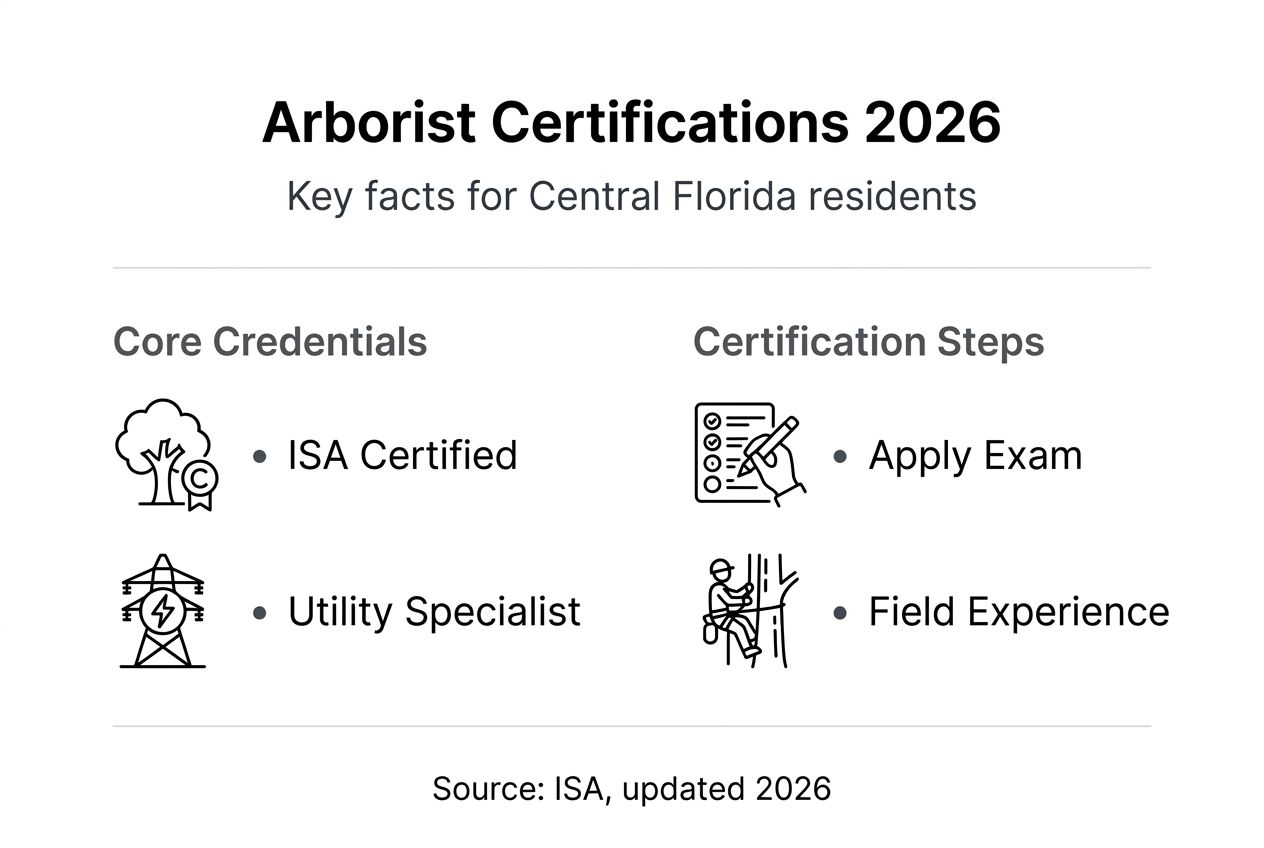
ISA Certified Arborist credentials form the industry gold standard. Candidates must document three years field experience or complete accredited degree programs in arboriculture, forestry, or related disciplines. The comprehensive exam tests practical and theoretical knowledge across all tree care domains, ensuring certified professionals can diagnose problems, recommend treatments, and execute safe interventions.
Specialized certifications address specific practice areas:
| Certification Type | Focus Area | Target Professionals |
|---|---|---|
| ISA Certified Arborist | General tree care knowledge | Residential and commercial practitioners |
| Municipal Specialist | Urban forestry management | City arborists and public works professionals |
| Tree Risk Assessment Qualification | Hazard evaluation protocols | Consultants and safety specialists |
| Board Certified Master Arborist | Advanced expertise demonstration | Senior practitioners seeking top tier recognition |
Third party accreditation provides credential legitimacy. ANSI recognition confirms ISA certification processes undergo regular audits verifying exam validity, candidate evaluation fairness, and continuing education rigor. ISO 17024 compliance aligns certification with international personnel certification standards used across professional industries globally.
Career demand supports certification value. Arborist employment shows 10% projected growth between 2019 and 2029 according to Bureau of Labor Statistics data, reflecting increased recognition of professional tree care importance in urban planning, property management, and environmental conservation efforts.
Pro Tip: Residential property owners benefit most from general Certified Arborist credentials, while commercial properties with extensive grounds may require Municipal Specialist expertise for large scale planning and maintenance program development.
Understanding these distinctions helps property owners match certification types to their specific needs. General credentials suit routine maintenance and health assessments. Specialized certifications become relevant for complex projects involving risk assessment, municipal coordination, or advanced diagnostics requiring cutting edge expertise.
Detailed look at certification exam content and process
The ISA Certified Arborist exam covers 200 multiple choice questions testing comprehensive knowledge. Exam domains include tree biology, soil management, pruning techniques, urban forestry, and safe work practices, ensuring candidates demonstrate mastery across all essential competency areas before earning certification.
Eligibility requirements create entry barriers maintaining credential value:
- Three years full time experience in arboriculture or related tree care work
- Associate degree in arboriculture, horticulture, or forestry reduces experience requirement to two years
- Bachelor’s degree in related field qualifies candidates immediately without additional experience
- Documented apprenticeship completion through recognized programs like TCIA
The application process follows sequential steps:
- Submit online application with documentation proving eligibility through experience records or transcripts
- Pay examination fees and select testing date at authorized Pearson VUE centers
- Receive study materials and exam content outline detailing knowledge domains and question distribution
- Complete exam within allotted time frame at testing facility under proctored conditions
- Receive pass/fail results immediately upon exam completion with score reports following
Preparation resources support candidate success. ISA provides official study guides covering all exam domains with practice questions mirroring actual test format. Prep courses offered through local chapters provide structured learning with experienced instructors. Online study groups and flashcard sets help candidates memorize terminology, scientific names, and technical specifications.
Exam difficulty reflects professional standards. Pass rates hover around 70%, indicating the assessment genuinely separates qualified candidates from those lacking sufficient preparation or experience. This selectivity maintains certification value, assuring property owners that credential holders possess verified competence rather than simply paying membership fees.
Role of apprenticeships and continuing education in certification
Apprenticeships build practical skills complementing theoretical knowledge. TCIA’s program requires 5,400 to 6,000 hours of supervised on the job training over approximately three years, ensuring participants master equipment operation, safety protocols, and real world problem solving before certification eligibility.
Structured training covers essential competencies:
- Proper pruning cuts preserving tree health and structural integrity
- Rigging techniques for safe limb removal in confined spaces
- Climbing skills using rope systems and aerial equipment
- Disease diagnosis through symptom recognition and laboratory procedures
- Client communication explaining technical recommendations in accessible language
Continuing education maintains certification validity. Certified Arborists must earn 30 continuing education credits every three years, preventing credential stagnation and ensuring practitioners stay current with evolving best practices, emerging research, and updated safety standards throughout their careers.
Credit sources include:
- Industry conferences featuring workshops on new techniques and equipment
- Online courses covering specialized topics like pest management or soil science
- Published articles and research papers advancing arboricultural knowledge
- Volunteer activities supporting urban forestry and community education initiatives
Ongoing learning benefits extend beyond compliance. Arborists encounter new pest species, climate related stress patterns, and technological innovations requiring updated approaches. Regular education ensures practitioners can recognize novel problems and apply cutting edge solutions rather than relying on outdated methods potentially harming trees or creating safety risks.
Pro Tip: Before hiring, ask potential arborists about recent continuing education topics to gauge their commitment to professional development and ensure their certification remains active and compliant with current standards.
Common misconceptions about arborist certification
Property owners frequently confuse certified arborists with general tree care workers. Certification requires passing rigorous exams, documented experience, and ongoing education, distinguishing credentialed professionals from laborers performing basic tasks without comprehensive training or accountability.
Common false beliefs corrected:
- Misconception: Any tree service employee qualifies as an arborist. Reality: Only individuals meeting eligibility requirements and passing certification exams earn the credential.
- Misconception: Certification guarantees perfect results on every project. Reality: Certification verifies baseline competence, but experience levels, equipment quality, and project complexity affect outcomes.
- Misconception: Licensed contractors automatically hold arborist certifications. Reality: Business licenses and arborist credentials represent separate qualifications with different requirements and governing bodies.
- Misconception: Certification replaces need for insurance verification. Reality: Credentials demonstrate knowledge, while insurance protects property owners from liability during tree work accidents.
- Misconception: Once certified, arborists never need additional training. Reality: Continuing education requirements ensure ongoing professional development maintaining credential validity.
Understanding certification scope prevents unrealistic expectations. Certified Arborists excel at diagnosis, treatment recommendations, and technical tree care execution. However, customer service quality, pricing fairness, and project management effectiveness depend on individual business practices beyond certification mandates.
Credential verification remains essential. Dishonest operators sometimes claim certification without actually holding valid credentials. Property owners should always confirm status using official verification tools rather than accepting verbal claims or outdated certificates at face value.
Practical advice for Central Florida property owners
Verifying certification protects your investment. ISA maintains an online “Find an Arborist” database allowing instant credential confirmation by entering names or certification numbers. This tool shows current status, certification dates, and any disciplinary actions, providing transparency about practitioner qualifications before signing contracts.
Essential questions for prospective arborists:
- What specific certifications do you hold and when do they expire?
- How many continuing education credits have you earned in the past three years?
- Can you provide references from similar projects in Central Florida?
- What insurance coverage protects property owners during tree work?
- How will you diagnose tree health issues before recommending treatments?
Certification matters for multiple reasons. Safety compliance reduces accident risks through standardized protocols trained professionals follow consistently. Liability protection limits property owner exposure when certified practitioners carry proper insurance and follow industry standards. Tree health improves when qualified professionals apply science based care rather than guessing solutions or using harmful outdated practices.
Steps to vet and select qualified arborists:
- Request certification numbers and verify status through ISA’s official database before initial consultations
- Ask for detailed written estimates explaining proposed work scope, timeline, and specific techniques
- Check online reviews focusing on comments about professionalism, cleanup, and problem resolution
- Confirm insurance coverage including liability and workers compensation with certificate copies
- Compare multiple quotes ensuring comprehensive service offerings match your property needs
- Review contracts carefully noting payment terms, warranty provisions, and cancellation policies
Red flags indicating unqualified operators:
- Reluctance providing certification numbers or insurance documentation
- Pressure tactics demanding immediate decisions without time for research
- Significantly lower pricing suggesting corner cutting on safety or quality
- Door to door solicitation without established business presence or references
- Recommendations for unnecessary tree removal generating higher profits
Property owners gain leverage through knowledge. Understanding certification benefits and verification processes creates informed consumers who can identify qualified professionals, negotiate fair pricing, and expect appropriate service standards matching credential promises.
Taking time for proper vetting prevents costly mistakes. Unqualified operators cause property damage, create safety hazards, and harm tree health through improper techniques. Certified professionals bring accountability, insurance protection, and proven competence reducing risks while delivering quality results.
Summary and next steps for hiring certified arborists
Certification ensures professional tree care through verified knowledge, practical experience, and ongoing education commitments. Central Florida property owners benefit from understanding credential types, verification processes, and practical hiring steps protecting their investments while securing quality maintenance services.
Key points reinforced:
- ISA Certified Arborist credentials require rigorous exams, apprenticeships, and continuing education maintaining professional standards
- Verification through official databases confirms active certification status before hiring decisions
- Specialized credentials address specific contexts while general certification suits most residential needs
- Proper vetting includes checking references, insurance, and certification compliance beyond marketing claims
Responsible hiring protects property value and tree health. Taking time to verify credentials, ask informed questions, and compare qualified candidates ensures you select practitioners capable of delivering safe, effective, science based care. Shortcuts risk property damage, safety incidents, and poor outcomes requiring expensive corrections.
For comprehensive information about certifications, eligibility requirements, and verification tools, explore detailed resources supporting informed decision making throughout your tree care provider selection process.
Trusted certified arborist services in Central Florida
McCullough Tree Service brings certified arborist expertise directly to Central Florida property owners seeking professional tree care solutions. Our team holds current ISA credentials with active continuing education compliance, ensuring we apply the latest techniques and safety standards to every project.
We offer comprehensive services including professional tree trimming preserving health and aesthetics, expert tree removal handling hazardous situations safely, and complete maintenance programs addressing all aspects of property tree care. Our certified arborists assess your specific needs, explain options clearly, and execute solutions protecting your investment while enhancing your landscape.
Ready to work with qualified professionals? Contact us today to schedule consultations with our certified team and discover how proper credentials translate to superior tree service outcomes for your Central Florida property.
FAQ
What qualifications are required to become an ISA Certified Arborist?
Candidates need a high school diploma or equivalent plus three years documented field experience in tree care, or they can substitute education with degrees in arboriculture, horticulture, or forestry reducing experience requirements. Completion of recognized apprenticeship programs like TCIA’s structured training also fulfills experience prerequisites for exam eligibility.
How can I verify an arborist’s certification status in 2026?
Use the International Society of Arboriculture’s online “Find an Arborist” verification tool by entering the practitioner’s name or certification number to confirm current credential status instantly. Always check for active certification with continuing education compliance rather than accepting verbal claims or outdated certificates.
Why is continuing education important for certified arborists?
Certified arborists must earn 30 continuing education credits every three years to maintain active credential status and stay current with evolving best practices. This ongoing learning ensures practitioners can address new pest species, updated safety protocols, and emerging research findings throughout their careers.
What’s the difference between a certified arborist and a tree service company?
Certified arborists hold individual credentials verifying personal knowledge and competence through exams and experience requirements, while tree service companies represent businesses that may or may not employ certified professionals. Always verify that actual workers performing your tree care hold current certifications rather than assuming company licensing guarantees individual qualifications.
How long does the ISA Certified Arborist exam take to complete?
The exam consists of 200 multiple choice questions with candidates receiving sufficient time to carefully consider each answer, typically allowing three to four hours for completion. Results appear immediately upon finishing with detailed score reports following to help unsuccessful candidates identify areas needing additional study before retaking the assessment.
Recommended
- Arborist Certification: Why It Matters in Central Florida
- 7 Essential Tips for Hiring Certified Arborists Locally
- Arborist Certification – Why It Matters in Florida
- Municipal tree management in Central Florida: expert guide