By: Shelby McCullough| Published: July 4, 2026
TL;DR:
- Retail centers should prioritize certified arborist services to manage hazards, maintain tree health, and reduce liability. Implementing risk-based scheduling and documentation ensures proactive care and budget control, especially during non-peak hours. Regular assessments and optimized contracts enhance safety and customer experience while lowering long-term costs.
Arborist services for retail centers are defined as professional tree care programs that combine risk assessment, scheduled pruning, emergency response, and compliance documentation to keep commercial properties safe and visually appealing. The industry term for this work is commercial arboriculture, and it covers everything from routine crown maintenance to full hazard tree removal. Retail center managers who treat trees as managed assets rather than background landscaping reduce liability exposure, lower long-term maintenance costs, and create a more welcoming environment for shoppers. Mcculloughtreeservice delivers this full range of services to retail and commercial properties across Orlando and Central Florida.
1. Arborist services every retail center needs
Commercial arboriculture for retail properties covers several distinct service categories. Each one addresses a different risk or operational need, and skipping any of them creates gaps that compound over time.
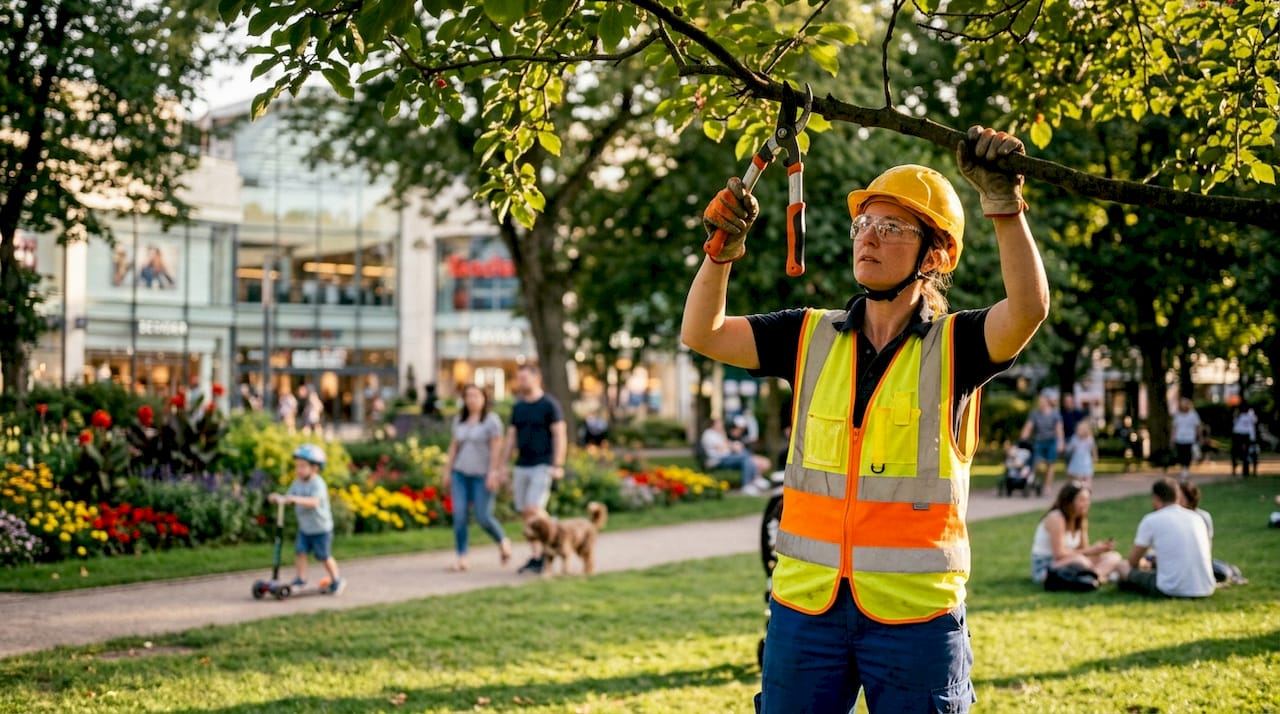
Tree risk assessment and hazard identification is the foundation of every sound maintenance program. Industry standards recommend annual or bi-annual assessments for high-traffic zones and 2–3 year cycles for lower-traffic perimeter areas. That frequency difference matters because a dead limb over a parking lot entrance carries far more liability than one at the back of a retention pond.
Urban tree pruning services keep canopies clear of signage, lighting, and pedestrian walkways. Proper pruning also improves tree structure, which reduces the chance of branch failure during storms. This is not cosmetic work. It is structural maintenance with direct safety implications.
Emergency tree removal and storm damage response protects tenants, customers, and infrastructure after severe weather. Retail centers in Florida face hurricane-force winds regularly, and a downed tree blocking a main entrance can shut down a property for days. Having a pre-arranged emergency response agreement with a certified arborist means faster mobilization and priority scheduling.
Routine maintenance contracts give property managers predictable scheduling and budgeting. Commercial tree service agreements typically include bi-annual property evaluations to identify health and safety hazards before they escalate. That proactive cadence is far cheaper than reactive emergency calls.
Documentation and compliance support rounds out the service list. Every commercial tree job should generate an auditable report covering work performed, tree conditions observed, and any follow-up recommendations. This documentation protects property managers in liability disputes and satisfies insurance requirements.
Pro Tip: Ask your arborist to flag trees by risk tier in every written report. That tiered record becomes your defense if a tenant or customer ever files a claim related to a tree.
2. How to choose certified arborist providers for retail centers
Certification is the single most reliable filter when evaluating commercial tree care providers. ISA certification and TCIA accreditation are the two primary industry credentials that signal adherence to safety and quality standards. ISA-certified arborists pass a rigorous exam and maintain continuing education requirements. TCIA-accredited companies meet peer-reviewed standards for business practices and crew safety.
Insurance coverage is non-negotiable. Every provider you hire must carry a certificate of insurance (COI) that includes general liability and workers’ compensation. Strict compliance with liability documentation protects property managers from claims arising from on-site accidents. Request the COI before any crew sets foot on your property.
Look for providers who deliver written reports after every visit. Auditable documentation turns tree maintenance into a trackable asset management activity. Professional arborists who act as partners align maintenance schedules with client budgets and contract deadlines, which makes vegetation management a documented line item rather than an unpredictable expense.
Scheduling compatibility matters more than most managers realize. A provider who can only work standard business hours will disrupt foot traffic and tenant operations. Confirm that your arborist can accommodate early morning, evening, or weekend work windows before signing any agreement.
- ISA certification confirms individual arborist competency
- TCIA accreditation confirms company-level safety and business standards
- COI with workers’ compensation is a baseline requirement, not a bonus
- Written post-service reports create an auditable maintenance record
- Flexible scheduling protects tenant relationships and customer experience
3. Pricing and contract models for commercial tree care
Retail center managers face three common pricing structures when sourcing commercial tree care services: fixed-price quotes, hourly rates, and annual maintenance agreements. Each model fits a different operational need.
Fixed-price quotes work best for defined, one-time jobs such as removing a specific hazard tree or completing a post-storm cleanup. The scope is clear, the cost is locked, and there are no billing surprises. The risk is that unforeseen complications, such as a root system near underground utilities, can trigger change orders.
Hourly rates suit reactive or exploratory work where the scope cannot be determined in advance. They give the arborist flexibility to address what they find, but they require close oversight to avoid cost overruns. Hourly billing is best reserved for small, unpredictable tasks.
Annual maintenance agreements are the most cost-effective model for retail centers with multiple trees and ongoing care needs. Costs spread evenly across the year, scheduling is pre-planned, and the arborist develops deep familiarity with your specific tree inventory. That familiarity improves the quality of risk assessments over time.
| Pricing model | Best use case | Budget predictability |
|---|---|---|
| Fixed-price quote | Defined one-time jobs | High |
| Hourly rate | Reactive or exploratory work | Low |
| Annual maintenance agreement | Ongoing multi-tree programs | Very high |
Pro Tip: Negotiate at least two complimentary property evaluations into any annual maintenance agreement. Most commercial providers include them as standard, and they give you scheduled checkpoints to catch problems early.
When reviewing contract terms, confirm that the agreement covers both scheduled maintenance and emergency callouts. A contract that excludes storm response leaves you scrambling for a provider at the worst possible time.
4. Scheduling and logistics for active retail sites
Tree work on an active retail property requires coordination that goes well beyond sending a crew with chainsaws. Commercial tree crews typically schedule work during non-peak hours, including early mornings, evenings, and weekends, to avoid disrupting shoppers and tenants. That scheduling discipline is a mark of a provider who understands retail operations.
Traffic management is a legal and safety requirement, not an optional courtesy. Work zones must be clearly marked with cones, barriers, and signage that meets local safety codes. Crews working near parking lot entrances or pedestrian walkways need a dedicated site safety plan before work begins.
Communication with tenants is equally important. Property managers should notify affected tenants at least 48 hours before any significant tree work begins. That notice window allows tenants to adjust deliveries, signage, and customer-facing operations to minimize disruption.
Risk-stratified maintenance planning also shapes scheduling decisions. High-traffic zones near entrances and food courts need more frequent attention than perimeter tree lines. Applying a uniform schedule to all trees wastes budget on low-risk areas while potentially under-serving high-risk ones.
- Schedule major work during early morning or after-hours windows
- Establish marked work zones that comply with local safety codes
- Notify tenants at least 48 hours before significant operations
- Prioritize high-traffic zones for more frequent maintenance cycles
- Confirm that your provider carries a site-specific safety plan for each job
Ongoing tree care practices that prevent hazards before they develop are far less disruptive than emergency removals that require full parking lot closures.
Key Takeaways
Effective commercial arboriculture for retail centers requires certified expertise, risk-based scheduling, and documented maintenance to protect assets and ensure customer safety.
| Point | Details |
|---|---|
| Prioritize certified providers | Hire ISA-certified arborists and TCIA-accredited companies to meet safety and liability standards. |
| Use risk-based scheduling | Assess high-traffic zones annually and perimeter areas every 2–3 years to allocate budget efficiently. |
| Choose annual agreements | Annual maintenance contracts deliver the best cost predictability and proactive hazard management. |
| Demand full documentation | Require auditable post-service reports and a valid COI with workers’ compensation from every provider. |
| Schedule around retail hours | Confirm your arborist can work non-peak hours to protect tenant operations and customer experience. |
Why I think most retail centers undervalue their trees
Most retail property managers I have spoken with treat trees as a liability waiting to happen rather than an asset worth managing. That framing leads to a reactive posture: wait for a problem, then pay to fix it. The math on that approach is brutal. Proactive maintenance is significantly cheaper than emergency storm response or defending a liability claim after a branch injures a customer.
The managers who get this right think of their arborist the same way they think of their HVAC contractor: a specialist on retainer who knows the property, documents every visit, and flags problems before they become emergencies. That relationship takes time to build, but it pays off in lower costs and fewer surprises.
The other thing most managers miss is the customer experience angle. A well-maintained tree canopy along a retail entrance creates shade, reduces ambient temperature, and makes the property more inviting. Shoppers spend more time in comfortable outdoor environments. That is not a soft benefit. It has a direct effect on dwell time and tenant sales.
My honest recommendation is to stop treating tree maintenance as a line item to cut and start treating it as part of your property’s asset management program. Get a certified arborist to conduct a full risk assessment, build a tiered maintenance schedule from the findings, and put it on an annual contract. You will spend less money over three years than you would on a single emergency removal and the liability exposure that comes with it.
— Results
Mcculloughtreeservice: expert tree care for retail properties
Retail center managers across Orlando and Central Florida rely on Mcculloughtreeservice for the full range of commercial arboriculture services. The company’s ISA-certified arborists conduct thorough risk assessments, deliver auditable post-service reports, and schedule work around your property’s operational hours to avoid disrupting tenants and customers.
Mcculloughtreeservice offers professional tree trimming and expert tree removal services designed specifically for commercial properties, with flexible scheduling that includes early morning and weekend windows. The team carries full insurance documentation and provides the compliance paperwork your property management records require. Contact Mcculloughtreeservice to schedule a commercial property evaluation and get a clear picture of your tree risk profile before the next storm season.
FAQ
What does an arborist do for a retail center?
A certified arborist conducts risk assessments, performs scheduled pruning, manages hazard tree removal, and provides compliance documentation to keep retail properties safe and visually maintained.
How often should retail centers schedule tree risk assessments?
High-traffic zones require annual or bi-annual assessments, while lower-traffic perimeter areas follow a 2–3 year cycle based on industry standards.
What certifications should a commercial arborist have?
Look for ISA certification for individual arborists and TCIA accreditation for the company. Both credentials confirm adherence to safety standards and professional practices critical for retail environments.
What is the best contract model for retail center tree care?
Annual maintenance agreements offer the best combination of cost predictability, scheduled evaluations, and proactive hazard management for retail properties with multiple trees.
Do arborists work around retail business hours?
Yes. Professional commercial crews schedule major tree work during non-peak hours, including early mornings and weekends, to avoid disrupting shoppers and tenant operations.
Recommended
- Tree Planting for Commercial Properties: Boosting Value and Compliance
- Why Hire an Arborist in 2026: What You Must Know
- Arborist certifications 2026: Essential guide for Central Florida