By: Shelby McCullough| Published: May 24, 2026
TL;DR:
- Arborist reports are formal evaluations by certified professionals that assess tree health, risks, and recommended actions for property management. They are essential for permit approvals, construction planning, and liability protection, with various types tailored to specific needs. Verifying arborist credentials and understanding report components ensure proper tree care and compliance with local regulations.
Most property owners first encounter an arborist report when a permit application requires one, a neighbor’s tree falls, or a contractor mentions it before breaking ground. At that point, defining arborist reports becomes suddenly urgent. Yet these documents are more than bureaucratic hurdles. They are formal, expert evaluations that tell you exactly what your trees are doing, what risks they carry, and what needs to happen next. If you’ve ever felt lost reading one or unsure whether you even need one, this guide breaks it all down in plain terms.
Table of Contents
- Key takeaways
- Defining arborist reports and why they matter
- What a typical arborist report contains
- Types of arborist reports homeowners need
- How to read an arborist report effectively
- Benefits of getting an arborist report
- My take on arborist reports after years in the field
- Work with a certified arborist you can trust
- FAQ
Key takeaways
| Point | Details |
|---|---|
| Arborist report definition | A formal written evaluation by a certified arborist covering tree health, structure, risk, and recommended actions. |
| Multiple report types exist | Different situations call for different reports, from health assessments to construction Tree Preservation Plans. |
| Credentials matter | Verify that your arborist holds an ISA certification or TRAQ qualification before relying on any report. |
| Reports support permits | Many municipalities require arborist reports before approving tree removal or construction near protected trees. |
| Budget and plan ahead | Report fees, permit costs, and processing times should factor into any project timeline from the start. |
Defining arborist reports and why they matter
An arborist report is a written assessment prepared by a certified arborist that documents the health, structure, and condition of one or more trees on a property. Think of it as a medical record for your trees. It doesn’t just say whether a tree looks healthy. It evaluates root systems, branch structure, disease presence, pest activity, structural weaknesses, and the likelihood that any defect poses a risk to people or property.
For property owners and managers, the importance of arborist reports shows up in several real situations:
- Tree removal permits. Most cities and counties require a formal report before you can legally remove a protected tree.
- Construction planning. If you’re adding a structure, driveway, or utility line near existing trees, a report informs the design and protects trees from unnecessary damage.
- Property transactions. Buyers and sellers increasingly request tree assessments to understand liabilities before closing.
- Insurance and liability. A documented assessment establishes a baseline and demonstrates due diligence if a tree later causes damage.
Certified arborists combine scientific knowledge of tree biology, risk assessment, and pruning techniques to ensure their reports reflect real conditions, not guesswork. This is exactly why the credential behind the report matters as much as the report itself.
Pro Tip: Always ask whether the arborist who conducted your assessment holds an active ISA Certified Arborist credential. This confirms they meet ongoing education requirements and follow professional standards.
What a typical arborist report contains
Understanding how to read arborist reports starts with knowing what goes inside one. Most reports follow a standard structure, though the depth and format vary depending on the purpose.
Here’s what you’ll typically find in a well-prepared report:
- Tree inventory and identification. Species name, location on the property, trunk diameter, height, and canopy spread. These measurements give the arborist and any reviewing authority a clear picture of what they’re working with.
- Health and structural condition assessment. This section evaluates foliage density, bark condition, wound response, signs of disease or pests, and structural integrity. A tree can look green and full from the street while carrying serious internal decay.
- Risk rating. Using the ISA TRAQ framework, arborists assign risk levels based on the likelihood of failure, the probability that a falling tree or branch would hit a target, and the severity of potential consequences.
- Recommended actions. This might include pruning, cabling, treatment, monitoring, or removal, with a timeline and priority level attached.
- Site photos and supporting documentation. Report photos and measurements support findings and give authorities or property owners visual evidence to back up the written assessment.
- Compliance notes. For permit-driven reports, this section addresses specific municipal requirements, setbacks, preservation constraints, and replacement obligations.
Here’s a quick reference for what each component tells you:
| Report component | What it tells you |
|---|---|
| Tree inventory | Size, species, and exact location of each assessed tree |
| Health assessment | Current condition, disease, pest activity, structural soundness |
| Risk rating | Probability and severity of failure under defined conditions |
| Recommended actions | What to do, how urgently, and in what sequence |
| Site photos | Visual confirmation of findings referenced in the written text |
| Compliance documentation | Whether the tree or project meets local regulatory requirements |
Types of arborist reports homeowners need
Not every arborist report looks the same, and using the wrong type for your situation can delay permits or cost you time and money. Here’s how the main types break down:
Tree health assessment reports are the most common. You request one when a tree looks stressed, you’re planning maintenance, or you want a baseline record of your property’s trees. These are typically used for residential or commercial properties without a pending construction project or permit application.
Construction and tree preservation reports are required when development activity will occur within the root zone or canopy of protected trees. Municipal projects often require that these reports become formal Tree Preservation Plans, guiding which trees get protected, how construction traffic is routed, and what barriers go up before any ground is broken. The role of arborists in development is critical here: a well-executed Tree Preservation Plan can cut construction-related tree damage significantly.
Risk assessment reports focus specifically on hazard identification. They evaluate structural defects, dead wood, root damage, or leaning conditions that could lead to failure. The ISA TRAQ process covers a standardized approach to this type of assessment, with qualifications valid for five years before renewal is required.
Permit application reports follow strict municipal checklists. Cities like Saratoga require specific affirmative findings in the report before they’ll approve a removal. These findings must address setbacks, the tree’s condition, preservation alternatives, and replacement plans.
Key differences at a glance:
- Health assessments: No permit needed, focuses on condition and care
- Tree preservation reports: Required for construction, guides contractor activity
- Risk assessments: Hazard-focused, often requested by insurance or HOAs
- Permit reports: Municipality-specific format, checklist-driven documentation
How to read an arborist report effectively
You don’t need a degree in arboriculture to make sense of a report. You need to know what to focus on and what questions to ask.

Start with the risk ratings. Most reports use a scale of low, moderate, high, or very high to describe both the likelihood of failure and the potential consequences. A tree rated “high likelihood, high consequence” needs immediate attention. A tree rated “low likelihood, low consequence” may only require monitoring.
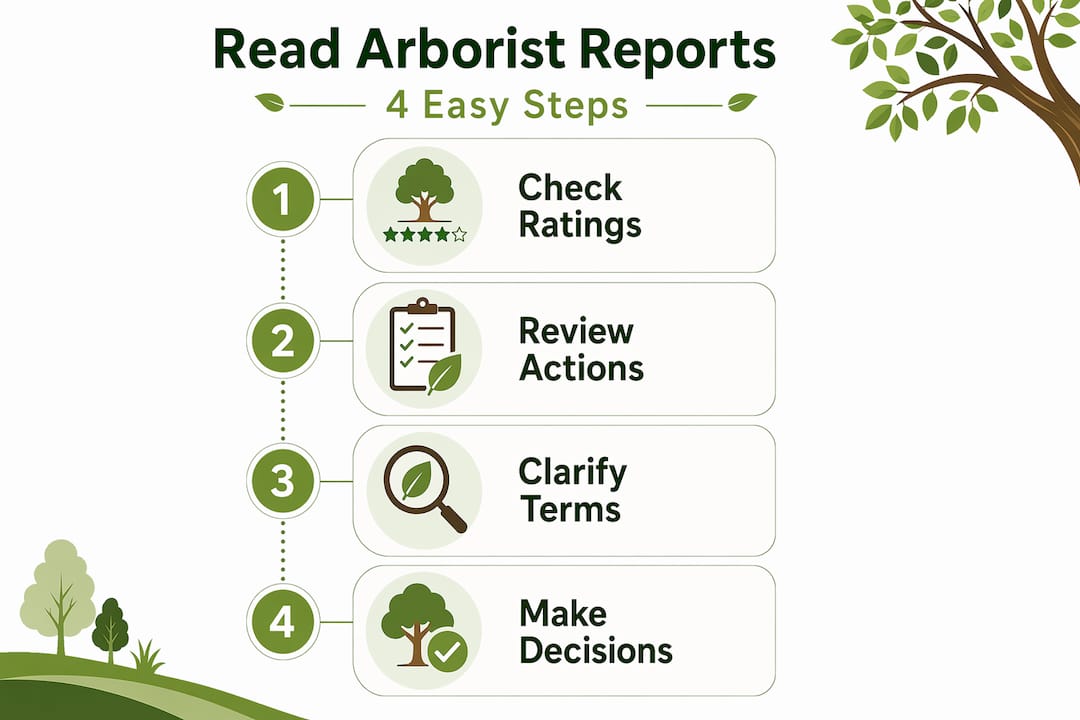
Next, read the recommended actions section carefully. Each action should list a priority level. “Priority 1” or “immediate” means the work should happen before the next storm season or within 30 days. “Priority 3” or “routine” can typically wait until your next scheduled maintenance cycle.
When you get to technical terms you don’t recognize, don’t skip them. Terms like co-dominant stems, included bark, or girdling roots all point to specific structural problems with specific solutions. If a term appears in the recommended actions but isn’t explained, ask your arborist to walk you through it.
Pro Tip: Before trusting any report, verify the arborist’s credentials directly on the ISA website. TRAQ qualifications must be renewed every 5 years, so an old credential may not reflect current assessment standards.
Common reading mistakes to avoid:
- Focusing only on the summary and skipping the detail sections
- Ignoring priority timelines and treating all recommendations as equal
- Assuming a “stable” rating means no action is needed, when monitoring may still be required
- Failing to check whether the report meets local permit requirements before submitting it
Benefits of getting an arborist report
The practical case for obtaining a report is stronger than most property owners realize. Here’s what a well-executed assessment actually delivers:
- Longer-living trees. Catching disease, root damage, or structural defects early gives you time to treat or manage them before the situation becomes irreversible.
- Liability protection. A documented assessment shows you took reasonable steps to identify and address hazards. This matters if a tree falls and causes property damage or injury.
- Permit compliance. Many tree removal and construction permits require a report that meets specific criteria. Skipping the report or using an unqualified assessor can stall your project for weeks.
- Better contractor relationships. When you hand a contractor a certified arborist’s report, there’s a shared reference point for what should and shouldn’t happen near your trees during construction.
- Cost clarity. Planning for permit-driven removals means budgeting not just for the report fee but also for permit costs and processing times. In some jurisdictions, independent consulting arborist reports run $400 to $700, with removal permits adding roughly $300 per tree and taking three to five weeks to process.
Hiring an independent consulting arborist rather than a contractor performing the removal also strengthens the credibility of your report, especially for permit applications where objectivity is scrutinized.
My take on arborist reports after years in the field
I’ll be honest: most property owners come to me treating an arborist report like a box to check. They need it for a permit or a sale, they get it done, and they file it away. That’s a real missed opportunity.
What I’ve seen repeatedly is that the report isn’t the end of the process. It’s the beginning. The findings tell you whether your trees are working with your property or slowly becoming a liability. The recommendations, when actually followed, extend the life of trees that might otherwise fail in the next major storm.
I’ve also seen what happens when property owners rely on reports from arborists whose credentials haven’t been maintained. A TRAQ qualification that expired two years ago isn’t just a technicality. It means the assessor may be using methods that don’t reflect current best practices. That’s not a minor concern when you’re submitting documentation to a municipality or using a risk rating to make a removal decision.
The arborist reports I find most valuable are the ones that get integrated into actual care plans, not just permit files. If you’re in Florida, where storm season puts real mechanical stress on trees every year, a current assessment from a certified arborist isn’t optional. It’s the difference between proactive management and reactive cleanup.
— Mcculloughtreeservice
Work with a certified arborist you can trust
If you’re ready to get a proper tree assessment or need help navigating a permit requirement, Mccullough Tree Service has you covered. Our certified arborists in Orlando and Central Florida prepare detailed reports that meet local regulatory standards, whether you need a health assessment, a Tree Preservation Plan for construction, or documentation for a permit application.
From routine tree trimming services that keep your canopy healthy year-round to certified arborist consultations that produce reports ready for permit submission, we offer the full range of professional tree care services your property needs. We also handle tree removal with full permit compliance so nothing falls through the cracks. Contact us today for an estimate and get the documentation you need done right.
FAQ
What is the arborist report definition?
An arborist report is a formal written assessment prepared by a certified arborist that evaluates the health, structure, and risk level of trees on a property, along with recommendations for care or removal.
What are the main types of arborist reports?
The main types include health assessment reports, construction tree preservation plans, risk assessment reports, and permit application reports, each designed for a specific situation or regulatory requirement.
How much does an arborist report cost?
Costs vary by location and scope, but independent consulting arborist reports typically range from $400 to $700, with additional permit fees of around $300 per tree depending on local regulations.
Do I need an arborist report to remove a tree?
In many municipalities, yes. Protected trees often require a permit backed by a certified arborist’s report before removal is approved, and the report must meet specific checklist criteria set by the local authority.
How do I verify my arborist’s credentials?
Check that your arborist holds an active ISA Certified Arborist credential or a current TRAQ qualification, both of which can be verified directly through the International Society of Arboriculture’s online database.
Recommended
- Why Hire an Arborist in 2026: What You Must Know
- Role of Arborists in Development: 80% Tree Damage Cut
- Tree inspections: protect your property and stay compliant