By: Shelby McCullough| Published: August 24, 2026
Your CC&Rs almost always decide who can remove a tree first, but the trunk’s exact location on the plat is what actually settles the question. If the trunk sits inside your lot boundary and your covenants don’t classify it as a common element, you generally control removal decisions, subject to board notification. If it sits on shared or association-owned land, the board decides. Either way, your city or county can override both of you: municipal tree ordinances often require permits regardless of what your HOA prefers.
Before you cut anything or file a request, do this:
- Pull your recorded plat, deed, and CC&Rs to confirm trunk location and maintenance responsibility.
- Schedule an ISA-certified arborist evaluation, especially if you’re citing safety, disease, or storm damage.
- Check your city or county’s tree ordinance before assuming HOA approval is the only hurdle.
Key Takeaways
Trunk location on the recorded plat, not canopy spread or personal preference, is what ultimately decides who controls a Florida HOA tree removal decision.
| Point | Details |
|---|---|
| Check the plat first | Trunk location on your recorded plat or survey settles authority disputes faster than reading CC&R language alone. |
| Local permits can override HOA rules | Municipal tree ordinances and the 2022 statute changes to Florida Statute 163.045 mean city or county rules can require permits regardless of board approval. |
| Document before you request | Photos with scale, a current survey, and a certified arborist report speed up board approval and permit review. |
| Emergency action has limits | Only minimum stabilization is authorized during a storm emergency; full removal and stump work generally need a permit afterward. |
| Get expert documentation early | Mcculloughtreeservice provides certified arborist reports and permit-ready removal scopes that Florida HOA boards can approve without delay. |
Table of Contents
- HOA Tree Removal Rules: Reading Your CC&Rs, Plats, and Surveys
- Local Permits and Tree Ordinances You Need to Check
- How Do You Request HOA Approval for Tree Removal?
- What Should Boards and CAMs Document Before Approving Removal?
- Emergency Storm Removal: What Counts as Immediate Action?
- Who’s Liable for Improper Tree Removal on HOA Property?
- Alternatives to Full Tree Removal That Boards Approve Faster
- Arborist Perspective: What Actually Wins Disputes
- Get a Permit-Ready Arborist Report Before You File Your Request
- Sources
HOA Tree Removal Rules: Reading Your CC&Rs, Plats, and Surveys
Your covenants, conditions, and restrictions spell out maintenance duties, but the language is often buried in sections about “common areas” or “limited common elements” rather than trees specifically. Start there before you start digging through anything else.
- Locate the maintenance and common-element clauses in your CC&Rs, then cross-reference them with your recorded plat or site survey to confirm exactly where the trunk sits.
- Compare trunk location against canopy spread. Overhanging branches into a shared area don’t transfer ownership. Recorded plats and site surveys are what actually settle disputes, not where the leaves fall.
- If your documents assign a tree as a limited common element, that assignment controls even when the trunk sits close to a shared property line under Florida condominium law.
- When documents conflict or the classification is ambiguous, loop in your community association manager or an attorney before spending money on removal.
Local Permits and Tree Ordinances You Need to Check
Your HOA’s approval isn’t the finish line. Most Florida counties and municipalities maintain protected-tree or heritage-tree ordinances that set diameter thresholds (often 4 inches or more measured at breast height) triggering a permit requirement no matter what your covenants say.
Statistic Callout: The 2022 amendments to Florida Statute 163.045 narrowed preemption protections and changed how common elements are treated, which means associations now face more local permit scrutiny for common-area tree work than they did before the change.
That statutory shift matters for boards specifically, but individual homeowners feel it too when their lot borders a common area. A few practical risks to keep in mind:
- Cutting a protected species or oversized trunk without a permit can trigger municipal fines that dwarf the cost of the removal itself.
- Many local codes require replacement planting, sometimes at a ratio of two or three new trees per removed tree.
- An arborist report following ISA tree-risk assessment standards speeds up permit review because inspectors trust standardized risk documentation over a homeowner’s description of “it looks dangerous.”
- Florida’s landscaping preemption under Section 720.3075 interacts with county-level rules on drought tolerance and invasive species, adding another layer boards need to check before approving removal.
How Do You Request HOA Approval for Tree Removal?
Getting a yes from your board comes down to showing up with the right paperwork the first time. Boards deny requests far more often for missing documentation than for a bad reason.
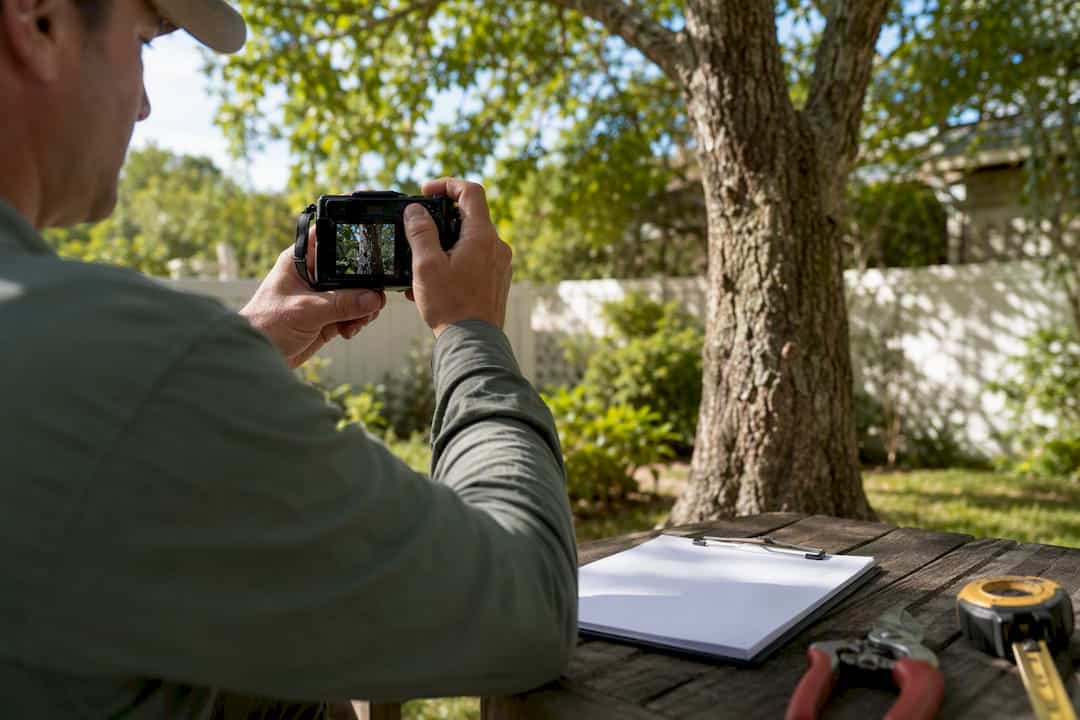
- Take dated photos with a visible scale reference (a tape measure or a person standing next to the trunk works fine).
- Pull your most recent survey or plat showing the tree’s exact location relative to lot lines.
- Get a written arborist report documenting condition, disease, or structural risk.
- Define the scope of work in plain terms: full removal, stump grinding, cleanup, and any replacement planting.
- Confirm your contractor carries general liability and workers’ comp insurance certificates before you submit anything.
- Submit a written request to the board or CAM with a short narrative explaining why: safety hazard, disease, root damage to structures, or planned construction.
Expect a review period of one to four weeks depending on how often your board meets, followed by a possible site visit, a formal vote recorded in the minutes, and then permit filing if your municipality requires one. Don’t start cutting before the board resolution and any permit are in hand unless the tree poses an immediate hazard.
Pro Tip: File your arborist report and photo documentation together as one packet. Boards move faster on requests that read like a decision they can rubber-stamp rather than a mystery they have to investigate themselves.
What Should Boards and CAMs Document Before Approving Removal?
Associations carry more liability exposure than most boards realize, and the fix is almost entirely paperwork discipline rather than legal complexity.
- Classify the tree first: common element, limited common element, or owner lot, using the recorded plat as the tiebreaker.
- Require a professional arborist evaluation before voting, and check local permit status in the same step, not after approval.
- Record the vote as a formal board resolution in the minutes, not a verbal agreement at the end of a meeting.
- Vet contractors for insured tree removal coverage, confirm scope of work in writing, and specify stump grinding and debris cleanup responsibility.
- Check whether your municipality’s replanting requirement creates a mitigation obligation the association needs to budget for.
Emergency Storm Removal: What Counts as Immediate Action?
A tree splitting a roof during a hurricane is not a permit-review situation. Immediate action is authorized when there’s a genuine threat to life, structures, or public safety, and boards or homeowners can act without waiting for a formal vote.
- Call 911 first if anyone is at risk or if a downed tree has hit power lines.
- Authorize only the minimum stabilization needed. Full removal and stump work can wait for a proper scope and permit.
- Photograph the damage before any cutting starts, and keep the contractor’s invoice for insurance purposes.
- Many municipalities offer expedited permit reviews or temporary waivers right after a declared storm event, but full restoration work often still needs standard permitting once the emergency passes.
Who’s Liable for Improper Tree Removal on HOA Property?
Liability generally follows classification: whoever the CC&Rs and plat assign as the maintenance party carries the exposure, but notice matters too. A board that knew about a hazardous tree and did nothing faces more exposure than one that acted on a documented risk assessment.
- Unpermitted removal can bring municipal fines, and some counties add mandatory replanting on top of the fine itself.
- HOAs can pursue enforcement remedies against homeowners who remove protected trees without board sign-off, including special assessments for restoration costs.
Statistic Callout: Insurance underwriters increasingly ask for documented safety audits and arborist reports as a condition of renewal, which means a board without a paper trail may face higher premiums even without a claim filed against it.
When a dispute escalates past a board hearing, that’s the point to bring in legal counsel rather than negotiating further on your own.
Alternatives to Full Tree Removal That Boards Approve Faster
Full removal isn’t always the answer, and boards often prefer it that way since replacement plantings and mitigation take time and money they’d rather avoid.
- Structural pruning or cabling can address a leaning trunk without eliminating the tree entirely.
- Root barrier installation handles sidewalk or foundation lifting caused by aggressive root systems.
- A phased maintenance plan with scheduled inspections can replace a one-time removal request with an ongoing, lower-risk solution.
- Offering to cost-share on removal and replanting for a boundary tree with roots on both sides of a property line often breaks a stalemate faster than insisting the neighbor pay in full.
Pro Tip: If a board hesitates on removal, propose a monitored mitigation plan with a six-month reassessment date. It gives them a lower-commitment yes instead of a permanent no.
Arborist Perspective: What Actually Wins Disputes
The single document that ends most HOA tree disputes isn’t a legal letter. It’s a certified arborist report with dated photos and a clear risk rating. Boards don’t resist facts; they resist ambiguity. Frame safety concerns around specific, measurable risk (root heave near a foundation, visible cavity, dead scaffold limbs) instead of general complaints about appearance, and approval moves faster than most homeowners expect.
— Results
Get a Permit-Ready Arborist Report Before You File Your Request
Skipping straight to a removal request without documentation is the most common reason Florida boards send homeowners back to square one. Mcculloughtreeservice builds the paper trail first: a certified arborist inspection, a written risk report, and a permit-ready scope your board or CAM can approve without a second meeting.
Our Central Florida crews handle everything from the initial certified arborist evaluation through insured removal, stump grinding, and cleanup, with insurance documentation ready for your board packet the first time you submit it. If a storm just took down a limb or an entire tree, our hazardous tree removal team handles emergency mitigation and the follow-up documentation your insurer will ask for later. Schedule an inspection now and get a written tree removal scope your association can vote on this month instead of next quarter.
Sources
- Condo Association Tree Removal in Florida: Common Elements, Board Approval, and Storm Cleanup | ProTreeTrim™ Florida
- Florida HOA landscaping + lawn maintenance rules playbook: drought, invasive species, and the 720.3075 landscape preemption. HOAStream
Verify current requirements with your county or city code office, since ordinance thresholds and permit fees vary by jurisdiction and change more often than most CC&Rs get updated.
Recommended
- Guide to Tree Removal in Orlando
- Tree Permits in Central Florida – What Homeowners Need to Know
- Proper Tree Removal: Protecting Safety and Property
- Guide to Cutting Trees in Florida Legally