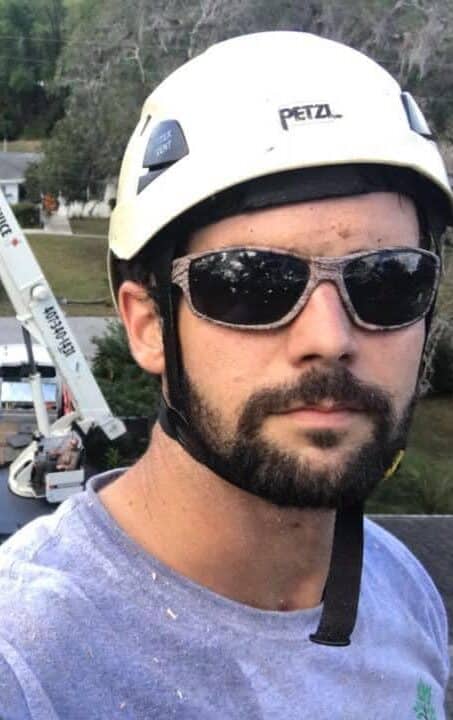
By: Shelby McCullough| Published: May 16, 2026
TL;DR:
- Homeowners in Central Florida should schedule annual tree inspections before storm season and urgent post-storm evaluations within 72 hours to ensure safety. Choosing ISA TRAQ-certified arborists for risk assessment and detailed reports helps identify hazards early and plan effective mitigation. Proactive scheduling, immediate response, and proper follow-up are essential to prevent storm-related property damage and tree failures.
After a major storm rolls through Central Florida, most homeowners walk outside and look up. They scan the canopy, spot a few broken branches, maybe a leaning trunk, and wonder: is that tree actually safe, or is it a lawsuit waiting to happen? Knowing how to schedule tree inspections before and after storm season is one of the most practical things you can do to protect your property and your family. This guide walks you through the right timing, how to find a qualified professional, what a real inspection covers, and exactly how to book one without wasting time or money.
Table of Contents
- Understanding why and when to schedule tree inspections
- How to choose and verify a qualified arborist for your tree inspection
- What tree inspection reports cover: trunks, branches, and roots
- Step-by-step guide to scheduling your tree inspection effectively
- What to expect after the inspection: interpreting reports and follow-up planning
- Why centralized scheduling and immediate post-storm plans transform tree safety in Central Florida
- How McCullough Tree Service supports your tree inspection and maintenance needs
- Frequently asked questions
Key Takeaways
| Point | Details |
|---|---|
| Schedule promptly after storms | Call a qualified arborist within 24 to 72 hours after storms to assess urgent tree risks. |
| Choose certified arborists | Hire ISA TRAQ-certified professionals who follow systematic risk assessment protocols. |
| Inspect trunks and roots | Look beyond leaves; trunk cavities, cracks, and root health significantly affect tree stability. |
| Plan routine inspections | Schedule yearly checks before storm season with additional seasonal or post-storm visits. |
| Use inspection reports actively | Treat reports as scheduling tools to plan and confirm timely mitigation actions. |
Understanding why and when to schedule tree inspections
Central Florida sits squarely in hurricane country. From June through November, trees on your property face wind loads, saturated soil, and root stress that can turn a healthy-looking oak into a hazard overnight. Scheduling inspections around these windows is not optional if you take property safety seriously.
Routine inspections are recommended at least once per year, ideally in late winter or early spring before storm season begins. That timing gives you a baseline and a chance to address issues like dead wood, structural weakness, or crowded canopies before high winds arrive.
Post-storm inspections are a separate category entirely. UF/IFAS Extension guidance makes clear that evaluation should happen as quickly as possible after a storm, with trees sorted into groups: those requiring urgent action versus those that can be monitored or treated over time. Waiting even a week after a storm means trees with failing root zones or cracked trunks remain dangerous while you search for someone to call.
Key windows to schedule tree inspections in Central Florida:
- Pre-season (March to May): Annual checkup and structural pruning before hurricane season
- Mid-season (August to September): Quick assessment if storms have already hit nearby
- Post-storm (within 24 to 72 hours): Urgent evaluation of all significantly affected trees
- After extended drought or flooding: Root stress shows up slowly; a mid-year check catches problems early
Also consider your property’s specific risk profile. Trees within striking distance of your home, fence, vehicle, or power lines warrant more frequent attention than trees in open yard space.
Pro Tip: Add your pre-season tree inspection to the same calendar block as your AC service or roof inspection. Treating it as a routine home maintenance task, not a one-off emergency response, means it actually gets done.
Now that you understand why inspections are crucial and when to schedule them, the next step is knowing how to choose the right professional for the job.
How to choose and verify a qualified arborist for your tree inspection
Not everyone with a chainsaw and a business card is qualified to assess tree risk. This is one area where credentials genuinely matter, because a missed defect can mean a tree falls on your roof during the next storm.
The credential to look for is ISA TRAQ, which stands for ISA Tree Risk Assessment Qualification. This is a specialized certification from the International Society of Arboriculture focused specifically on structured risk evaluation. Importantly, ISA TRAQ holders must retrain and retest every five years, so the certification stays current with evolving risk assessment methods.
A certified arborist without TRAQ can still provide valuable care, but if you specifically need a formal risk assessment with written documentation, TRAQ is the standard that holds up if a liability question ever arises.
What to ask before you book an arborist:
- Are you ISA TRAQ certified, and when did you last recertify?
- Do you conduct a systematic three-part risk assessment covering likelihood of failure, likelihood of impact, and consequences?
- Will I receive a written report with specific findings and risk categories?
- Do you assess roots and soil conditions, or only visible above-ground structure?
That last question is important. Some providers do a visual walkthrough and call it an inspection. A real assessment involves systematically evaluating every major structural zone of the tree, not just what’s easy to see from the driveway.
Pro Tip: Before hurricane season, save the contact information for two qualified arborists in your area. When a storm hits, arborists book up within hours. Having a call list ready means you get on the schedule before your neighbors do.
With the right expert in mind, let’s explore the key inspection details you should make sure are covered when scheduling.
What tree inspection reports cover: trunks, branches, and roots
A thorough tree inspection is not a quick visual scan. It covers three structural zones: branches, trunk, and root system. Each zone presents different types of failure risk, and missing one can lead to serious consequences.
Branch defects to look for:
- Dead or hanging branches (called “widow makers” for a reason)
- Co-dominant stems with included bark, which creates a weak attachment point
- Canopy asymmetry that increases wind load on one side
Trunk defects that require immediate professional attention:
According to UF/IFAS Extension, trunk cavities, vertical or horizontal cracks, and mushroom-like fruiting structures on bark are all indicators of internal decay. These are not cosmetic issues. They signal that the interior wood holding the tree upright may already be compromised.
Root zone signs that often get missed:
Root problems are tricky because most of the evidence is underground. Arborists look for surface clues like crown thinning, leaning that has worsened over time, heaving soil around the base, or fungal growth near the root collar. Use the tree risk assessment checklist to track these indicators before your inspection.
| Inspection zone | Common defects | Visual indicators |
|---|---|---|
| Branches | Dead wood, weak attachments | Hanging limbs, tight V-shaped forks |
| Trunk | Decay, cracks, cavities | Hollow sounds, mushroom growth, bark splits |
| Root zone | Root rot, girdling roots | Crown dieback, leaning, soil heaving |
| Overall structure | Structural imbalance | Asymmetric canopy, excessive lean |
Pro Tip: Tap on the trunk with a mallet or the handle of a screwdriver. A solid thump suggests intact wood. A hollow sound warrants deeper investigation and a professional assessment right away.
Now that you know what thorough inspections assess, let’s walk through scheduling practical steps that prioritize safety and urgency.

Step-by-step guide to scheduling your tree inspection effectively
This is where most homeowners get stuck. They know they need an inspection but aren’t sure where to start, especially after a storm when they’re already managing a dozen other things.
“The best time to prepare for a post-storm inspection is before the storm arrives. Identify your arborists, know your property boundaries, and have a symptom list ready.”
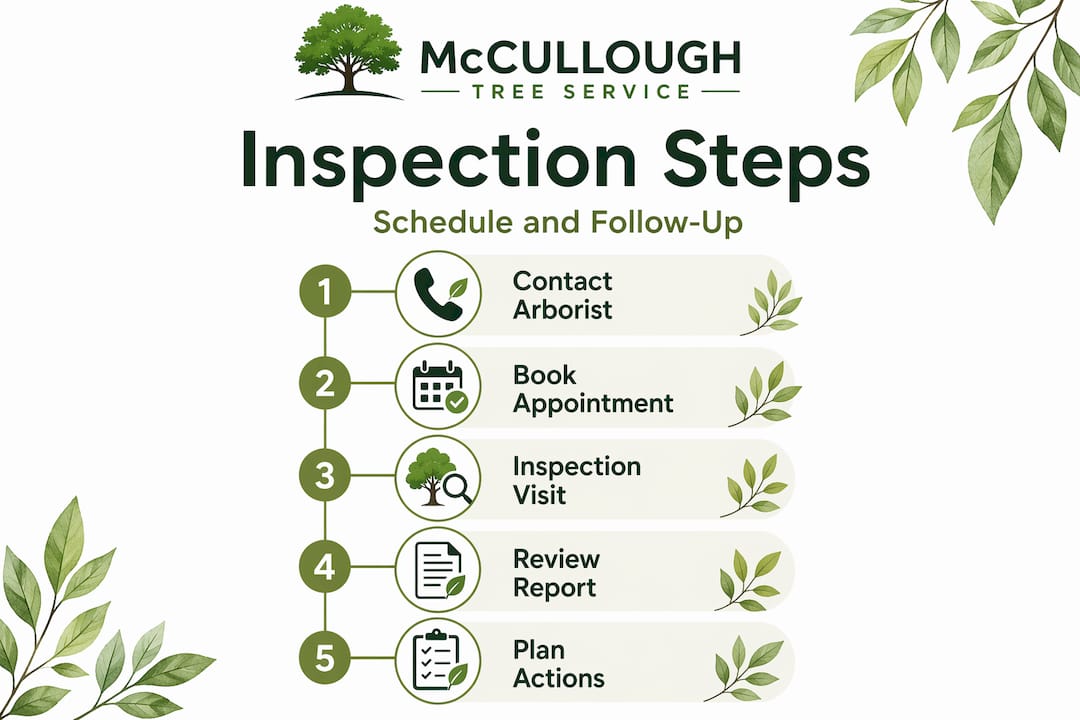
Steps for arranging tree evaluations the right way:
- Confirm property ownership. Before you call anyone, verify whether the tree is on private property or a public right-of-way. City forestry departments handle public trees; you are responsible for booking private arborists for trees on your property.
- Document your concerns before calling. Walk your property and photograph any visible damage, leaning, or unusual growth. Note how long issues have been present. This saves time during the consultation and helps the arborist prioritize.
- Contact 1 to 2 pre-vetted arborists immediately after a storm. Do this within 24 hours if possible. After a storm, demand for qualified arborists spikes immediately. Homeowners who already have contacts book quickly; everyone else waits.
- Prioritize trees by risk. Start with trees closest to the structure, power lines, and high-traffic areas. A large oak leaning over your roof is not in the same category as a palm 40 feet from your back door.
- Request a written risk assessment. Not a verbal opinion. A formal written report with risk categorization (low, medium, high, extreme) protects you legally and gives you a clear action plan.
- Schedule follow-up work immediately. Once you have the report, book any recommended pruning, cabling, or removal while the arborist and their crew are available. Delaying follow-up is how manageable risks become emergencies.
Comparison: Emergency vs. routine inspection scheduling
| Factor | Emergency post-storm | Routine annual inspection |
|---|---|---|
| Timing | Within 24 to 72 hours | Late winter to early spring |
| Priority | Highest-risk trees first | All trees on property |
| Report format | Written risk categorization | Written health and risk summary |
| Follow-up speed | Immediate | Scheduled within 30 days |
| Arborist credential | ISA TRAQ preferred | ISA certified arborist |
Check the emergency tree service steps guide and the tree storm cleanup resources to understand what comes after the inspection.
Pro Tip: Keep a simple tree log in a notes app on your phone. Record each inspection date, the arborist’s name, key findings, and any follow-up work completed. This record is useful for insurance claims and future inspections.
After scheduling and the inspection, let’s discuss what to do next to verify and act on the inspection findings.
What to expect after the inspection: interpreting reports and follow-up planning
Getting the report is not the finish line. It’s the starting point for a short list of actions that actually reduce your risk.
A professional inspection report should include a risk rating for each tree evaluated, specific defects identified by zone, recommended mitigations (pruning, removal, cabling, monitoring), and a suggested timeline. Treat this report as a scheduling artifact, meaning it drives your next set of appointments, not just a document you file away.
How to act on inspection findings:
- High or extreme risk trees: Schedule removal or major structural pruning within days, not weeks.
- Medium risk trees: Book cabling, bracing, or targeted pruning within the month. Mark the calendar.
- Low risk with recommendations: Address during your next routine maintenance cycle, but do not ignore.
- Monitor-only trees: Schedule a follow-up inspection in 6 to 12 months to check whether the condition has progressed.
Follow-up inspections after mitigation work confirm that the risk was actually addressed. A pruned tree still needs a secondary check to verify proper cuts and structural integrity. Keep all records of each inspection and treatment for tree care best practices and future insurance documentation.
Pro Tip: If a report recommends removal, get it done before the next storm season. Trees flagged as high risk do not improve on their own, and delayed removal often becomes emergency removal at a much higher cost.
With this process in mind, let’s share a fresh perspective on the challenges and best practices in scheduling tree inspections in Central Florida.
Why centralized scheduling and immediate post-storm plans transform tree safety in Central Florida
Here is the hard truth most homeowners learn after the fact: the problem is never the inspection itself. It’s the gap between something going wrong and the moment you actually have a qualified arborist standing in your yard.
After a major storm, every homeowner in Central Florida is making the same phone calls at the same time. Building your schedule around storm recovery, with pre-identified arborists already in your contacts, is the only way to avoid being last in line during a high-demand recovery period. We have seen trees fail within days of a storm on properties where the homeowner was still trying to find someone to call.
There is also a perception gap that creates real danger. Most homeowners focus almost exclusively on visible damage. A branch on the lawn is alarming. A trunk cavity hidden behind bark is invisible, and that is exactly the kind of defect that causes whole-tree failure under the next wind load. The root zone gets even less attention, yet root rot and compaction issues cause more catastrophic failures than broken branches ever will.
Inspection is not just a formality. Effective follow-up scheduling ensures findings convert to action. We have reviewed reports from other providers that listed five mitigation recommendations, and when we visited the property a year later, none had been completed. The inspection was done. The risk was documented. But the tree still came down in the next storm.
Treat your inspection report as a living document, not a receipt. Each recommendation on that report is a scheduled task with a deadline attached. The emergency tree service steps and a pre-built call list of ISA TRAQ arborists give you the tools to respond, not react. Use the tree risk assessment checklist to stay ahead of problems before storm season forces your hand.
The homeowners who avoid expensive emergencies are not the ones with the best trees. They are the ones with the best systems.
How McCullough Tree Service supports your tree inspection and maintenance needs
If you are ready to move from reading about inspections to actually scheduling one, McCullough Tree Service is the team Central Florida property owners trust for exactly this.
Our staff includes certified arborist professionals trained in ISA TRAQ risk assessment methodology, meaning you get a written, structured evaluation, not just a walkthrough and a verbal opinion. We respond quickly after storms because we understand that a 48-hour delay is the difference between a manageable situation and a genuine emergency. Our storm clean up crews are equipped to assess and clear damaged trees safely, and our routine tree trimming services keep your canopy healthy and resilient before the next storm arrives. We provide transparent reporting and clear scheduling so you always know what was found, what needs to happen next, and when we will be back.
Frequently asked questions
How soon after a storm should I schedule a tree inspection?
Schedule your tree inspection as soon as possible after a storm, ideally within 24 to 72 hours, because quick post-storm evaluation helps you identify urgent risks and begin mitigation before conditions worsen.
What qualifications should I look for in an arborist?
Look for arborists holding ISA TRAQ certification, which signals specialized risk assessment training, since ISA TRAQ holders must retrain and retest every five years to maintain their credential.
Can the city inspect trees on my private property?
No. City forestry programs handle only public right-of-way trees, so you must hire a private certified arborist for any trees located on your own property.
What should an inspection report include?
A thorough report addresses all three structural zones, including trunk cavities, cracks, and root indicators, and provides clear risk categorization with specific mitigation recommendations for each defect found.
How often should routine tree inspections be scheduled?
Routine inspections should happen at least once per year, typically before storm season, with additional checks scheduled after significant weather events or if you notice new symptoms like crown thinning or unusual leaning.
Recommended
- Why routine arborist inspections matter for Central Florida trees
- Comprehensive Guide to Tree Services in Orlando
- Guide to Tree Removal in Orlando
- Comprehensive Orlando Tree Service by Certified Arborists