By: Shelby McCullough| Published: May 11, 2026
TL;DR:
- In Central Florida, tree failure risk during hurricanes is heightened by shallow soils and species-specific vulnerabilities.
- Visual inspections combined with professional assessments using advanced tools are essential for identifying hidden internal decay that threatens trees’ stability.
Florida homeowners know that hurricane season is not a matter of “if” but “when.” What many people don’t realize is that the trees in their own yard often pose a bigger threat than the storm itself. A healthy tree is an asset. A failing one is a hazard standing in plain sight, waiting for the right wind gust to become a disaster. Recognizing the difference before a storm hits can mean the difference between a close call and catastrophic property damage. This guide walks you through the expert-backed signs, species-specific risks, and clear action steps that every Central Florida homeowner and property manager needs to know.
Table of Contents
- Core criteria: How to evaluate tree safety
- Top visual signs: What to look for in unsafe trees
- Hidden risks: Signs you can’t see without expert tools
- Species comparison: Which trees are most at risk in Central Florida?
- Action steps: What to do if your tree shows unsafe signs
- Why most tree safety advice misses Central Florida realities
- Central Florida tree safety: Connect with certified experts
- Frequently asked questions
Key Takeaways
| Point | Details |
|---|---|
| Visual signs matter | Visible cracks, fungus, and leaning trees are the most common indicators of instability. |
| Hidden decay is risky | Internal rot and weak roots may not be obvious—expert tools help spot these threats. |
| Species affect risk | Some tree species like laurel or water oak are more prone to storm damage than others. |
| Certified assessment vital | ISA TRAQ-certified arborists provide reliable risk evaluations and minimize rating bias. |
| Act early for safety | Pruning, cabling, or removal can prevent costly damage—don’t wait for storms to expose hazards. |
Core criteria: How to evaluate tree safety
Building on the urgent need for early detection, let’s first outline the core criteria experts use to assess tree safety. Not all warning signs are equal, and not all trees respond to storms the same way. Professionals rely on a structured framework that considers three main areas: root health, trunk integrity, and branch attachment quality.
Root health is where many Central Florida trees fail first. Our region’s sandy, shallow soils don’t anchor roots the way deeper, clay-based soils do in other parts of the country. When soils become saturated during heavy rainfall, even a large tree can uproot in winds that wouldn’t topple the same species growing in firmer ground. UF/IFAS post-hurricane studies across 281 species confirm that species-specific wind resistance varies widely and that confined or shallow roots dramatically increase uprooting risk.
Trunk integrity refers to the structural soundness of the main stem. Internal decay, splits, cavities, and codominant stems (two trunks of equal size forking from the same point) all reduce a trunk’s ability to handle lateral wind forces. Branch attachment quality covers how branches connect to the trunk. Weak, narrow-angle attachments are prone to splitting under load.
Professional arborists assign a Likelihood of Failure (LoF) rating to trees they assess. The four categories are:
- Improbable — The tree is structurally sound; failure is not expected under normal conditions.
- Possible — Some defects exist but failure under typical loading is unlikely.
- Probable — Significant defects make failure likely under normal weather.
- Imminent — Failure could occur at any moment, even without a storm.
“Understanding LoF ratings helps homeowners communicate with arborists and make informed decisions about whether to monitor, treat, or remove a tree.” Pair that knowledge with a solid tree risk assessment guide and you’re already ahead of most property owners in the region.
Species also matter enormously. Laurel oaks and water oaks are notoriously prone to internal decay and storm failure. Live oaks, with their broader root systems and more flexible wood, tend to fare much better. Knowing your species is step one in identifying dangerous trees before the season starts.
Top visual signs: What to look for in unsafe trees
With the criteria established, let’s take a closer look at the visible warning signs anyone can spot during a routine check. You don’t need specialized tools to start. A slow walkaround your property, looking carefully at the base, trunk, and canopy, will reveal a lot.
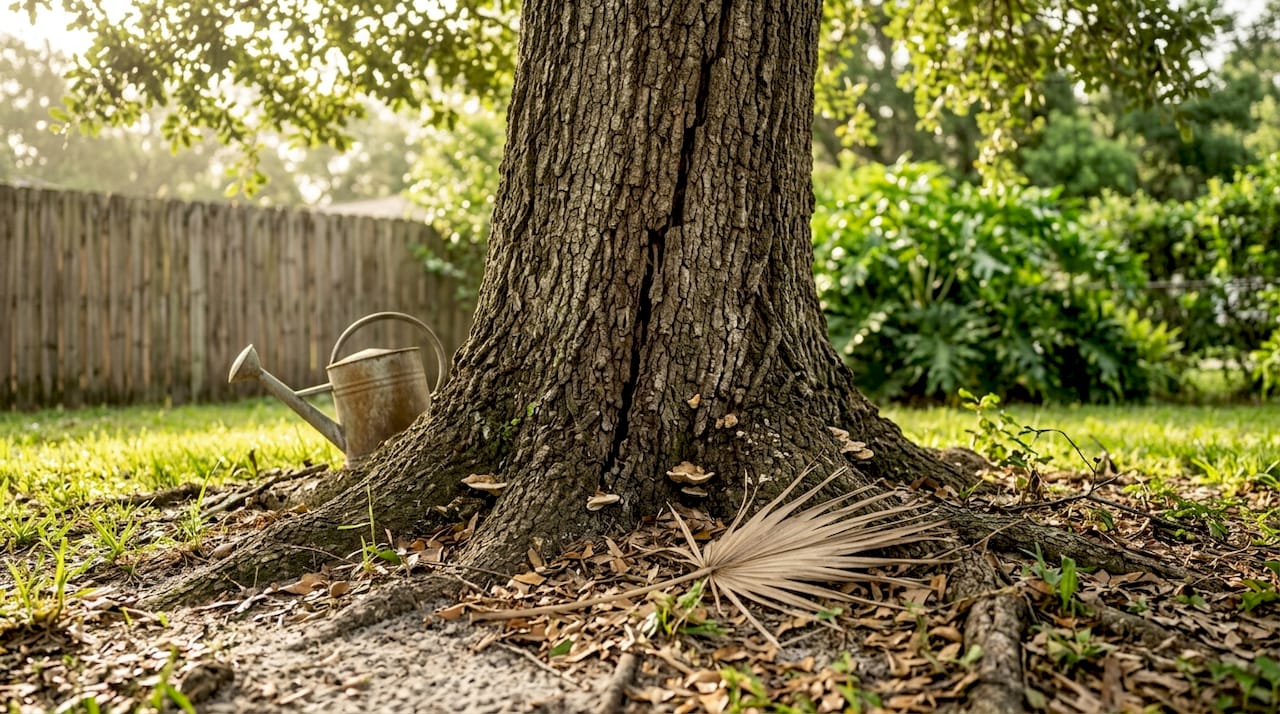
The primary tree failure mechanics in Central Florida include uprooting from saturated sandy soils and shallow roots, trunk breakage from codominant stems or internal decay such as Ganoderma butt rot, and branch failure from weak attachments or excessive end-weight on long limbs.
Here’s what to look for during your visual check:
- Root plate heaving. If the ground around the base is cracking, lifting, or mounding on one side, the root plate may be separating. This is one of the clearest pre-failure warning signs.
- Fungal growth at the base. Conk-shaped mushrooms or shelf fungi, especially Ganoderma species, are a red flag. They indicate advanced internal decay. By the time you see the fruiting body outside the tree, significant rot has already developed inside.
- Cracks or splits in the trunk. Vertical cracks along the bark, especially near the base or where large branches attach, suggest the tree is already under stress and beginning to fail structurally.
- Cavities in the trunk. Open holes signal hollow areas where wood has rotted away. A tree with a large hollow trunk has significantly less load-bearing capacity than its exterior suggests.
- Visible leaning with disturbed soil. A slight lean is normal for many trees. But leaning with soil disturbance, raised roots on one side, or a recent change in the lean angle is a serious concern.
- Dead, hanging, or overextended branches. Called “widow makers,” dead branches suspended in the canopy can fall without warning. Overextended branches with heavy end-weight are prone to splitting.
- Codominant stems. Two trunks of roughly equal diameter growing from the same point create a V-shaped fork with a weak attachment zone called “included bark.” This is one of the most common causes of major branch failure in Florida storms.
Pro Tip: Take photos of any concerning signs and timestamp them. This creates a visual record that helps an arborist track changes over time and helps you notice gradual shifts that might otherwise go undetected.
Use a printed tree risk assessment checklist during your walkaround so you don’t miss anything. Real-world hazard examples from Central Florida properties can also sharpen your eye before you head outside.
Hidden risks: Signs you can’t see without expert tools
While visual signs are helpful, some of the most dangerous defects are hidden and require specialized assessments. A tree can look perfectly healthy from the outside while harboring severe internal decay that extends through much of its core. This is why visual inspections alone should never be your final word on a tree’s safety.
Certified arborists use advanced diagnostic tools to find what the naked eye misses. Sonic tomography sends sound waves through the trunk to map its internal structure. Decay shows up as areas where sound travels slower, revealing hollow zones and rot pockets. Resistance drilling inserts a fine drill bit into the trunk and measures how much resistance the wood provides. Healthy wood drills hard. Decayed wood offers almost no resistance.
ISA TRAQ-certified arborists carry credentials specifically for tree risk assessment. The TRAQ (Tree Risk Assessment Qualification) program is the gold standard in the industry. Research published in a peer-reviewed journal found that assessor variability in LoF ratings decreases significantly with TRAQ credential holders, though an interesting paradox exists where more experienced assessors can sometimes show more variance, likely because they weigh context more heavily. Retrospective bias, where an assessor rates LoF higher after knowing a failure already occurred, is another documented issue that certification helps minimize.
For Central Florida homeowners, the recommendation is clear: prioritize ISA TRAQ-certified assessments especially after storm events or when trees are located near structures, vehicles, or utility lines. A visual check gets you started, but a professional tree health assessment closes the gap.
| Assessment Method | Who Can Do It | What It Detects | Limitations |
|---|---|---|---|
| Visual walkaround | Homeowner | External signs: fungus, cracks, lean | Misses internal decay |
| Sonic tomography | Certified arborist | Internal decay maps | Requires specialized equipment |
| Resistance drilling | Certified arborist | Decay density inside trunk | Invasive, needs expertise |
| Full TRAQ assessment | ISA TRAQ-certified arborist | Comprehensive risk rating | Requires certification |
Species comparison: Which trees are most at risk in Central Florida?
Knowing which species are most susceptible helps prioritize inspection and intervention efforts. Not every tree on your property carries the same level of risk, and a species-aware approach lets you focus your time and budget where it matters most.
Hurricane winds combined with Central Florida’s sandy and frequently saturated soils amplify root and trunk failures in ways that wouldn’t occur in other climates. Species like laurel oak and water oak show significantly higher failure rates than live oaks or well-established palms. Early intervention through pruning or cabling can sometimes save at-risk trees, but species is a major factor in that decision.
| Tree Species | Storm Risk Level | Primary Failure Mode | Early Intervention Possible? |
|---|---|---|---|
| Laurel oak | High | Internal decay, uprooting | Sometimes, if caught early |
| Water oak | High | Trunk breakage, codominant stems | Limited |
| Live oak | Moderate | Branch failure, root damage | Yes, pruning helps |
| Slash pine | Moderate | Windthrow in shallow soils | Yes, crown reduction |
| Sabal palm | Low to moderate | Crown decay, trunk snap | Yes, regular monitoring |
| Queen palm | Moderate | Frond failure, crown rot | Yes, with proper nutrition |
The UF/IFAS species-specific research across 281 tree species reinforces this table. Wind resistance is not just about size or apparent health. It’s baked into the biology and root architecture of each species. A 60-foot laurel oak growing next to your roof deserves more scrutiny than a 60-foot live oak in the same position.
Key takeaways by species group:
- Laurel and water oaks: Prioritize annual inspections, especially for any internal decay signs. These trees commonly hide rot behind healthy-looking bark.
- Live oaks: More resilient but not immune. Watch for included bark at major forks and any sign of root zone compaction.
- Palms: Crown decay and nutrient deficiencies are the main culprits. Yellowing fronds and a thin canopy often signal problems before a physical failure occurs.
If you’re unsure whether a tree is becoming a liability, reviewing the key tree removal signs for Central Florida will help you think through the decision clearly.
Action steps: What to do if your tree shows unsafe signs
Once you’ve identified an unsafe tree, the next step is essential, here’s what to do right away. Acting quickly reduces your liability and, more importantly, protects your family, neighbors, and property.
Early intervention through pruning or cabling can save trees with moderate defects from full failure, especially if discovered before hurricane season begins. Here’s a clear action sequence:
- Document everything with photos. Walk around the tree and photograph all visible defects from multiple angles. Date-stamp your images. This documentation is useful for arborist consultations and insurance claims.
- Keep people and vehicles away. If the signs suggest imminent risk, treat the area like a safety zone. Don’t park under the tree and keep children away until it’s assessed.
- Schedule an ISA TRAQ-certified arborist assessment. A professional assessment should follow any significant visual concern, particularly before storm season or after a major weather event.
- Discuss your options. If the LoF rating is “possible” or “probable,” pruning to reduce wind load, or installing structural cables to stabilize weak unions, may be viable options that preserve the tree.
- Remove the tree if the risk is rated “probable” or “imminent.” At that level, no amount of pruning or monitoring changes the calculus. Removal is the only responsible choice.
Pro Tip: Schedule your arborist assessment between February and April, before hurricane season begins in June. Booking early means you’ll have time to act on any recommendations before the first storm of the year arrives.
For a broader view of how to prepare your property, the tree risk assessment tips page offers Central Florida-specific guidance that complements the steps above.
Why most tree safety advice misses Central Florida realities
Generic tree safety checklists are everywhere. What they rarely account for is the specific combination of threats that makes Central Florida uniquely dangerous: shallow sandy soils, a six-month hurricane season, high humidity that accelerates fungal decay, and a tree canopy dominated by species that simply weren’t built to handle repeated major storms.
We’ve evaluated thousands of trees across Orlando and the surrounding communities, and one pattern stands out. Homeowners often wait until they see dramatic visual symptoms, like a large crack or a leaning trunk, before calling for an assessment. By that point, the tree has often been in decline for years. The internal decay that makes a tree dangerous almost always starts long before it shows up on the outside.
The other gap in generic advice is the assumption that a single inspection is enough. In Central Florida, trees that are rated “possible” for failure in spring can shift to “probable” after a summer of storm stress, saturated soil, and new fungal growth. Ongoing monitoring, not a one-time checklist exercise, is what actually keeps properties safe. We’ve seen trees pass a spring visual check and then fail before September.
ISA TRAQ certification isn’t just a credential to impress clients. It represents a standardized approach to risk evaluation that reduces the human variability and retrospective bias that can otherwise distort assessments. If your arborist can’t show you that credential, you’re getting an opinion, not an evaluation. There’s a meaningful difference between the two when a major storm is headed toward your neighborhood.
Our hazard evaluation guide for Florida property owners goes deeper on these local realities and gives you a framework for thinking about ongoing risk rather than point-in-time snapshots.
Central Florida tree safety: Connect with certified experts
Understanding the signs of an unsafe tree is the first step. Acting on that knowledge is where property protection actually happens.
McCullough Tree Service brings ISA-certified arborists and decades of Central Florida experience to every assessment. Whether you need a professional tree removal for a high-risk tree or want to learn more about the difference between trimming and pruning as a preventative measure, our team is equipped to guide you through every decision. We handle emergency storm response, comprehensive health assessments, and routine maintenance for residential and commercial properties across Orlando and Central Florida. Contact us to schedule your assessment before hurricane season arrives.
Frequently asked questions
How often should I inspect my trees in Central Florida?
Inspect your trees at least twice per year and after any major storm event. Regular visual checks catch early signs of instability, but advanced tools are needed to detect hidden decay.
What are the most dangerous tree species during Florida storms?
Laurel oaks and water oaks are especially vulnerable to hurricane winds and saturated soils. Species like these show significantly higher failure rates than live oaks under the same storm conditions.
Can visible signs always determine if a tree is unsafe?
No. While visible signs provide important clues, some defects are entirely hidden inside the trunk. Certified arborists use sonic tomography and resistance drilling to detect decay that visual checks cannot reveal.
What is LoF, and should homeowners use it for decisions?
Likelihood of Failure (LoF) is a professional risk rating with four levels from improbable to imminent. UF/IFAS studies support its use as a structured guide, but homeowners should treat it as expert input rather than a standalone decision tool.
Is early intervention always required if I see signs?
Not always. Pruning or cabling can reduce risk for trees rated “possible” or “probable” when defects are caught early. Full removal becomes necessary only when the risk is imminent or the tree’s structural integrity is severely compromised.
Recommended
- Spot Tree Hazards: Real Examples & Solutions for Central Florida
- Why prioritize tree safety: protect property & prevent risks
- Why remove hazardous trees: key benefits for properties
- Identify a Dangerous Tree: Signs & Solutions