By: Shelby McCullough| Published: April 11, 2026
TL;DR:
- Many healthy-looking trees in Central Florida may have internal decay and pose storm risks.
- Native species like live oaks and sabal palms are more wind-resistant than fast-growing oaks.
- Proactive professional assessment and maintenance are essential to prevent storm damage and property loss.
Central Florida’s combination of hurricane-force winds, sandy soil, and year-round growth creates a tree safety environment unlike almost anywhere else in the country. A tree that looks perfectly healthy from your back porch can be hiding root rot, internal decay, or structural cracks that make it a serious threat the moment a tropical storm rolls through. Higher-risk species like laurel oaks are far more likely to fail during storms than native alternatives, and the difference between a close call and a catastrophic loss often comes down to what you spotted before the storm arrived. This guide walks you through exactly what to look for, which trees worry us most, and what to do about it.
Table of Contents
- What makes a tree hazardous? Understanding risk factors
- Most common examples of tree hazards on Florida properties
- Top Central Florida trees most at risk during storms
- Recognizing and addressing hazardous trees: Actions and professional help
- The truth most property owners miss about tree hazards
- Protect your property with expert tree care
- Frequently asked questions
Key Takeaways
| Point | Details |
|---|---|
| Hazards have clear warning signs | Dead wood, cracks, fungus, and leaning show a tree may present danger. |
| Some tree species fail more often | Laurel and water oaks are more likely to fall in storms, while live oaks are safer. |
| Professional assessment prevents costly damage | Experts spot hidden risks and recommend safe actions, reducing emergency costs. |
| Proactive care is essential | Routine checks and proper pruning before storm season help keep your property safe. |
What makes a tree hazardous? Understanding risk factors
Not every damaged tree is a hazard, and not every hazard looks damaged. That distinction matters more than most property owners realize. Professionals define a tree hazard using three factors working together: a structural defect, a target nearby (your home, a car, a fence, a person), and the potential consequences if that tree or limb fails.
Think of it like a simple equation. A cracked trunk in the middle of an empty field is a defect, but it is not really a hazard. That same crack directly over your roof? That is a high-priority emergency. Risk scoring considers defects, targets, and consequences together, which is why professionals use a structured matrix rather than gut instinct.
Central Florida adds several layers of complexity to this equation:
- Sandy soil provides less root anchorage than clay-heavy soils, making trees more likely to uproot in high winds
- Hurricane season runs June through November, meaning trees face repeated stress year after year
- Fast-growing species common in Florida often develop weaker wood than slow-growing natives
- Urban soil compaction around driveways and foundations can restrict root development and stability
- Proximity to structures is higher in suburban neighborhoods, raising the consequence score significantly
For a deeper look at how professionals evaluate these factors together, the tree risk assessment tips page breaks down the full process used by certified arborists in our region.
| Risk Factor | Low Risk | High Risk |
|---|---|---|
| Defect severity | Minor surface crack | Major trunk split |
| Target proximity | Open field | Over structure or road |
| Soil condition | Dense, stable | Sandy, compacted |
| Species | Live oak, sabal palm | Laurel oak, water oak |
| Storm history | No prior damage | Multiple storm events |
Pro Tip: Walk your property after every significant storm and photograph any new leaning, cracking, or exposed roots. These photos become valuable documentation for your insurance company and for any arborist you bring in later.
Most common examples of tree hazards on Florida properties
With a clear understanding of risk factors, let’s identify the specific warning signs and hazard types property owners should watch for. Some of these are obvious. Others are easy to miss until it is too late.
Here are the hazard types we see most often on Central Florida properties:
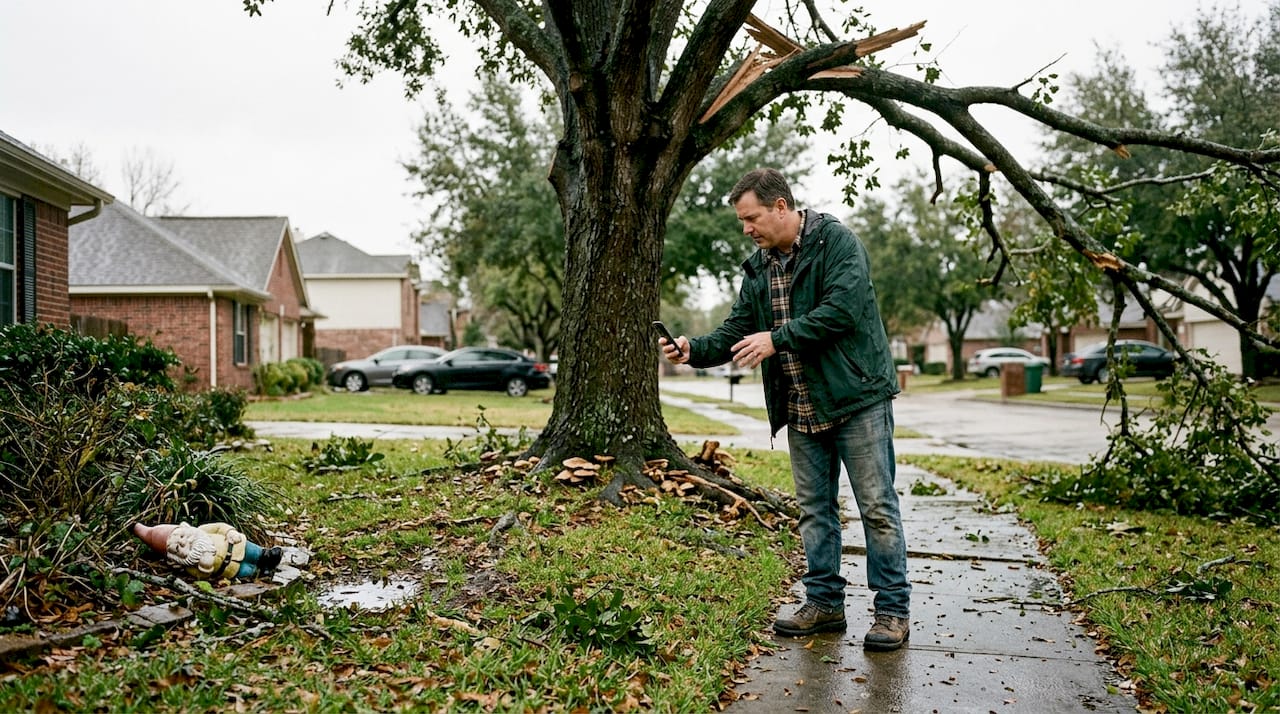
- Dead or dying limbs: Often called “widow makers,” these branches can fall without warning. They may look gray, lack leaves during growing season, or feel hollow when tapped.
- Major trunk cracks or splits: Vertical cracks running along the trunk, or co-dominant stems (two main trunks growing from the same point) that are splitting apart, signal serious structural weakness.
- Mushrooms or fungal growth: Fungal bodies at the base of a tree or along the trunk are a visible sign of internal decay. The tree may look fine on the outside while rotting from within.
- Exposed or heaving roots: Roots lifting the soil around the base of a tree often mean the root system is failing or that the tree is beginning to lean and shift.
- Leaning after storms: A tree that has developed a new lean following a storm event is not just aesthetically off. It may have partially uprooted and could fall with the next wind event.
- Overgrown or unbalanced canopy: A canopy that is heavily weighted to one side creates a leverage problem in high winds, dramatically increasing the chance of failure.
Knowing how to identify signs of dangerous trees on your own is a valuable first step, but visual inspection has limits. A tree health assessment by a certified arborist can detect internal decay that no amount of walking around the yard will reveal.
“UF research on post-hurricane tree failures found laurel oaks and water oaks had the highest rates of structural failure among commonly planted Florida species.”
Pro Tip: Press your thumb firmly against the base of a tree near the soil line. If the bark feels spongy, soft, or crumbles easily, that is a strong indicator of basal decay that warrants immediate professional evaluation.
Top Central Florida trees most at risk during storms
The next step is knowing which specific tree species require the most attention when hurricane season looms. Not all trees are created equal when it comes to wind resistance, and the data from real storm events makes this very clear.
Native species like live oaks and sabal palms consistently outperform non-native and fast-growing alternatives in hurricane conditions. Live oaks have a low center of gravity, flexible branch structure, and deep root systems that anchor well even in sandy Florida soil. Sabal palms, Florida’s state tree, are remarkably wind-tolerant because their fronds flex rather than catch wind like a sail.
On the other end of the spectrum, water oaks and laurel oaks are among the most common trees in Central Florida neighborhoods and also among the most likely to fail. They grow quickly, develop weaker wood, and are prone to internal decay as they age. Post-hurricane data from over 281 species studied after major storms confirms this pattern consistently.
| Species | Wind Resistance | Failure Risk | Notes |
|---|---|---|---|
| Live oak | High | Low | Deep roots, flexible structure |
| Sabal palm | High | Low | Fronds flex in wind |
| Laurel oak | Moderate | High | Prone to internal decay |
| Water oak | Low | High | Weak wood, fast-growing |
| Slash pine | Moderate | Moderate | Susceptible to root rot |
| Camphor tree | Low | High | Shallow roots, brittle wood |
Before storm season, check your highest-risk trees for these specific warning signs:
- Thinning canopy or unusual leaf drop outside of normal seasonal patterns
- Bark that is peeling away from the trunk without obvious insect activity
- Any visible cracks near branch unions or at the base of major limbs
- A noticeable lean that was not present the previous season
For more guidance on getting your trees ready before a storm hits, our storm prep for trees page covers a full seasonal checklist. And if you have already experienced storm damage, the storm cleanup tips resource walks through safe next steps.
Key stat: Researchers studied more than 281 tree species following major hurricane events to build the wind-resistance ratings used by arborists today. That is real-world data, not estimates.
Recognizing and addressing hazardous trees: Actions and professional help
Once you have identified species and risk factors, it is critical to act quickly and correctly. Here is how to move from awareness to action without making the situation worse.
Step 1: Document everything. Before anyone touches the tree, take photos from multiple angles. Capture the lean, any cracks, fungal growth, and the proximity to your home or other structures. This documentation protects you with your insurance company and gives an arborist a baseline to work from.
Step 2: Assess whether DIY is appropriate. Small dead branches under two inches in diameter that are easy to reach from the ground can sometimes be handled with basic pruning tools. Anything larger, higher, or near a structure is not a DIY job.
Step 3: Call a certified arborist for anything serious. Leaning trees, large dead limbs, fungal growth, or any tree near your home requires professional eyes. Certified arborists carry the training and equipment to assess and address hazards safely.
Step 4: Understand your options. Not every hazard requires removal. Alternatives like structural cabling, crown reduction pruning, or targeted deadwood removal can reduce risk significantly while preserving the tree. A good arborist will present these options honestly.
Step 5: Schedule follow-up monitoring. A single assessment is not enough for high-risk trees. Plan for annual evaluations, especially before and after hurricane season.
“Proper targeted pruning over thinning is consistently more effective at reducing storm failure risk than removing random branches across the canopy.”
Common mistakes we see property owners make include topping trees (which creates weak regrowth and more hazards), ignoring a slow lean, and waiting until after a storm to deal with a tree they already knew was a problem. For guidance on what removal looks like and when it is the right call, visit our hazardous tree removal page. Understanding the difference between trimming vs pruning also helps you ask better questions when you call a professional.
Pro Tip: Ask any tree service you hire whether they carry liability insurance and whether their arborists hold ISA (International Society of Arboriculture) certification. This protects you if something goes wrong during the work.
The truth most property owners miss about tree hazards
Here is what years of working with Central Florida property owners has taught us: most people wait too long, and they wait because the tree still looks green.
The most dangerous tree failures we have seen did not come with obvious warning signs visible from the driveway. They came from trees that had been slowly decaying internally for years, trees that looked full and healthy right up until the moment a storm pushed them over. Appearance is not a reliable safety indicator, and that is a lesson that costs some owners dearly.
Storm preparedness is also not something you can accomplish in the week before a named storm makes landfall. The structural integrity of your trees is built or lost over years of care, or neglect. Proactive pruning, species selection, and annual assessments are the actual tools that protect your property. Scrambling to remove a tree the day before a hurricane is dangerous, expensive, and often too late.
Central Florida’s conditions also require local knowledge. General tree care guidelines written for the Pacific Northwest or the Northeast do not account for our sandy soil, our specific storm patterns, or the species that dominate our neighborhoods. Understanding why removing hazardous trees proactively protects long-term property value is a mindset shift worth making before a storm makes the decision for you.
Protect your property with expert tree care
If any of the hazards described in this article sound familiar, the right move is a professional site visit before the next storm season puts your property to the test.
At McCullough Tree Service, our certified arborists assess your specific trees, soil conditions, and property layout to give you an honest picture of your risk. We offer everything from targeted tree removal services for high-risk trees to precision work by our tree trimming experts who know how to reduce storm risk without harming the trees you want to keep. Proactive care ahead of hurricane season is always less expensive and less stressful than emergency response after the damage is done. Reach out today to schedule your on-site evaluation and get a clear plan for your landscape.
Frequently asked questions
What are the first warning signs of a hazardous tree on my property?
Early warning signs include dead branches, mushrooms growing on or near the trunk, visible cracks in the bark, and any new leaning that developed after a storm. Catching these early gives you more options and more time to respond safely.
Are some tree species in Central Florida at higher risk during hurricanes?
Yes. Laurel oaks and water oaks show much higher failure rates in storms, while live oaks and sabal palms are significantly more wind-resistant due to their structure and root systems.
Can I address tree hazards myself or should I call a professional?
Small branches and minor deadwood are sometimes manageable on your own, but major hazards or large limbs always require a certified arborist. The risk of injury or property damage from DIY work on large trees is not worth it.
What’s the difference between tree trimming and pruning for safety?
Proper targeted pruning reduces storm failure risk far more effectively than general thinning. Strategic cuts that remove specific hazardous growth points protect the tree’s structure while lowering the risk of failure.
Why is Central Florida’s soil type important for tree hazards?
Sandy soil and hurricane winds are a dangerous combination because sandy soil provides far less root anchorage than denser soil types, making uprooting much more likely when strong winds hit.
Recommended
- Why Trim Trees for Safety in Central Florida
- Tree risk assessment tips for Central Florida owners
- Safe Tree Removal Central Florida: 85% Injury Cut Guide
- Tree Planting Considerations for Central Florida Homes