By: Shelby McCullough| Published: September 2, 2026
Most residential land clearing in Orlando and Central Florida runs $2,500 to $6,500 per acre, so a quarter-acre lot with moderate brush typically lands between $650 and $1,600. Wooded lots with mature trees, stumps, or poor access push toward the top of that range or beyond. Vegetation density, permits, and grading are the three variables that move your number most. The breakdowns below show exactly how.
TL;DR:
- Vegetation density and tree complexity are the primary factors that influence land clearing costs in Orlando, with mature trees significantly raising prices.
- Small lots are typically billed as flat daily rates of $500 to $1,500, while larger acres benefit from lower per-acre prices, often between $2,500 and $6,500 depending on vegetation type.
- Permitting costs, especially wetland determinations and environmental reviews, can add thousands of dollars to the project depending on parcel size and environmental sensitivity.
- On-site assessments by experienced crews and certified arborists help identify hazard trees, protected species, and permit issues early, preventing costly change orders.
- Accurate budgeting requires early permit review through Orange County’s FastTrack system before soliciting bids, as permit requirements significantly influence overall land clearing expenses.
Table of Contents
- Land Clearing Cost Orlando: Quick Benchmarks by Job Type
- What Drives Land Clearing Pricing in Orlando
- Sample Land Clearing Budgets by Lot Size
- Permits, Wetlands, and Orange County Rules That Affect Your Bid
- Site Prep Add-Ons That Change Your Total Budget
- How Long Land Clearing Takes in Orlando
- Getting Accurate Quotes: What to Ask Every Contractor
- Why Certified Arborists and Licensed Crews Matter on Orlando Clearing Jobs
- What Actually Moves the Needle on Your Budget
- Request an On-Site Estimate for Your Orlando Property
- Sources
Land Clearing Cost Orlando: Quick Benchmarks by Job Type
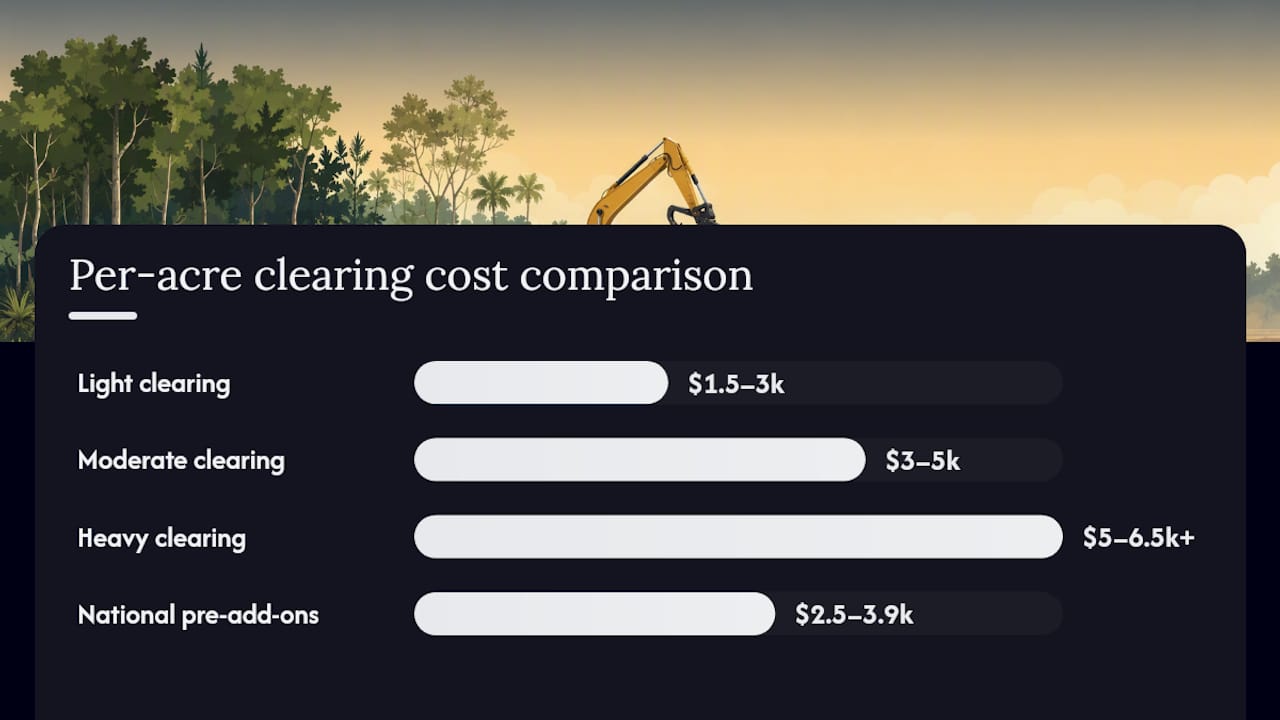
Light clearing, meaning grass, palmetto, and scattered saplings, typically runs $1,500 to $3,000 per acre. Moderate clearing, with mixed brush and mid-size trees, lands in the $3,000 to $5,000 range. Heavy clearing, involving dense woods, large hardwoods, and multiple stumps, can run $5,000 to $6,500 per acre or higher on engineered commercial sites. These figures track closely with Central Florida contractor pricing and broader national cost guide averages, which show overall clearing costs near $2,500 to $3,900 before accounting for heavy density or grading add-ons.
Small lots rarely get billed by the acre. Most Orlando crews price jobs under half an acre as a flat day rate instead, because mobilizing equipment costs roughly the same whether you’re clearing a fifth of an acre or a full one. Per-acre pricing generally drops as the job scales up, since that fixed mobilization cost gets spread across more square footage.
Quick reference for preliminary budgeting:
- Light brush clearing: $1,500 to $3,000 per acre
- Moderate mixed vegetation: $3,000 to $5,000 per acre
- Heavy wooded/commercial-grade clearing: $5,000 to $6,500+ per acre
- Small-lot flat day rates: often $500 to $1,500 per day depending on equipment and crew size
- Permit passthrough fees: typically $200 to over $1,100 depending on parcel size and wetland review
Pro Tip: Ask every bidder whether their quote is per-acre or a flat day rate before comparing numbers side by side. A “cheaper” day rate on a dense half-acre lot can end up costing more than a per-acre quote once you account for the extra days needed.
What Drives Land Clearing Pricing in Orlando
Vegetation density is the single biggest factor in any Orlando clearing bid. A palmetto-and-grass lot clears in a fraction of the time it takes to remove a mature oak hammock, and contractors price accordingly. Site-work estimators treat vegetation density as the primary driver behind clearing and grubbing costs, more so than acreage alone.
Individual trees complicate pricing fast. A 40-foot oak leaning toward a fence line or power easement takes far more rigging, time, and insurance risk than a straight pine of the same height. That’s reflected in per-tree removal pricing you can compare against our Orlando tree removal guide. Stumps add another decision point: grinding leaves the root system in place and costs less, while grubbing pulls the entire stump and root ball, which costs more but is often required before grading or foundation work.
Access and soil conditions matter just as much as what’s growing on the lot:
- Tight access (narrow driveways, no room to stage equipment) adds mobilization time and sometimes requires smaller machinery at a higher hourly rate
- Sloped terrain slows equipment and raises erosion risk during clearing
- Sandy soils clear easily; rocky or mucky sections can stall tracked equipment and add hours
- Longer haul distances to disposal sites increase trucking costs per load
Disposal method changes the bottom line too. Contractors who can chip and mulch on-site keep costs down, while material that has to be hauled off in roll-off containers adds a line item tied to Orlando’s disposal and roll-off logistics. Burning is sometimes an option on larger rural parcels, but most in-city and suburban Orlando lots require haul-off or mulching due to local burn restrictions.
Pro Tip: Walk your lot before calling contractors and flag any trees within 15 feet of a fence, structure, or power line. Bids that don’t account for hazard trees upfront tend to balloon with change orders once the crew shows up.
Sample Land Clearing Budgets by Lot Size
Every scenario below assumes moderate Central Florida vegetation unless noted, and excludes grading, permits, and stormwater work covered in later sections.
- Quarter-acre lot. Low complexity (grass and light brush, easy access): roughly $400 to $700. Typical (mixed brush, a few small trees): $650 to $1,300. High complexity (dense growth, one or two large trees with stumps): $1,300 to $2,200.
- Half-acre lot. Low complexity: $800 to $1,400. Typical: $1,300 to $2,500. High complexity, including several mature trees and stump grubbing: $2,500 to $4,200.
- One-acre lot. Low complexity: $1,500 to $2,800. Typical, matching the regional $2,500 to $6,500 per-acre range: $2,800 to $5,200. High complexity, dense hardwood with heavy stump work and tight access: $5,200 to $6,500 or higher.
- Five-acre lot. Low complexity, taking advantage of per-acre economies of scale: $7,000 to $12,000. Typical: $12,000 to $22,000. High complexity, dense wooded acreage requiring extensive haul-off: $22,000 to $32,000 or higher.
Grading, silt fencing, and permit fees are typically required rather than negotiable, since they’re tied to Orange County code and stormwater rules. Disposal method, stump handling (grind versus grub), and scheduling flexibility are usually where you have the most room to negotiate a lower price.
Permits, Wetlands, and Orange County Rules That Affect Your Bid
Clearing more than a token amount of vegetation in unincorporated Orange County almost always triggers some level of permit review. The exact requirements depend on parcel size, zoning, and whether wetlands or protected surface waters are anywhere near the property line.
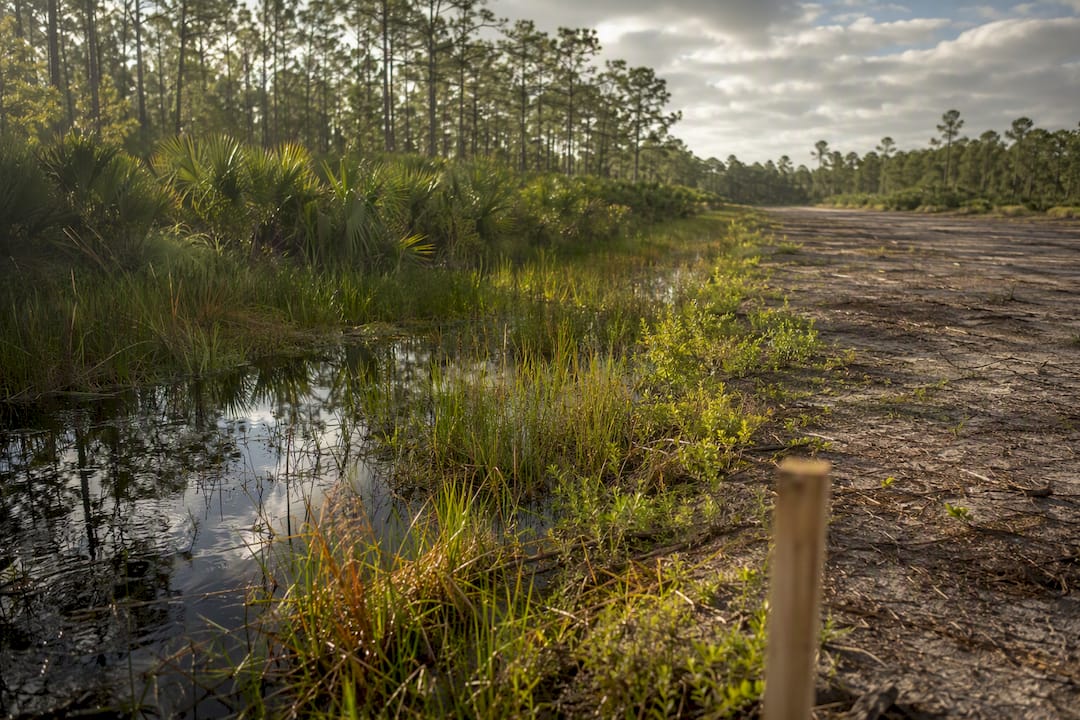
Wetland determination fees are billed by parcel size. Orange County charges $1,110 for parcels under 10 acres to formally determine whether wetlands exist on-site, plus documentation costs if a consultant needs to complete a delineation. Larger parcels or ones near known wetland systems can require more extensive review.
Standard permit fees stack on top of that. Orange County’s permit fee schedule shows Level 2 and Level 3 reviews, which apply to more complex or environmentally sensitive sites, can add thousands of dollars beyond a basic noticed general permit.
- Basic clearing permit: usually a few hundred dollars for straightforward, non-wetland parcels
- Wetland determination: $1,110 for parcels under 10 acres, scaling up from there
- Level 2/3 standard permit review: can run into the thousands depending on site complexity
- Environmental consultant fees for delineation: typically billed separately from the county fee
Skipping this step is not a shortcut worth taking. Orange County’s wetland conservation rules carry enforcement measures and penalties for unauthorized impacts, and mitigation after the fact almost always costs more than getting the determination done upfront. Check your parcel through OC FastTrack before soliciting bids, and loop in an environmental consultant early if your lot backs up to a pond, creek, or low-lying wooded area.
Site Prep Add-Ons That Change Your Total Budget
Clearing the vegetation is often just the first invoice. Grading and earthwork typically get priced per cubic yard, with unit costs driven by how much material has to be cut, filled, or hauled to balance the site. Florida site-work estimating frameworks treat clearing, earthwork, and stormwater control as separate cost categories, because each scales differently.
Stormwater and retention pond requirements kick in once impervious surface or lot disturbance crosses certain thresholds tied to zoning and drainage codes. A small residential lot might need nothing more than silt fencing during construction. A multi-acre commercial or subdivision project often needs a retention pond sized to hold runoff, which adds excavation, liner, and sometimes engineering design fees on top of the base clearing cost.
- Rough grading: typically priced per cubic yard moved, varying with depth and distance
- Erosion control (silt fencing, hay bales): usually a modest flat add-on for residential lots
- Stormwater/retention systems: required past certain disturbance thresholds, scaling with lot size
- Soil import or export: needed when on-site soil can’t support the planned structure or grade
Central Florida’s water table sits close to the surface in many areas, and poor or mucky soils sometimes require geotechnical testing before you can finalize a grading plan. Dewatering equipment gets added to the bid when groundwater interferes with excavation. This is one area where a flat per-acre clearing quote can be misleading. It’s worth pulling actual plan quantities rather than relying on rules of thumb once earthwork enters the picture, a distinction our land clearing cost breakdown walks through in more detail.
How Long Land Clearing Takes in Orlando
A quarter- to half-acre residential lot with moderate vegetation typically clears in one to three days. A full acre with mixed density runs three to seven days. Multi-acre commercial or subdivision-scale jobs stretch into multiple weeks, especially once grading and stormwater work follow the initial clearing.
Florida’s wet season, roughly July through September, slows almost every job. Saturated ground bogs down tracked equipment, and standing water on low-lying lots can delay start dates by days or weeks. Some Central Florida contractors quietly build a risk premium into wet-season bids to cover the extra time and potential site damage.
- Small lots (under half an acre): 1 to 3 days
- One-acre lots: 3 to 7 days
- Multi-acre or commercial sites: 2 to 6 weeks depending on scope
- Wetland determinations and standard permits: can add 2 to 6 weeks of lead time before work even starts
Scheduling around permit approval matters as much as scheduling around weather. Start the permit process the moment you have a survey in hand, not after you’ve already picked a start date.
Getting Accurate Quotes: What to Ask Every Contractor
A vague quote is where cost overruns start. Insist on a written bid that spells out scope, not just a lump sum.
- Scope and exclusions. The bid should state exactly what’s included (clearing, stump handling, haul-off) and exactly what’s not (grading, permits, stormwater work).
- Stump plan. Confirm whether pricing covers grinding or full grubbing, since the two differ significantly in both cost and what’s left in the ground afterward. Our stump grinding process guide breaks down when each makes sense.
- Haul and disposal method. Ask whether debris gets mulched on-site or hauled to a facility, and who’s responsible for roll-off scheduling if hauling is required.
- Permit responsibility. Nail down whether the contractor pulls permits and coordinates with the county, or whether that falls on you. Permit coordination is frequently passed through to the owner even when it’s not stated clearly in the initial quote.
- Licensing and insurance. Verify active licensing, general liability, and workers’ compensation coverage before signing anything.
Pro Tip: Get at least three bids on any job over a quarter-acre, and make sure each one prices the identical scope. A bid that’s 30% cheaper almost always means something got left out, not that you found a better deal.
Red flags worth walking away from: no written contract, a request for full payment upfront, or a contractor who can’t answer basic questions about wetland proximity on your parcel.
Why Certified Arborists and Licensed Crews Matter on Orlando Clearing Jobs
Hazard trees, protected species, and wetland buffers all require judgment calls that generic clearing crews aren’t trained to make. A certified arborist can identify which trees pose real structural risk, flag protected species before they become a permit violation, and coordinate directly with Orange County reviewers when a project’s scope changes mid-permit.
McCullough Tree Service brings certified arborist credentials to land clearing jobs across Central Florida, which matters most on lots with mature hardwoods, uncertain wetland boundaries, or municipal oversight. Local experience with Orange County’s permit process also tends to shave weeks off projects that would otherwise stall waiting on paperwork clarifications. That’s a real advantage when your timeline depends on getting through review the first time, not the third.
What Actually Moves the Needle on Your Budget
Most cost breakdowns readers find online use national averages that don’t reflect Central Florida’s wetland review process or Orange County’s permit tiers, and that gap causes more budget surprises than vegetation density does. A property owner who nails down their per-acre clearing estimate but skips the wetland determination step is the one who ends up with a stop-work order and a mitigation bill nobody planned for.
The conventional advice, get three quotes and pick the middle one, isn’t wrong, but it treats permitting as an afterthought instead of the first call to make. Checking your parcel through OC FastTrack before you solicit a single bid tells you whether you’re budgeting for a simple clearing job or a project that needs a consultant, a delineation, and a longer timeline. That single step reorders everything else: which contractors are worth calling, how much contingency to build in, and when you can realistically break ground.
Prioritize the permit question first, the vegetation and access questions second, and the contractor comparison last. Reversing that order is the most common reason Central Florida clearing budgets run over.
— Results
Request an On-Site Estimate for Your Orlando Property
Unlike a generic clearing outfit that quotes off satellite photos, McCullough Tree Service walks your Orlando property in person, flags hazard trees and likely permit issues before you commit to a scope, and prices the job with a certified arborist’s eye for what’s actually growing on your lot.
Land clearing is one piece of a broader site-prep puzzle that also includes stump removal, hazardous tree work, and post-clearing tree health decisions, all areas covered on our land clearing services page. If your project also needs demolition-adjacent site prep beyond vegetation removal, a specialist like Barnes Demolition handles that scope in tandem with clearing work. For Orlando property owners ready to move forward, request an on-site estimate through our land clearing process guide, where our team coordinates permit steps alongside the physical clearing work and outlines financing options for larger projects.
Sources
- Land Clearing Cost in Central Florida (2026 Guide) | Dirt Dynamics
- How to Estimate Site Work Costs for Florida Land Development Projects — RSP Engineers
- Orange County Applicant’s Handbook — Wetland & Surface Water Protection
- City of Orlando — Request a roll-off dumpster
Recommended
- Land Clearing Cost: What to Budget per Acre in 2026
- Land Clearing in Central Florida: Methods, Costs & Tips
- Complete Land Clearing Guide for Central Florida Homes
- How to Clear Land: Step-by-Step Guide for Central Florida