By: Shelby McCullough| Published: August 7, 2026
For most residential lots under an acre, forestry mulching is the best starting point in 2025. It handles brush and small trees in a single pass, leaves a protective mulch layer, and skips the hauling bill. Large agricultural acreage clears fastest with a feller-buncher or bulldozer combination. Construction site prep almost always calls for excavation and grading together. Environmentally sensitive sites near wetlands or protected species habitat need selective manual clearing or low-impact mulching to stay on the right side of permit requirements.
HomeAdvisor’s 2025 cost data puts the typical national range at $1,395 to $6,170 for a standard residential clearing project, with an average around $3,775. Per-acre costs vary widely based on vegetation density and terrain. Angi’s 2025 figures show significant state-level variance, so a Florida quote will look different from a Pacific Northwest one even for the same lot size.
Three dimensions separate one method from another in any land clearing solutions comparison for 2025:
- Cost range: Manual labor runs cheapest per hour but slowest per acre; mechanical methods carry higher mobilization costs but clear faster at scale.
- Speed (acres/day): A skid-steer mulcher can handle up to 4 acres per day in light brush; a hand crew might cover a quarter-acre on the same day in heavy growth.
- Site impact: Burning and excavation disturb soil most aggressively; mulching in place protects topsoil and reduces erosion risk immediately.
Mcculloughtreeservice handles land clearing projects across Central Florida for residential, commercial, and municipal clients, with certified arborist oversight on every job.
Key Takeaways
Forestry mulching is the most cost-effective method for most residential lots in 2025, with national per-acre costs running $400–$800 and no hauling bill.
| Point | Details |
|---|---|
| Method by project type | Forestry mulching for residential lots; mechanical clearing for large acreage; excavation for construction pads. |
| 2025 cost range | National typical range is $1,395–$6,170 per project; per-acre costs run $400–$2,000 depending on method and vegetation. |
| Top permit checks | Verify wetland buffers and tree preservation ordinances with your county before signing a clearing contract. |
| Contractor must-haves | Require state contractor license, CGL and workers’ comp insurance, and a written itemized estimate before any work begins. |
| Mcculloughtreeservice | Provides certified arborist-led land clearing, stump grinding, and permit coordination for residential and commercial projects in Central Florida. |
Table of Contents
- What are the main land clearing methods and which fits your project?
- What does land clearing cost in 2025, by method and lot size?
- What drives the price on your specific clearing quote?
- What equipment is used and how fast can crews clear your land?
- What permits and environmental rules apply to your clearing project?
- How do you choose a land clearing contractor you can trust?
- How long does a land clearing project take from start to finish?
- How can you reduce land clearing costs without cutting corners?
- What does the 2025 USDA Roadless Rule change mean for your project?
- Safety considerations for each land clearing method
- Real-world clearing outcomes: what different methods look like in practice
- What technology changes are shaping land clearing in 2026?
- A perspective on what actually matters when clearing land in Central Florida
- Mcculloughtreeservice handles land clearing from first assessment to final grade
- Sources
What are the main land clearing methods and which fits your project?
Land clearing covers a range of techniques, and contractors use the term loosely. Knowing what each method actually involves helps you read bids accurately and ask the right questions. Here is a plain-language breakdown of the six approaches you will encounter, along with their practical tradeoffs.
Manual clearing
Crews use chainsaws, brush cutters, and hand tools to remove vegetation selectively. It is the slowest method and the most labor-intensive, but it causes the least soil disturbance and works well on steep slopes or tight spaces where machines cannot operate safely. Best for small lots, selective tree removal, or sites with protected vegetation nearby.
Mechanical clearing (feller-buncher, bulldozer, excavator)
Heavy equipment fells trees, pushes stumps, and grades the surface in one mobilization. Fast on large, accessible sites. The tradeoff is significant soil disruption, compaction, and a large debris pile that needs hauling or burning. Best for construction pads, agricultural conversion, and large rural acreage where speed matters more than soil preservation.
Forestry mulching
A single machine (typically a tracked mulcher or skid steer with a mulching head) grinds trees, brush, and stumps into chips that stay on site as ground cover. ACEPro’s 2025 guide notes that mulching can be 20–50% cheaper or faster than traditional multi-phase clearing on suitable sites because it eliminates hauling and burning. Best for residential lots, wildfire mitigation, and sites where erosion control matters.
Controlled burning
Where permitted, burning clears large areas cheaply. Fuel and labor costs are low, but burn permits are increasingly restricted, air quality rules vary by county, and fire risk is real. Best for rural agricultural land in states with active burn programs. Rarely practical in Central Florida’s suburban and wildland-urban interface zones.
Chemical brush control
Herbicides kill unwanted vegetation over days to weeks, reducing the need for mechanical removal. Useful for invasive species management or follow-up treatment after mechanical clearing. Slower than any mechanical method and requires licensed applicators for most commercial-scale work. Best as a secondary treatment, not a primary clearing strategy.
Excavation and demolition
When a site has structures, concrete, or buried debris, excavators and demolition equipment handle removal before any vegetation clearing begins. This is the most expensive category because it combines equipment, hauling, and disposal fees. Best for brownfield redevelopment or lots with existing structures.
| Method | Best for | Site impact | Debris outcome |
|---|---|---|---|
| Manual clearing | Small lots, selective removal, steep slopes | Low | Haul or chip on site |
| Mechanical (bulldozer/feller-buncher) | Large acreage, construction pads | High (compaction, erosion risk) | Haul or burn |
| Forestry mulching | Residential lots, wildfire mitigation, erosion-sensitive sites | Low to moderate | Mulch in place |
| Controlled burning | Rural agricultural land (where permitted) | Moderate | Ash residue |
| Chemical brush control | Invasive species, follow-up treatment | Low | Vegetation dies in place |
| Excavation/demolition | Brownfields, sites with structures | Very high | Haul off site |
What does land clearing cost in 2025, by method and lot size?
Cost ranges shift depending on method, vegetation density, and lot size. The figures below reflect 2025 national averages; Florida projects often run slightly lower on labor but higher on permit fees in certain counties.
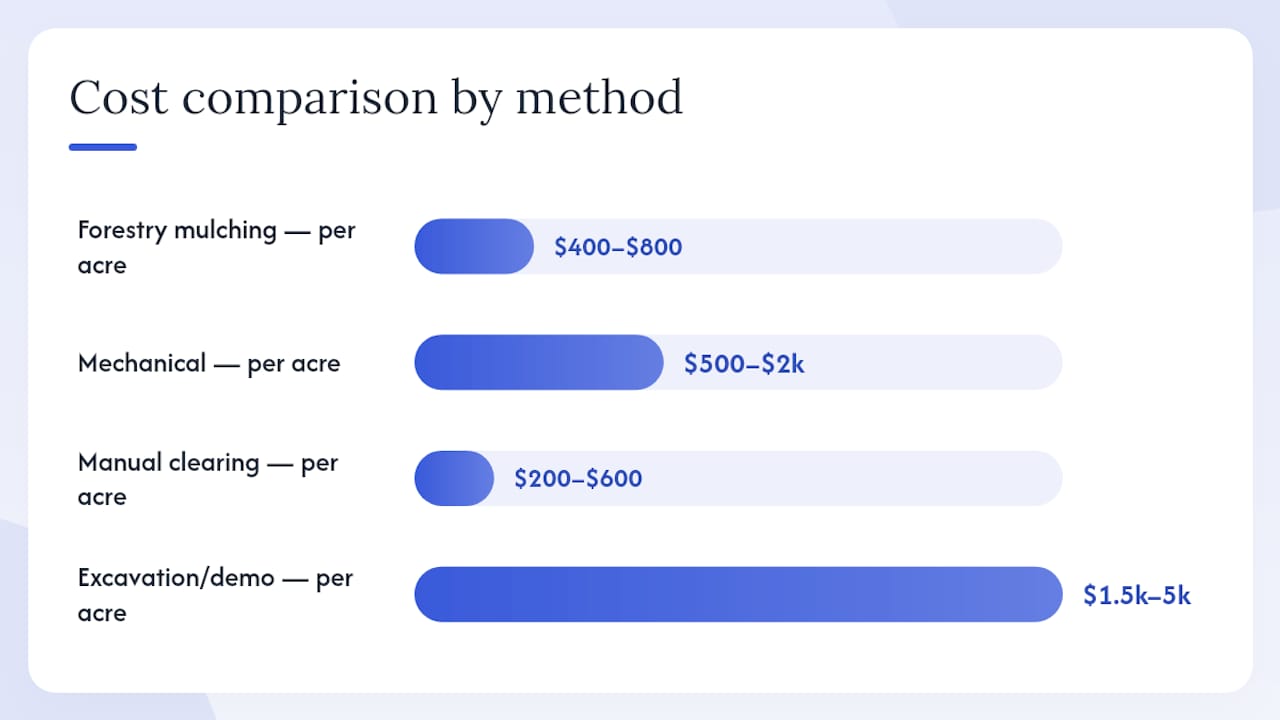
| Method | Typical per-acre range | Half-acre estimate | 10-acre estimate |
|---|---|---|---|
| Forestry mulching | $400–$800/acre | $200–$400 | $4,000 |
| Traditional mechanical clearing | $500–$2,000/acre | $400–$800 | $5,000–$20,000 |
| Manual clearing (light brush) | $200–$600/acre | $100–$300 | $2,000–$6,000 |
| Excavation/demolition | $1,500–$5,000/acre | $1,000–$3,000 | $10,500–$35,100 |
| Stump grinding (add-on) | $100–$400/stump | Varies by count | Varies by count |
Sample calculation: half-acre residential lot
A homeowner clearing a half-acre suburban lot with moderate brush and four large trees might see a quote structured like this:
- Mobilization: $200–$400
- Forestry mulching (0.5 acre): $200–$400
- Stump grinding (4 stumps): $400–$800
- Debris hauling (if any excess): $150–$300
- Permit (county-dependent): $50–$200
- Total: $1,000–$2,100
Sample calculation: 10-acre rural parcel
A developer clearing 10 acres of mixed pine and scrub for agricultural use with a feller-buncher and bulldozer:
- Mobilization: $800–$1,500
- Mechanical clearing (10 acres): $5,000–$20,000
- Stump grinding or root raking: $1,000–$3,000
- Debris hauling (multiple loads): $1,500–$4,000
- Grading and erosion control: $2,000–$6,000
- Permits: $200–$600
- Total: $10,500–$35,100
HomeAdvisor and MyGro’s 2025 pricing review confirm that most projects nationally fall within a typical per-acre range, with the upper end influenced by heavy timber, steep terrain, or complex debris disposal requirements.
What drives the price on your specific clearing quote?
Two quotes for the same acreage can differ by $10,000 or more. Here is what actually moves the number.
Vegetation type and density is the single biggest variable. Light brush and saplings clear in a fraction of the time that mature hardwoods or dense palmetto scrub require. Heavy timber can push per-acre costs two to three times higher than the same acreage in light brush.
Terrain and slope affect both equipment choice and safety. Steep grades require tracked equipment rather than wheeled machines, which costs more per hour. Rocky or wet ground slows productivity and raises fuel consumption.
Access and mobilization add a fixed cost regardless of lot size. A remote site that requires a long equipment haul or a narrow access road can add $500–$1,500 to any job before a single tree falls.
Debris disposal is where budgets often surprise property owners. Mulching in place eliminates this line item entirely. Hauling debris off site adds truck loads at $300–$600 each, and burning requires a permit and a weather window. For construction debris and contaminated soils, EPA cleanup guidance governs disposal requirements and can add significant cost if regulated materials are present.
Permits and compliance vary by county and project type. Wetland buffers, tree preservation ordinances, and air quality permits for burning each carry fees and processing time. Budget $50–$600 for typical residential permits; complex projects near waterways or protected habitat can run higher.
Seasonality matters more than most buyers realize. Labor and fuel costs have risen steadily through 2024–2025, and MyGro’s 2025 analysis notes that equipment price increases and labor inflation are pushing baseline costs upward. Scheduling clearing during a contractor’s slower season (typically late fall or early winter in Florida) can yield 10–15% savings on labor.
What equipment is used and how fast can crews clear your land?
Understanding the machines on a contractor’s equipment list tells you a lot about the timeline and price you should expect.
- Forestry mulcher (tracked): Handles trees up to 8–10 inches in diameter. In light to moderate brush, SkidPro benchmarks show up to 4 acres per day in optimal conditions. Heavy timber or steep terrain cuts that to 1–2 acres per day.
- Skid steer with mulching head: More maneuverable than a tracked mulcher; ideal for residential lots and tight spaces. Productivity runs 1–3 acres per day depending on vegetation.
- Feller-buncher: Cuts and stacks trees rapidly on large, open acreage. Pairs with a grapple skidder to move material to a landing for chipping or burning. Best on 5+ acre projects.
- Bulldozer (crawler dozer): Pushes stumps and grades simultaneously. Productive on large sites but causes significant soil compaction. Hourly rates typically run $100–$200/hour for machine and operator.
- Excavator: Handles stumps, buried debris, and demolition. Slower than a dozer for pure clearing but more precise. Necessary on sites with structures or buried obstructions.
- Stump grinder: A dedicated machine for grinding stumps below grade after trees are felled. Adds $100–$400 per stump depending on diameter. Large stumps (24+ inches) can take 30–60 minutes each.
Pro Tip: When getting bids, ask each contractor to specify the machine type, horsepower, and crew size they plan to use. A contractor quoting a skid steer for a 5-acre job with heavy timber will take three times as long as one bringing a tracked mulcher, and the timeline difference directly affects your permit windows and follow-on trade scheduling.
Advanced GPS guidance and telematics on newer equipment are reducing operator error and fuel waste on large projects. MyGro’s 2025 review notes that high-tech approaches reduce per-acre costs at scale, but the savings only materialize when mobilization costs are spread across enough acreage.
What permits and environmental rules apply to your clearing project?
Permits are not optional, and the triggers are more common than most property owners expect.
Wetlands and waterways are the most frequent compliance issue. Any clearing within 50–300 feet of a wetland, stream, or floodplain may require a Section 404 permit from the U.S. Army Corps of Engineers and a state-level environmental resource permit. In Florida, the St. Johns River Water Management District and Southwest Florida Water Management District both issue permits for work near wetlands.
Protected species trigger consultation requirements under the Endangered Species Act. In Central Florida, gopher tortoise burrows, scrub-jay habitat, and certain plant communities require surveys before clearing begins. A certified arborist or environmental consultant can identify these triggers early and save you weeks of delay.
Controlled burning requires a burn permit from the Florida Forest Service in most counties. Air quality rules, wind conditions, and proximity to structures all affect permit approval. Many suburban and wildland-urban interface areas in Central Florida have effectively banned open burning.
Tree preservation ordinances in Orange, Seminole, and Osceola counties protect certain species and diameter classes. Removing a protected tree without a permit can result in fines and replacement requirements. Check local Central Florida permit requirements before any work begins.
“Clearing near waterways without a permit is one of the most common and costly mistakes property owners make. Restoration orders can cost more than the original clearing project.” This is a consistent finding across county enforcement records in Florida.
Erosion control is required on most permitted projects. Silt fences, sediment basins, and staged clearing (working in phases rather than clearing everything at once) are standard best practices. Mulching in place after mechanical clearing provides immediate soil protection and reduces the need for additional erosion control measures.
For contaminated sites, consult EPA cleanup guidance before any ground disturbance. Disturbing contaminated soil without a plan can trigger federal liability.
How do you choose a land clearing contractor you can trust?
The cheapest bid is rarely the right bid. Here is what to verify before signing anything.
Credentials to require:
- General contractor license (state-issued; verify on the Florida DBPR license lookup)
- Commercial General Liability insurance ($1 million minimum per occurrence)
- Workers’ compensation insurance (required for any crew of more than one in Florida)
- Certified arborist credential (ISA-certified) for projects involving tree assessment or selective removal
- Proof of equipment ownership or rental agreements (not just a verbal claim)
Red flags to walk away from:
- No written estimate or a quote given verbally with no line items
- Vague debris disposal plan (“we’ll take care of it” without specifying where)
- Inability to produce a current certificate of insurance on request
- No permit discussion on a project that clearly triggers permit requirements
- Pressure to pay a large deposit before any work begins
Questions to ask every bidder:
- What specific equipment will you use, and what is the crew size?
- How do you handle debris, and where does it go?
- Will you pull permits, or is that my responsibility?
- What erosion control measures are included?
- What is your timeline, and what could extend it?
For practical tips on comparing bids and asking the right questions, expert contractor guidance covers the questions that separate good contractors from risky ones.
| Evaluation dimension | What to look for | Red flag |
|---|---|---|
| Licensing | State contractor license, verified | “We’re working on it” |
| Insurance | CGL + workers’ comp certificates | Verbal assurance only |
| Credentials | ISA-certified arborist for tree work | No credentials offered |
| Debris plan | Named disposal site or mulch-in-place spec | “We’ll handle it” |
| Permit support | Contractor pulls or assists with permits | Ignores permit question |
| Written estimate | Itemized line items | Verbal quote only |
How long does a land clearing project take from start to finish?
Timeline depends heavily on lot size, permit requirements, and method. Here is a realistic phase breakdown.
Phase 1: Assessment and permits (1–6 weeks)
A site visit, survey, and permit applications come first. Simple residential projects in counties with online permit portals can move in 1–2 weeks. Projects near wetlands or requiring environmental surveys can take 4–6 weeks or longer. This phase costs little directly but controls your entire schedule.
Phase 2: Mobilization and clearing (1–5 days for most residential; 1–3 weeks for large acreage)
Equipment arrives, access roads are established if needed, and clearing begins. A half-acre residential lot with forestry mulching typically clears in a single day. Ten acres of mixed timber with a feller-buncher and dozer takes 3–7 days depending on conditions.
Phase 3: Stump grinding and debris removal (1–3 days)
Stumps are ground after clearing. Debris hauling adds time proportional to volume. This phase often costs more than buyers expect because truck loads add up fast.
Phase 4: Grading and erosion control (1–3 days)
Final grading, silt fence installation, and seeding or mulching for erosion control. Required on most permitted projects and often a condition of the permit itself.
Phase 5: Final inspection (1–5 days)
County or state inspectors sign off on erosion control and any permit conditions. Schedule this before starting follow-on construction to avoid holds.
For a detailed walkthrough of each phase, the land clearing process guide covers what to expect at each step.
Seasonality note: In Central Florida, the wet season (June–September) slows ground work significantly. Saturated soils increase equipment rutting and erosion risk. Scheduling clearing for October through March avoids the worst of it and often yields better contractor availability.
How can you reduce land clearing costs without cutting corners?
Several strategies consistently lower the final bill without compromising quality or compliance.
- Phase the work. Clear only what you need now. A phased approach spreads cost over time and avoids clearing land that sits idle for months.
- Mulch in place. Choosing forestry mulching over traditional clearing eliminates hauling costs entirely. On a half-acre lot, that can save $300–$800 in truck fees alone.
- Sell merchantable timber. If your site has mature pine or hardwood, a timber buyer may pay you for the logs before clearing begins. This is most practical on larger rural parcels with commercial-grade timber.
- Combine clearing with grading. Scheduling both with the same contractor in one mobilization saves the second mobilization fee, typically $500–$1,500.
- Choose off-season timing. Contractor availability is higher in fall and winter in Florida, and some will negotiate on price during slower periods.
- Consider selective clearing. Rather than clearing everything, identify which trees and vegetation to keep. Selective clearing preserves shade, reduces erosion, and often costs less than full clearing.
For debris from smaller residential clearing jobs, practical disposal options including chipping, municipal pickup, and hauling can help homeowners manage smaller volumes without a full haul-away contract.
Questions to ask your contractor to find savings:
- Can we mulch in place instead of hauling?
- Is there any timber on this site worth selling?
- Can you combine clearing and grading in one mobilization?
- What is the price difference between full clearing and selective clearing?
- Is there a discount for scheduling during your slower season?
What does the 2025 USDA Roadless Rule change mean for your project?
If your property borders or is adjacent to National Forest land, a significant federal policy shift in 2025 is worth understanding.
Secretary Rollins rescinded the 2001 Roadless Rule on June 23, 2025, removing prohibitions on road construction and timber harvest that had applied to nearly 58.5 million acres of National Forest System land, including roughly 28 million acres at high wildfire risk. The rescission changes what management activities are theoretically permissible in formerly roadless areas.
In August 2025, USDA opened the formal rulemaking phase, with the Forest Service publishing a Federal Register notice to begin the NEPA scoping and public comment process. This means the policy is still moving through formal channels.
What this means practically:
The rescission does not automatically authorize any ground-disturbing project. Federal Register NEPA documentation confirms that site-level environmental review and EIS processes remain required even when higher-level rules are rescinded. Private projects adjacent to federal land may eventually see new access or management options, but each project still needs its own NEPA analysis, Forest Service approval, and site-level permits.
If your project is near National Forest land in Florida (Ocala National Forest, Apalachicola National Forest, or Osceola National Forest), contact the relevant Forest Service district office directly. Do not assume the rescission changes your permit requirements without confirming with the local ranger district.
Safety considerations for each land clearing method
Land clearing carries real physical risk. The method you choose determines which hazards dominate.
Manual clearing exposes crews to chainsaw injuries, falling limbs, and snake or wildlife encounters in dense vegetation. OSHA’s logging standards (29 CFR 1910.266) apply to commercial operations. Proper PPE includes chainsaw chaps, hard hats with face shields, and cut-resistant gloves. Never work alone in dense brush.
Mechanical clearing introduces rollover risk on slopes, struck-by hazards from flying debris, and overhead power line contact. Operators need OSHA-compliant training and equipment with ROPS (rollover protection structures). Establish a clear exclusion zone around operating equipment. No bystanders within 300 feet of a feller-buncher in operation.
Forestry mulching generates high-velocity debris from the mulching head. The discharge zone can throw material 50–100 feet. Operators must keep all personnel clear of the discharge arc. Inspect the mulching head daily for worn or missing teeth, which increase debris scatter and reduce cutting efficiency.
Controlled burning requires a certified burn manager in most states, a written burn plan, and a firebreak established before ignition. Wind shifts are the primary cause of escaped burns. Never burn without a water source and suppression equipment on site. In Florida, the Florida Forest Service requires a burn authorization call before any open burn.
Chemical brush control requires applicators to hold a Florida Department of Agriculture and Consumer Services (FDACS) pesticide license for commercial application. Herbicide drift can damage adjacent vegetation and waterways. Always read and follow label requirements, which are federal law.
Excavation and demolition carry the highest risk of underground utility strikes. Call 811 (Sunshine State One Call in Florida) before any digging. Trench collapses are a leading cause of construction fatalities; any excavation deeper than 5 feet requires OSHA-compliant shoring or sloping.
Real-world clearing outcomes: what different methods look like in practice
Three scenarios illustrate how method choice plays out on actual projects.
Scenario 1: Half-acre residential lot, Central Florida
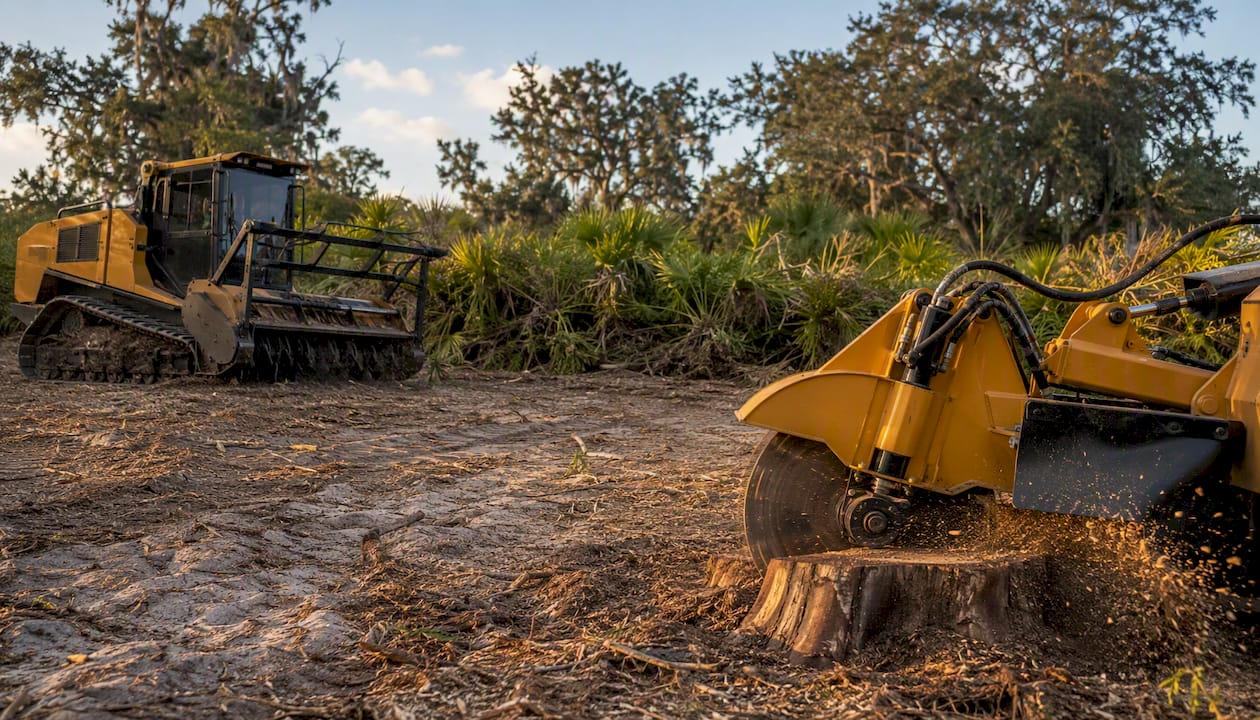
A homeowner in Orange County needed to clear a half-acre lot with palmetto scrub, several sand pines, and scattered oaks before building a home. The contractor used a tracked forestry mulcher for the scrub and smaller trees, then a stump grinder on the four larger oaks. Total clearing time: one day. The mulch layer stayed in place, satisfying the county’s erosion control requirement without additional silt fencing. Total cost came in at $1,400, well within the national average range.
Scenario 2: 15-acre rural parcel, North Florida
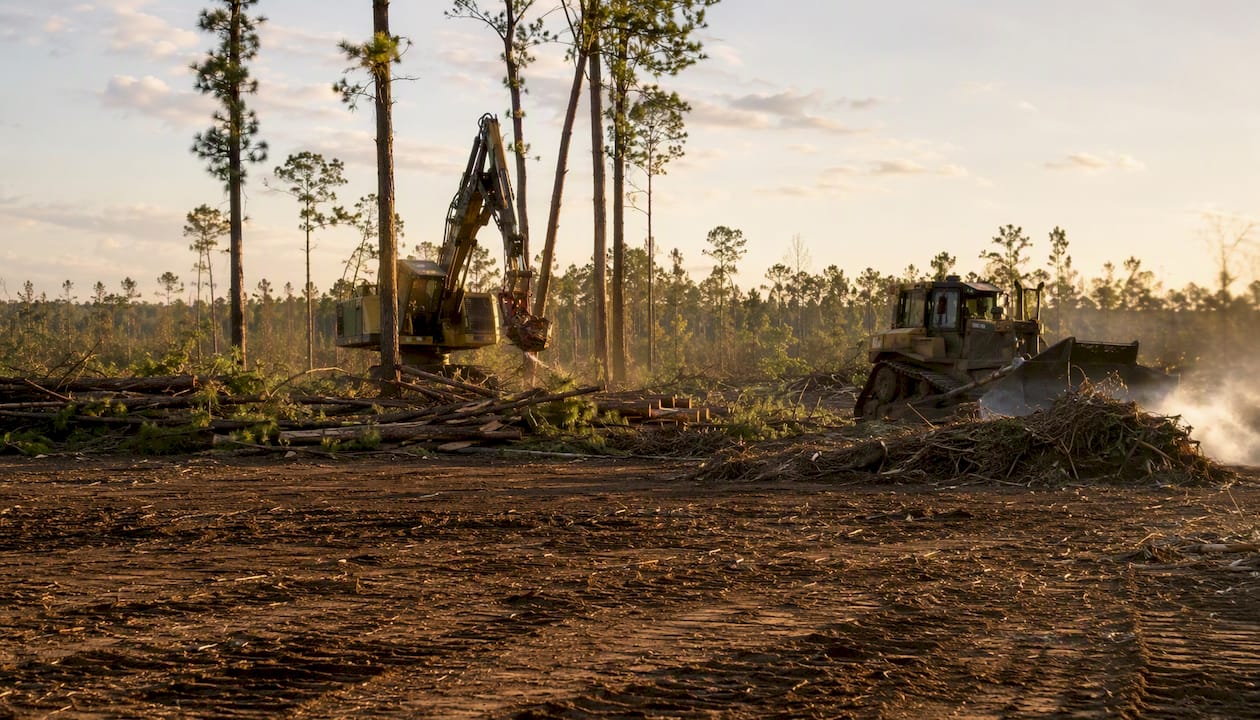
A developer converting pine flatwoods to agricultural use brought in a feller-buncher and a dozer. The timber was merchantable enough that a local mill paid for the pine logs, offsetting roughly $3,000 of the clearing cost. Remaining slash was piled and burned under a Florida Forest Service permit. Grading followed clearing in the same mobilization. Total project: 8 days, approximately $18,000 net after timber credit.
Scenario 3: Wildfire mitigation, adjacent to Ocala National Forest
A property owner with 5 acres bordering the Ocala National Forest needed defensible space cleared to reduce wildfire risk. Selective clearing and forestry mulching preserved the larger oaks while removing the understory ladder fuels. The mulch layer reduced bare soil exposure. Because the project was adjacent to federal land, the owner confirmed with the Lake George Ranger District that no federal permits were required for work entirely on private land. Total cost: approximately $4,500.
What technology changes are shaping land clearing in 2026?
The equipment on job sites in 2025 looks meaningfully different from what was standard five years ago.
GPS-guided dozers and graders are now common on mid-size and large projects. The operator sets a digital grade plan, and the machine’s blade adjusts automatically to hit the target elevation. This reduces over-grading, cuts fuel use, and speeds up the grading phase that follows clearing.
Telematics systems on mulchers and feller-bunchers give fleet managers real-time data on fuel consumption, idle time, and cutting head performance. Contractors using telematics can identify inefficiencies mid-project and adjust crew scheduling, which matters on large jobs where a day of downtime costs $1,500–$3,000 in idle equipment.
Remote-controlled and semi-autonomous mulching machines are entering the market for hazardous terrain applications. These are not yet standard on residential jobs, but they are appearing on steep slope wildfire mitigation projects where operator safety is a concern.
Drone surveys before clearing have become routine on projects over 5 acres. A drone survey produces a detailed vegetation map and topographic model in 2–4 hours, letting contractors price the job more accurately and identify permit triggers (wetland boundaries, protected species habitat) before mobilization. The survey cost ($300–$800) typically pays for itself in avoided surprises.
MyGro’s 2025 analysis confirms that advanced automation and GPS guidance can materially reduce labor and hauling costs on large projects, but the savings favor large acreage where fixed mobilization costs are spread over more acres.
A perspective on what actually matters when clearing land in Central Florida
Most of the debate in land clearing centers on method choice, but the bigger variable is almost always the contractor’s judgment on the day of the job.
Mcculloughtreeservice has worked on residential lots, commercial parcels, and municipal sites across Central Florida long enough to know that the method listed on a bid rarely tells the whole story. Sandy soils in Orange and Seminole counties drain fast but compact easily under heavy equipment, which means a tracked mulcher often causes less long-term damage than a dozer even when the dozer would clear faster. Palmetto root systems are aggressive re-sprouters; chemical follow-up after mechanical clearing is often necessary to prevent regrowth within a season.
The permit landscape in Central Florida has tightened over the past few years. Orange County’s tree preservation ordinance, Seminole County’s environmental land management rules, and the St. Johns River Water Management District’s wetland permitting requirements all add steps that buyers from other states do not expect. A certified arborist on the team is not a luxury on most Central Florida projects; it is the difference between a permit approval and a stop-work order.
The one piece of advice that applies to every project: get the permit question answered before you sign a clearing contract. Discovering a wetland buffer or a gopher tortoise survey requirement after equipment is on site is an expensive problem that a 30-minute pre-application call to the county could have prevented.
Mcculloughtreeservice handles land clearing from first assessment to final grade
Clearing land in Central Florida is not a one-size-fits-all job, and Mccullough Tree Service brings certified arborist oversight, licensed equipment operators, and permit coordination to every project. Whether you need a half-acre residential lot cleared before construction, stump grinding after storm damage, or a larger commercial parcel prepped for development, the team handles the full scope: vegetation removal, tree removal for larger specimens, stump grinding, and coordination with county permitting offices.
The process starts with a site visit and a no-obligation quote. Have your lot size, a few photos of the vegetation, and any access notes ready when you call. Mcculloughtreeservice will identify permit requirements, recommend the right method for your site conditions, and give you an itemized estimate you can compare against other bids. Request your land clearing site assessment and get a clear picture of what your project will actually cost.
Sources
These resources let you verify costs, check permit requirements, and track federal policy changes directly from primary sources.
- National Environmental Policy Act — Federal Register
- How Much Does It Cost to Clear Land? 2025 Data — HomeAdvisor
- How Much Does It Cost to Clear Land? 2025 Data — Angi
- How Much Does Land Clearing Cost? A 2025 Pricing Review — MyGro
- 2025 Land Clearing Guide: Forestry Mulching vs. Traditional Methods — ACEPro
- How Much Can a Skid Steer Mulcher Clear in a Day? — SkidPro
- Cleanups — EPA
Recommended
- Effective Land Clearing Methods for All Budgets
- Efficient land clearing methods for Florida property owners
- Expert Tips on the Land Clearing Process
- Land Clearing in Central Florida: Methods, Costs & Tips