By: Shelby McCullough| Published: August 4, 2026
Award your next municipal tree-care contract to a vendor who can show ISA Certified Arborist supervision, a written tree management plan, unit pricing with emergency call-out rates, and current proof of insurance. That single requirement filters out most unqualified bidders before you open a single envelope. To get your solicitation right from the start, build these items into the RFP or IFB:
- Require an ISA Certified Arborist or Municipal Specialist® on staff or supervising all field work
- Write a routine pruning cycle into the scope with a six-year cycle: prune approximately one-sixth of the tree inventory annually
- Require unit pricing per tree and per hour, plus pre-negotiated emergency call-out rates
- Mandate ANSI Z133 safety compliance and ANSI A300 pruning standards, as used in North Miami’s IFB
- Require certificates of insurance naming the municipality as additional insured (CGL, auto, workers’ comp)
- Evaluate bids on responsiveness, certifications, municipal references, and pricing — in that order
Mcculloughtreeservice serves Central Florida municipalities and can supply ISA-credentialed supervision, storm cleanup, and management-plan documentation as a local reference point.
Table of Contents
- How do you keep municipal tree-care equipment performing safely?
- What safety rules govern landscaping tools on public property?
- What new technologies are shaping public grounds care in 2026?
- How do sustainability goals affect your equipment choices?
- What tools does a qualified municipal tree-care contractor need?
- Key Takeaways
- Why certified supervision and a management plan pay for themselves
- Mcculloughtreeservice supports Central Florida municipal procurement
- Authoritative resources to attach to your municipal solicitation
How do you keep municipal tree-care equipment performing safely?
Maintenance protocols for public grounds equipment follow a straightforward logic: inspect before every shift, service on a fixed schedule, and document everything. Aerial lift platforms need daily pre-operation checks per OSHA 1926.453, including boom function, hydraulic fluid, and outrigger stability. Chippers and stump grinders require blade and tooth inspections before each use; a dull cutting tooth does not just slow production, it increases kickback risk.
Scheduled service intervals matter more in Florida’s climate than in cooler states. Heat and humidity accelerate belt wear, hydraulic seal degradation, and corrosion on cutting edges. A contractor operating in Orange or Osceola County should log every service event, keep replacement parts on-site for high-wear components, and retire equipment that fails inspection rather than patch it into another shift.
What safety rules govern landscaping tools on public property?
ANSI Z133 is the controlling safety standard for arboricultural operations in the United States, covering everything from personal protective equipment to aerial rescue procedures. OSHA 29 CFR 1910 and 1926 overlay it for general industry and construction contexts. Any contractor working on public rights-of-way must also comply with the Manual on Uniform Traffic Control Devices (MUTCD) for work-zone setup.
For procurement officers, the practical implication is simple: your RFP should require bidders to submit a written safety program that references ANSI Z133 and OSHA standards, and to confirm their crews hold current first-aid and CPR certifications. A contractor who cannot produce that document at bid time is a liability risk, not just a compliance gap.
What new technologies are shaping public grounds care in 2026?
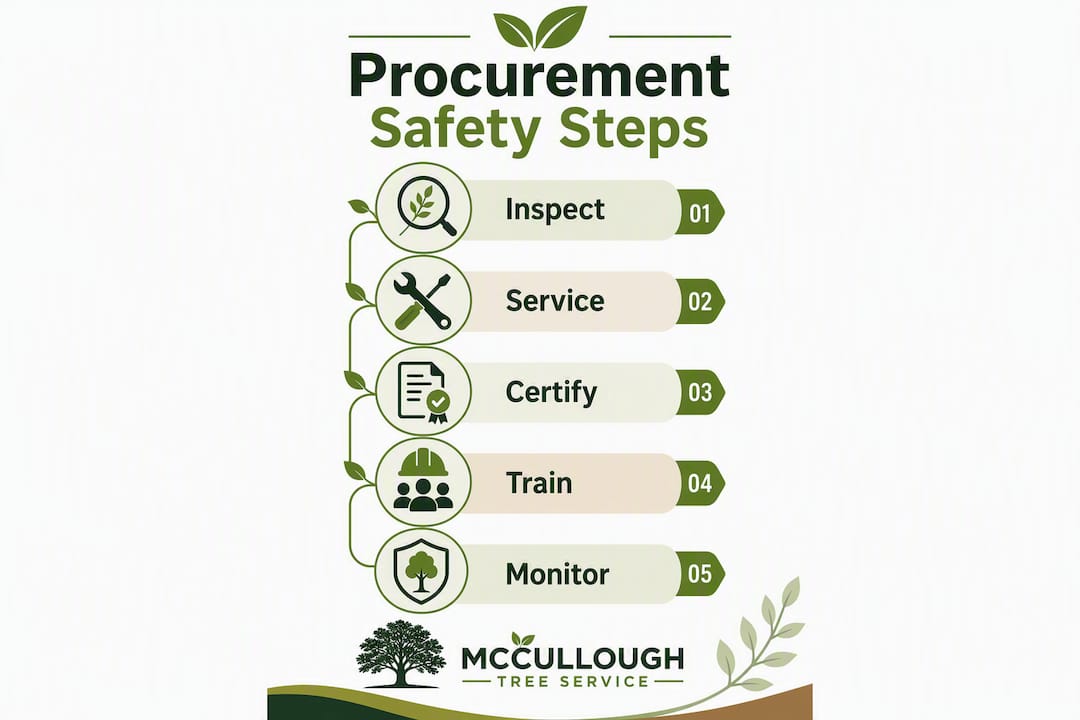
Battery-electric chainsaws, pole saws, and chippers have reached commercial-grade performance levels that make them viable for municipal contracts. The operational advantage for cities is noise reduction in residential parks and zero direct emissions near pedestrian areas. Several Florida municipalities have begun specifying low-emission or electric equipment as a preference in RFP language, though not yet as a hard requirement statewide.
Drone-assisted tree inspection is the other shift worth watching. Crews using drones for canopy assessment can cover a park inventory faster and flag structural defects that ground-level inspection misses. The data feeds directly into i-Tree Eco analyses, which quantify replacement value and ecosystem services to support budget requests.
How do sustainability goals affect your equipment choices?
Specifying eco-friendly public landscaping equipment in 2025 is less about brand preference and more about performance criteria written into the contract. Require bidders to state fuel type, emission tier, and noise output for major equipment. That language lets you score bids on environmental criteria without picking a manufacturer.
Mulching on-site rather than hauling green waste off-site cuts disposal costs and returns organic matter to park soils. A contractor with a commercial-grade chipper can convert removed limbs into mulch at the work site, which aligns with Florida’s green waste diversion goals and reduces the municipality’s tipping fees.
What tools does a qualified municipal tree-care contractor need?
The best municipal tools for landscaping contracts are not defined by brand but by capability class. A contractor bidding on a full-service municipal agreement should arrive with:
- Aerial lift platforms rated for the canopy heights in your inventory (typically 40–75 feet for urban street trees)
- Commercial chippers capable of processing limbs up to 12 inches in diameter
- Stump grinders with sufficient cutting depth for root-flare removal, not just surface grinding
- Bucket trucks and cranes for removals near structures or over roadways
- Handheld and pole-mounted tools (chainsaws, pruning saws, loppers) compliant with ANSI A300 standards
Durability and scale matter more than novelty. A contractor who owns their equipment outright, rather than renting per job, can mobilize faster after a storm and maintain consistent service levels across a multi-year contract.
Key Takeaways
Awarding a municipal tree-care contract in Central Florida requires ISA Certified Arborist supervision, a six-year pruning plan, unit pricing, emergency call-out terms, and full insurance documentation as non-negotiable baseline requirements.
| Point | Details |
|---|---|
| ISA credential requirement | Require an ISA Certified Arborist or Municipal Specialist® to supervise all field work; this is the recognized competence benchmark. |
| Six-year pruning cycle | Contract for 1/6 of the inventory pruned annually; Edmond’s model shows costs decline as backlog clears. |
| Emergency call-out clause | Pre-negotiate rates and priority response to avoid costly post-storm emergency procurement, per Lake Wales contract guidance. |
| Insurance and standards | Require CGL, auto, and workers’ comp certificates naming the city as additional insured; mandate ANSI Z133 and ANSI A300 compliance. |
| Mcculloughtreeservice | Provides ISA-credentialed supervision, storm cleanup, stump grinding, and management-plan support for Central Florida municipal contracts. |
Why certified supervision and a management plan pay for themselves
The conventional wisdom in municipal procurement is to award on price. That logic fails with tree care faster than almost any other public works category. A low bid without ISA supervision produces improper pruning cuts that shorten tree life, raise hazard liability, and generate removal costs within a decade. The certified-arborist requirement is not a credential formality — it is the mechanism that converts a tree from a recurring expense into a long-term public asset.
A routine maintenance plan does something price alone cannot: it makes costs predictable. Community forestry guidance consistently shows that reactive-only programs cost more over time because deferred pruning accelerates structural failure and emergency removals. A written plan with measurable metrics — inspection frequency, hazard mitigation progress, canopy health scores — also gives you a defensible record if a tree failure leads to a liability claim.
Three contract language examples worth adopting:
- “Contractor shall employ or subcontract an ISA Certified Arborist Municipal Specialist® to supervise all pruning and removal operations.”
- “Routine pruning shall follow a six-year cycle; contractor shall prune approximately one-sixth of the designated inventory annually, prioritizing Priority 1 hazard trees in Year 1.”
- “Contractor shall respond to emergency call-outs within four hours of notification at pre-negotiated unit rates; the municipality shall receive priority scheduling during declared storm events.”
Pro Tip: Add the emergency call-out clause with a defined response window and pre-negotiated rates before hurricane season, not after. Post-storm procurement under pressure almost always costs more and delivers less.
Central Florida’s species mix, including live oaks, laurel oaks, and sabal palms, and its June–November hurricane season create conditions that generic contract templates from other states do not address. Species-specific pruning timing and storm-prep protocols belong in your scope of work, not left to contractor discretion. Urban tree care practices for Central Florida differ meaningfully from national templates, and your RFP language should reflect that.
Mcculloughtreeservice supports Central Florida municipal procurement
Mccullough Tree Service delivers exactly what a well-written Central Florida municipal RFP requires: ISA-certified arborist supervision, documented six-year maintenance scheduling that prunes one-sixth of the inventory each year, tree inventory support, and pre-negotiated emergency response for storm cleanup and hazard removal across parks and streetscapes.
Services that map directly to standard RFP line items include tree trimming and pruning under ISA supervision, tree removal for hazard and right-of-way work, stump grinding, land clearing, planting, and storm cleanup. Mcculloughtreeservice can also provide sample scope language and management-plan templates to attach as appendices to your solicitation.
To request a municipal proposal or discuss attaching sample contract language to your next RFP, contact Mcculloughtreeservice directly at mcculloughtreeservice.com.
Authoritative resources to attach to your municipal solicitation
These documents give your RFP legal and technical grounding and demonstrate due diligence to elected officials and auditors.
- Village of North Palm Beach RFP — Tree Trimming 2024: A working model for unit pricing structure, evaluation criteria, and scope language; adapt directly for your solicitation.
- City of North Miami IFB No. 47-23-24: Demonstrates ISA Certified Arborist oversight requirements and ANSI Z133/A300 compliance clauses in a Florida municipal context.
- Edmond, OK Park Tree Inventory and Maintenance Strategy: Shows a six-year pruning cycle, year-by-year budget projections, and i-Tree Eco valuation methodology; use to justify multi-year budget requests.
- ISA Certified Arborist Municipal Specialist® Application Guide: Defines the credential requirements; attach as an exhibit when specifying Municipal Specialist supervision.
- Why Hire a Certified Arborist? (ISA/APWA): Provides the economic and liability rationale for certification requirements; useful for budget justification narratives.
- Lake Wales, FL Tree Trimming Service Agreement: A Florida-specific executed contract with emergency services provisions and insurance language; use as a template for indemnification and call-out clauses.
- NYSDEC — Building a Successful Municipal Forestry Program: Covers inventory, management planning, and standard-of-care metrics; useful for framing the long-term program rationale in a budget memo.
Attach the North Miami IFB and Lake Wales agreement as contract-language appendices. Include the Edmond strategy as a budgeting exhibit. Reference the ISA/APWA document in the evaluation criteria narrative to justify the certification requirement to your procurement office.
Recommended
- Complete Land Clearing Guide for Central Florida Homes
- Site Preparation Guide for Central Florida Property Owners
- Central Florida Municipal Tree Maintenance Guide 2026
- Land clearing checklist 2026: Central Florida guide