By: Shelby McCullough| Published: March 24, 2026
Managing municipal trees in Central Florida demands more than seasonal pruning and emergency response. With diverse species, intense summer heat, hurricane threats, and complex urban infrastructure, administrators need a comprehensive, evidence-backed checklist to ensure tree health, safety, and regulatory compliance. This guide outlines critical criteria and best practices for effective urban tree maintenance, from initial planting through decades of ongoing care. By following structured protocols rooted in industry standards and local conditions, you can protect your community’s green infrastructure investment while meeting legal obligations and maximizing environmental benefits.
Table of Contents
- Key takeaways
- Establishing effective maintenance criteria for municipal trees
- Pruning and ongoing tree health management
- Protecting trees during urban development and legal compliance
- Selecting the right species and fostering urban forest sustainability
- Professional tree care services for municipal needs in Central Florida
- FAQ
Key Takeaways
| Point | Details |
|---|---|
| Scheduled watering plan | Newly planted trees receive 10 gallons daily for the first 18 months to establish roots, then taper to support drought tolerance and storm resistance. |
| Mulching guidelines | Apply 2 to 4 inch organic mulch in a 3 foot diameter ring around the trunk, keeping material away from the trunk flare to prevent rot and pest damage. |
| Pruning cycles | Follow a structured pruning timeline that removes damaged branches at planting to limit foliage loss to under 25 percent, at about two years shorten low or vigorous branches removing up to 40 percent of foliage, and every two to six years thereafter space scaffold branches and maintain live crown ratios above 60 percent. |
| Baseline documentation | Document planting date, species, and initial trunk diameter in a digital asset management system to guide scheduling of watering reductions, stake removal, and first pruning interventions tailored to each tree. |
| Compliance and standards | Maintain compliance with local permit requirements and industry standards such as ANSI A300 and ISA best practices for training inspections and overall urban tree care. |
Establishing effective maintenance criteria for municipal trees
Successful municipal tree programs begin with consistent foundational care. Municipal tree maintenance in Central Florida emphasizes watering newly planted trees with 10 gallons daily initially, reducing frequency over 18 months as root systems establish. This gradual transition prevents transplant shock while encouraging deep root growth that improves drought tolerance and storm resistance.
Mulching plays an equally critical role in moisture retention and temperature regulation. Apply organic mulch in 2-4 inch depths within rings at least 3 feet in diameter, ensuring material never contacts the trunk flare. Volcano mulching, where material piles against the trunk, invites rot and pest damage. Proper mulch rings suppress weeds, moderate soil temperature swings, and gradually improve soil structure as organic matter decomposes.
Fertilization timing matters as much as formulation. Wait at least 3 months after planting before applying slow-release fertilizer at rates of 1/4 to 1/2 pound per inch of trunk diameter. Premature fertilization pushes top growth before roots can support it, weakening structural development. Choose formulations with balanced ratios suited to soil test results rather than generic products.
Staking requires careful judgment. Only stake trees when necessary for stability, using flexible materials that allow some trunk movement. This natural motion stimulates trunk taper and root expansion. Remove all stakes between 6 and 12 months after planting. Stakes left longer create weak trunk sections and girdling damage that compromises long-term structural integrity.
Initial pruning should wait until after the first growing season except for removing dead, damaged, or crossing branches. Early structural pruning establishes a strong central leader and well-spaced scaffold branches that reduce future maintenance needs. Adopting urban tree care best practices from the start creates healthier, safer trees that require less intensive intervention over their lifespan.
Pro Tip: Document each tree’s planting date, species, and initial trunk diameter in a digital asset management system. This baseline data enables precise scheduling of watering reductions, stake removal, and first pruning interventions tailored to individual tree development rather than relying on generic timelines.
Pruning and ongoing tree health management
Structured pruning cycles form the backbone of municipal tree safety and aesthetics. Pruning shade trees follows a structured timeline: at planting remove damaged branches limiting foliage loss to under 25%, at 2 years shorten low or vigorous branches removing up to 40% of foliage, then every 2 to 6 years thereafter shorten competing leaders, space scaffold branches, and maintain live crown ratios above 60%.
Foliage removal limits prevent physiological stress that weakens trees and invites disease. Never remove more than 25 to 40 percent of a tree’s foliage in a single pruning session. Excessive removal forces trees to deplete stored energy reserves to regenerate leaves, slowing growth and reducing stress tolerance. This principle applies equally to storm cleanup, where the temptation to over-prune damaged trees can cause more harm than the original storm damage.
Maintaining live crown ratio above 60 percent ensures adequate photosynthetic capacity for root growth and defense compound production. Crown ratio represents the percentage of total tree height occupied by live foliage. Trees with ratios below 60 percent show declining vigor, reduced growth rates, and increased susceptibility to pests and pathogens.
Branch diameter limits protect structural integrity. Avoid cutting branches larger than half the trunk diameter at the point of attachment. Large cuts create wounds that trees struggle to compartmentalize, opening pathways for decay organisms. When large branch removal becomes necessary, consult certified arborists to assess whether the tree remains viable or requires replacement.
Understanding the difference between trimming versus pruning helps municipalities allocate resources appropriately. Trimming addresses aesthetic shaping and clearance maintenance, while pruning focuses on structural development and health management requiring greater expertise and precision.
Pro Tip: Schedule major pruning during late winter dormancy for most species, avoiding active growth periods when energy reserves are lowest. This timing minimizes stress, reduces sap flow from cuts, and allows trees to compartmentalize wounds before spring growth begins.
Recommended pruning timeline for municipal shade trees
| Tree Age | Pruning Objective | Foliage Removal Limit | Key Actions |
|---|---|---|---|
| At planting | Remove damage, establish structure | <25% | Remove broken, diseased, or crossing branches; maintain central leader |
| 2 years | Shape crown, improve clearance | <40% | Shorten low or overly vigorous branches; space scaffold limbs |
| 4-10 years | Maintain structure, manage size | <40% | Shorten competing leaders; ensure adequate scaffold spacing |
| 10-25 years | Preserve health, ensure safety | <25% | Remove deadwood; maintain crown ratio >60%; no cuts >1/2 trunk diameter |
| 25+ years | Extend lifespan, reduce hazards | <25% | Crown cleaning; weight reduction on extended limbs; hazard assessment |
Protecting trees during urban development and legal compliance
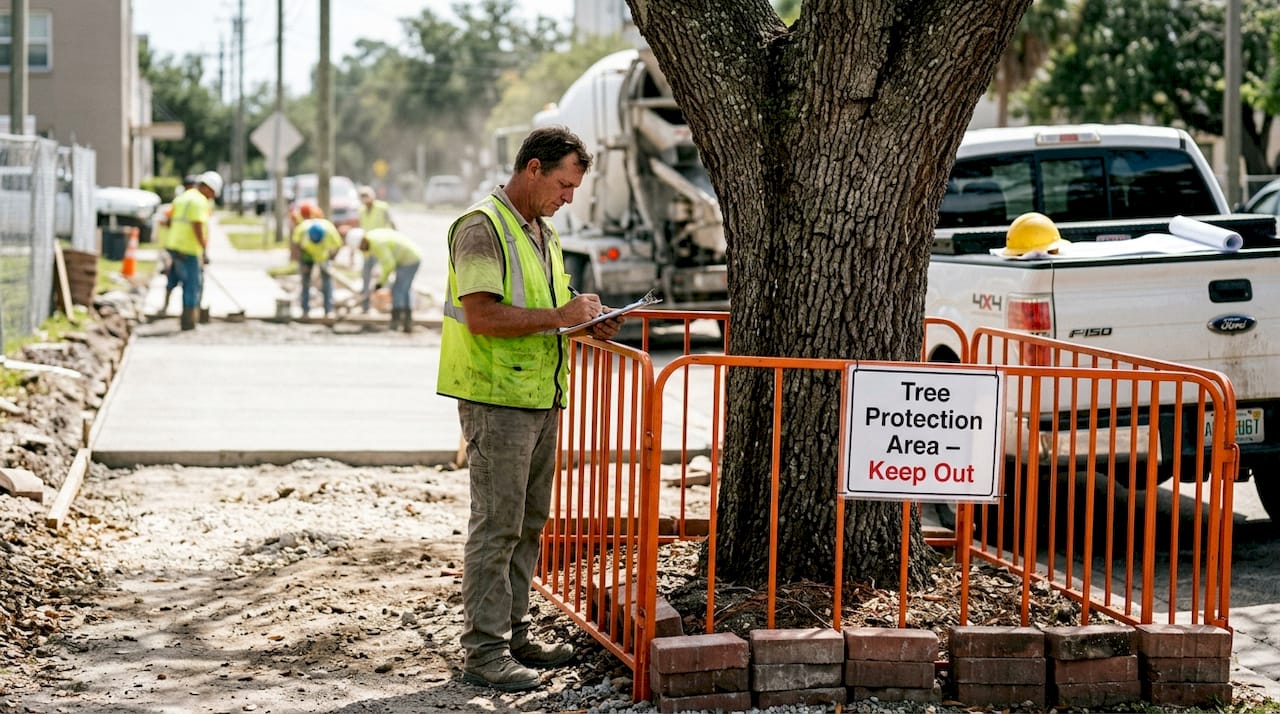
Construction activities pose severe threats to established trees through root damage, soil compaction, and grade changes. Tree protection during construction requires barriers at least 36 inches high around tree protection zones, with strict prohibitions on storage or grading within these areas. Protection zones typically extend to the drip line or beyond based on species and site conditions.
ANSI A300 standards and ISA Best Management Practices provide nationally recognized protocols for tree care operations. Municipalities should require contractors and staff to follow these standards, ensuring consistent quality and reducing liability exposure. Training programs that emphasize these frameworks improve outcomes while demonstrating due diligence in asset management.
Permit requirements vary across Central Florida jurisdictions but generally mandate approval before removing or significantly disturbing protected trees. Orange County’s urban forestry program and updated arbor ordinance effective in 2024 illustrate evolving regulatory frameworks that recognize urban forest benefits including stormwater management, air quality improvement, and property value enhancement.
Specimen tree protections often exceed those for smaller municipally managed trees. Specimen designations typically consider trunk diameter, species rarity, historical significance, or exceptional form. Administrators must differentiate protection requirements and apply appropriate permit procedures based on tree classification.
Certified arborists play essential roles in defining tree protection zones, conducting pre-construction assessments, and monitoring compliance during development activities. Their expertise in root architecture, species tolerance, and stress physiology ensures protection measures match actual biological needs rather than generic distances. Engaging qualified arborists early in project planning prevents conflicts and preserves valuable trees that might otherwise be lost to avoidable damage.
Navigating tree permit requirements requires understanding both municipal ordinances and state regulations that may apply to specific situations or funding sources.
Construction protection measures comparison
| Protection Method | Application | Effectiveness | Limitations |
|---|---|---|---|
| Physical barriers (36+ inches) | All construction near trees | High for preventing direct damage | Does not prevent soil compaction outside barrier |
| No-storage/grading zones | Critical root zones | Very high for root preservation | Requires enforcement and monitoring |
| Mulch/chip layers (6-12 inches) | Temporary access routes | Moderate for reducing compaction | Ineffective against heavy equipment |
| Root pruning (pre-construction) | Unavoidable root zone impacts | Moderate if done properly | Can destabilize trees if excessive |
| Monitoring/inspection schedule | All protected trees | High when paired with other methods | Reactive rather than preventive |
Selecting the right species and fostering urban forest sustainability
Species selection determines maintenance costs, survival rates, and ecosystem benefits for decades. Conduct comprehensive site analysis including soil type, drainage patterns, overhead clearances, and underground utilities before choosing species. The UF IFAS tree recommendation tool emphasizes “right tree right place” principles using site-specific parameters to match species characteristics with urban conditions.
Native species and those requiring lower inputs generally show higher survivability in Central Florida’s climate extremes. Live oak, bald cypress, and slash pine tolerate both flooding and drought while resisting common pests. Non-native selections should demonstrate proven performance in similar conditions and low susceptibility to invasive pests threatening the region.
Avoid species known for infrastructure conflicts or high maintenance demands in constrained urban sites. Trees with aggressive surface roots damage sidewalks and utilities. Species prone to storm breakage create recurring hazard management costs. Salt-sensitive selections fail along roadways treated for occasional freeze events.
Balancing aesthetic preferences with functional requirements produces sustainable outcomes. Flowering trees provide seasonal interest but may require more intensive care than evergreen shade species. Diversity within plantings reduces catastrophic losses from species-specific pests or diseases while creating varied visual interest across seasons.
Implementing municipal tree management strategies that integrate species selection with maintenance planning, budget allocation, and risk assessment creates resilient urban forests that deliver maximum community benefits at sustainable costs.
- Prioritize native species adapted to local soil and climate conditions for reduced irrigation and pest management needs
- Use site analysis tools to match species mature size with available growing space and clearance requirements
- Diversify plantings to prevent monoculture vulnerabilities while considering maintenance efficiency and aesthetic cohesion
- Evaluate salt tolerance for roadside locations and flood tolerance for low-lying areas prone to standing water
- Consider growth rates in relation to desired canopy coverage timelines and budget constraints for establishment care
- Assess structural characteristics including branch attachment angles and wood strength for storm resistance
Professional tree care services for municipal needs in Central Florida
Maintaining healthy, safe municipal trees requires specialized expertise and equipment that many public works departments lack in-house. Partnering with professional tree trimming services ensures adherence to ANSI A300 standards and ISA Best Management Practices while accessing trained crews and specialized equipment on flexible schedules.
Certified arborist services provide essential support for complex decisions including species selection, protection zone definition, hazard assessment, and regulatory compliance documentation. These professionals bring current knowledge of pest threats, treatment options, and legal requirements that evolve faster than most municipal staff can track. Ongoing tree trimming and pruning programs adapt to seasonal needs, storm damage, and growth patterns, delivering cost-effective care that extends tree lifespan and maximizes community benefits from your urban forest investment.
FAQ
What is the best watering schedule for newly planted municipal trees?
Water newly planted trees with 10 gallons daily during the first few weeks, then reduce frequency gradually over 18 months as root systems establish. Adjust volume and timing based on rainfall, temperature, and soil drainage to prevent both drought stress and waterlogging. Monitor soil moisture at root depth rather than relying solely on calendar schedules.
How often should municipal trees be pruned for safety and health?
Prune at planting, at 2 years, then every 2 to 6 years depending on species growth rate and site conditions, removing up to 40 percent of foliage maximum per session. Regular cycles prevent large branch removal that creates difficult-to-heal wounds while maintaining structural integrity and clearance requirements. Mature trees may need less frequent intervention focused on deadwood removal and hazard reduction.
What legal protections exist for municipal trees during construction activities?
Protect trees with barriers at least 36 inches high, restrict grading and storage in protection zones, and obtain permits before authorized removals or major disturbances. Ordinances vary by jurisdiction but generally require certified arborist involvement for protection zone definition and monitoring. Violations can result in fines, mitigation requirements, or project delays, making compliance both legally and financially prudent.
How do I choose the right tree species for specific urban sites?
Conduct site analysis evaluating soil conditions, available space, utility conflicts, and environmental stresses before selecting species. Use research-based tools like the UF IFAS recommendation system to match species characteristics with site parameters. Prioritize proven performers in similar conditions, native species when suitable, and diversity to reduce pest vulnerability while meeting aesthetic and functional goals.
What qualifications should municipal tree care contractors possess?
Require ISA Certified Arborist credentials, current liability insurance, and demonstrated knowledge of ANSI A300 standards in bid specifications. Verify contractor training programs, safety records, and references from similar municipal projects. Qualified contractors reduce liability exposure, deliver better outcomes, and help municipalities meet regulatory requirements while protecting valuable tree assets.
Recommended
- Central Florida tree maintenance checklist 2026
- Municipal tree management in Central Florida: expert guide
- in Orlando & Central FloridaBest practices for urban tree care in Central Florida
- Why routine arborist inspections matter for Central Florida trees
- Mccullough Tree Service in Orlando and Central Florida