By: Shelby McCullough| Published: March 12, 2026
Navigating land clearing regulations in Central Florida demands careful planning and strict compliance with environmental protections. Property owners face a maze of Water Management District rules, Environmental Resource Permits, and wildlife habitat safeguards that can trigger fines exceeding $150,000 if violated. This comprehensive checklist simplifies the 2026 compliance landscape, helping you avoid costly mistakes while protecting sensitive ecosystems and keeping your project on schedule.
Table of Contents
- 1. Identify Your Property’s Water Management District And Applicable Regulations
- 2. Obtain All Necessary Environmental Resource Permits Before Clearing
- 3. Plan To Protect Sensitive Wildlife Habitats During Land Clearing
- 4. Prepare Detailed Site Plans And Applications For Smooth Permit Approvals
- 5. Hire Qualified Professionals To Ensure Compliance And Project Success
- Comparison Of Key Land Clearing Considerations Across Central Florida Water Management Districts
- Professional Land Clearing And Tree Services In Central Florida
Key takeaways
| Point | Details |
|---|---|
| Identify your Water Management District | Three districts cover Central Florida with different permit thresholds and stormwater standards. |
| Secure Environmental Resource Permits | ERPs are mandatory before altering land, wetlands, or drainage patterns. |
| Protect wildlife habitats | Gopher tortoise burrows and other protected species require surveys and safeguards. |
| Prepare detailed site plans | Complete applications with accurate documentation accelerate approvals and reduce delays. |
| Hire qualified professionals | Experienced contractors navigate regulations efficiently while ensuring safety and compliance. |
1. Identify your property’s Water Management District and applicable regulations
Central Florida property owners must first determine which Water Management District governs their land. Three main districts regulate projects: Southwest Florida Water Management District (SWFWMD), St. Johns River Water Management District (SJRWMD), and South Florida Water Management District (SFWMD). Each enforces distinct permit thresholds and stormwater requirements that directly impact project scope and budget.
SFWMD maintains the strictest stormwater standards, requiring designs that handle the 25-year/3-day design storm event. This means projects in SFWMD territory often need more extensive drainage infrastructure compared to SWFWMD or SJRWMD properties. Understanding these differences early prevents surprise costs and timeline extensions when applications reveal additional engineering requirements.
Identifying your district establishes the foundation for every subsequent compliance step. Visit your district’s website to access specific regulations, application forms, and contact information for permitting staff. Many districts offer online maps and address lookup tools that instantly show jurisdiction boundaries. Early identification allows you to budget appropriately and choose contractors familiar with your district’s particular requirements, streamlining the entire land clearing process.
Pro Tip: Schedule a pre-application consultation with your district’s permitting office to clarify threshold questions and understand exactly which regulations apply to your specific property and project size.
2. Obtain all necessary Environmental Resource Permits before clearing
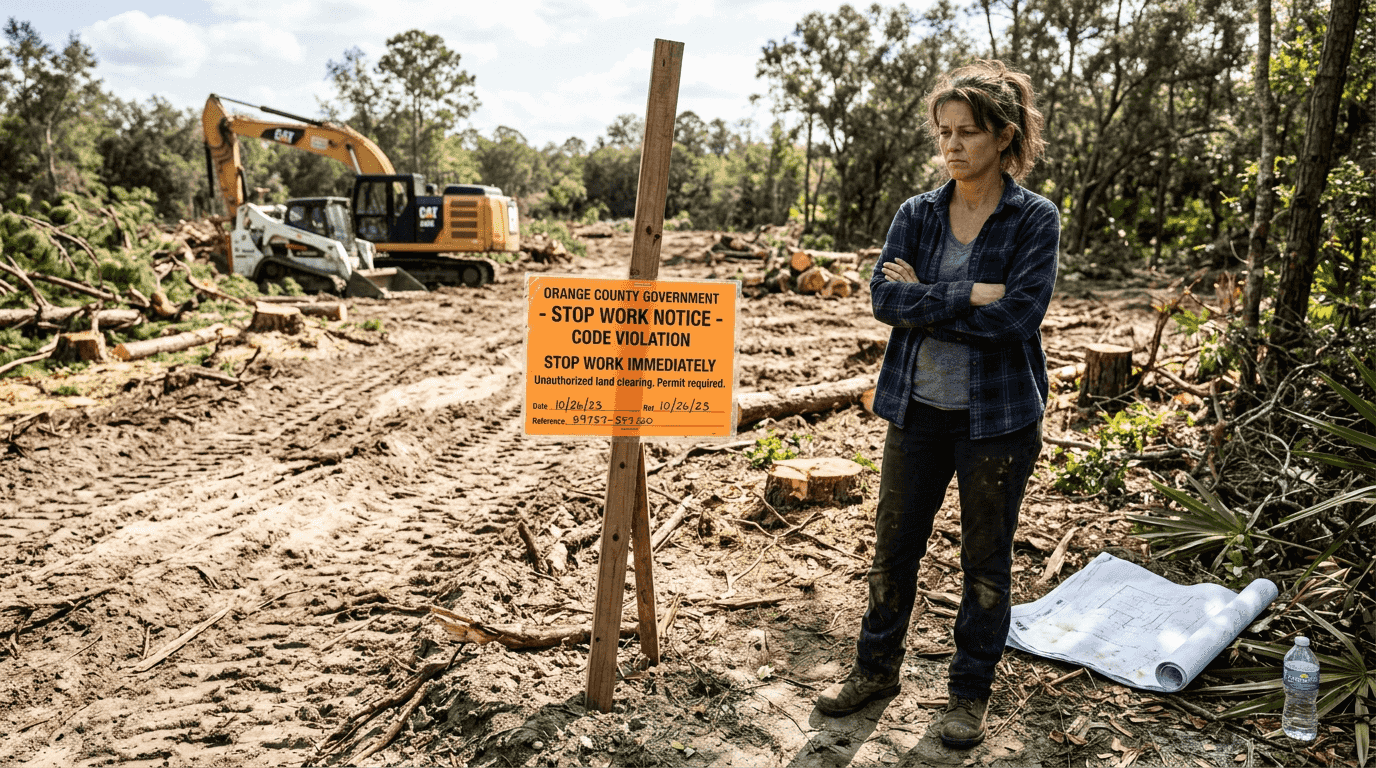
Environmental Resource Permits regulate construction activities altering land surfaces, including drainage modifications, wetland impacts, and water flow changes. Clearing land without proper ERPs exposes property owners to severe penalties, stop-work orders, and project delays that compound costs rapidly. The permitting process verifies your project meets environmental standards while protecting water quality and ecosystems.
Submitting complete applications with accurate site plans represents the fastest path to approval. Incomplete packages trigger requests for additional information that extend review periods by weeks or months. Your application must demonstrate how you will manage stormwater runoff, prevent erosion, and mitigate impacts to wetlands or surface waters. Districts review engineering calculations, drainage designs, and construction sequencing to ensure compliance.
Unauthorized clearing without required permits can trigger penalties surpassing $150,000, plus mandatory restoration costs and legal fees. Enforcement actions have halted projects across Central Florida when landowners skipped the permitting step or assumed small projects fell below regulatory thresholds. Even minor land alterations may require permits if they affect protected resources or drainage patterns.
Assess whether your project triggers ERP requirements by evaluating total disturbed acreage, proximity to wetlands, and changes to existing drainage. Districts publish threshold charts showing when permits become mandatory based on project characteristics. Consulting with permitting experts familiar with your district ensures application accuracy and prevents costly resubmissions. Many professional land clearing services include permit assistance as part of their offerings, leveraging established relationships with district staff to expedite approvals.
3. Plan to protect sensitive wildlife habitats during land clearing
Central Florida hosts numerous protected species whose habitats receive legal safeguards under state and federal law. Property owners must survey land for protected wildlife before clearing begins, particularly gopher tortoise burrows that are frequently encountered in sandy soils throughout the region. Disturbing these burrows without proper relocation permits violates Florida wildlife protection statutes.
Gopher tortoises are a threatened species whose burrows provide critical shelter for over 350 other species. Damaging burrows triggers enforcement actions that have resulted in six-figure fines in recent Central Florida cases. Before any clearing equipment arrives, conduct a thorough habitat assessment to identify burrows, nesting areas, and other protected features. Authorized wildlife professionals can relocate tortoises following strict protocols that ensure animal welfare.
Violations of habitat protections have resulted in stop-work orders across Central Florida communities when regulators discover unauthorized clearing near sensitive areas. One recent case highlighted enforcement priorities:
The case highlights the importance of strong ecological protections and the need for vigilance in enforcing them to protect biodiversity.
Ecological surveys identify not just gopher tortoises but also protected bird nesting sites, wetland boundaries, and rare plant communities. Expert consultations map these sensitive areas, allowing you to design clearing plans that avoid impacts or implement required mitigation measures. Professional land clearing services incorporate habitat assessments into project planning, ensuring compliance while protecting local biodiversity that enhances property values and ecological health.
- Conduct pre-clearing wildlife surveys with qualified biologists
- Document all protected species locations with GPS coordinates
- Obtain relocation permits before disturbing gopher tortoise burrows
- Flag sensitive habitat boundaries to prevent accidental disturbance
- Schedule clearing outside bird nesting seasons when possible
4. Prepare detailed site plans and applications for smooth permit approvals
Detailed site plans form the cornerstone of successful permit applications, providing reviewers with comprehensive information about existing conditions and proposed changes. Plans must include accurate topography showing elevation contours, existing drainage patterns with flow directions, current vegetation communities, and precisely defined clearing boundaries. Professional surveyors and engineers create plans that meet district standards, preventing rejection due to technical deficiencies.
Submit all required forms and documentation to the correct Water Management District agency through their specified channels. Each district maintains different submission requirements, with some accepting online applications while others require paper packages. Missing forms or incomplete attachments delay review timelines, pushing project start dates further into the future. Complete applications with detailed plans move through review queues faster than incomplete submissions that generate multiple information requests.
Here are the steps to prepare a flawless application package:
- Conduct professional survey of site boundaries and topography
- Draft preliminary clearing and drainage plans with licensed engineer
- Check Water Management District requirements for your specific project type
- Compile all required forms, plans, environmental assessments, and supporting documents
- Submit complete application package through district’s preferred method
Pro Tip: Request pre-application meetings with district staff to review preliminary plans and confirm you are addressing all regulatory requirements before formal submission, potentially saving weeks of review time.
Different Water Management Districts maintain varying review timelines, fee structures, and stormwater design requirements:
| District | Permit Threshold | Review Timeline | Application Fee | Stormwater Standard |
|---|---|---|---|---|
| SWFWMD | 1+ acres or wetland impact | 30-60 days | $500-$2,000 | 25-year/24-hour storm |
| SJRWMD | 1+ acres or wetland impact | 45-90 days | $750-$2,500 | 25-year/24-hour storm |
| SFWMD | 0.5+ acres or wetland impact | 60-120 days | $1,000-$3,000 | 25-year/3-day storm |
Understanding these differences helps property owners budget accurately and establish realistic project timelines. SFWMD’s stricter thresholds and longer review periods require earlier planning compared to SWFWMD projects. Fee structures scale with project size, so larger clearing operations face proportionally higher permitting costs. Factor these variables into your overall land clearing process planning to avoid budget overruns.
5. Hire qualified professionals to ensure compliance and project success
Qualified land clearing contractors bring regulatory expertise that protects property owners from compliance pitfalls that derail projects. These professionals understand local Water Management District requirements, permitting processes, and environmental protection protocols that vary significantly across Central Florida. Their experience translates to more accurate permit applications, faster approvals, and reduced risk of enforcement actions.
Professionals prepare applications that address reviewer concerns proactively, incorporating engineering calculations, erosion control plans, and habitat mitigation strategies that demonstrate regulatory knowledge. This expertise helps avoid common mistakes that trigger information requests or application rejections. Skipping professional permit assistance risks stop-work orders and fines when projects proceed without proper authorizations or violate environmental standards.
Experienced clearing crews implement best practices for erosion control during and after land disturbance, protecting water quality and preventing sediment runoff that damages downstream properties. They install silt fences, stabilize slopes, and manage stormwater according to approved plans. Wildlife protection protocols ensure crews recognize and avoid protected species habitats, preventing accidental violations.
Certified arborists assess tree health and determine which vegetation requires removal versus preservation, optimizing clearing plans while maintaining property aesthetics and environmental values. Their expertise identifies diseased or hazardous trees that pose safety risks, while recognizing healthy specimens worth protecting. This selective approach often reduces clearing costs while enhancing final property conditions.
Key benefits of professional land clearing services include:
- Regulatory compliance with Water Management District and wildlife protection requirements
- Safety protocols that protect workers and adjacent properties
- Efficient equipment operation that completes projects faster
- Environmental stewardship through erosion control and habitat protection
- Permit application expertise that accelerates approvals
Partnering with established land clearing professionals provides peace of mind that your project meets all 2026 regulatory standards while achieving your development or land management objectives efficiently.
Comparison of key land clearing considerations across Central Florida Water Management Districts
Property owners benefit from understanding how permit requirements vary across the three primary Water Management Districts governing Central Florida projects. These differences affect project budgets, timelines, and engineering requirements significantly. Each district maintains distinct standards reflecting regional water resource priorities and environmental conditions.
Permit size thresholds determine when Environmental Resource Permits become mandatory based on total acreage disturbed or wetland impacts. SFWMD enforces the lowest threshold at 0.5 acres, meaning smaller projects trigger permitting requirements compared to SWFWMD and SJRWMD territories where 1-acre thresholds apply. This difference catches property owners off guard when they assume consistent statewide standards.
Stormwater design standards impose the most significant cost variables across districts. SFWMD requires infrastructure handling the 25-year/3-day storm event, representing substantially more rainfall volume than the 25-year/24-hour standard enforced by SWFWMD and SJRWMD. Projects in SFWMD jurisdiction need larger retention ponds, more extensive drainage systems, and additional engineering to meet these stringent requirements.
Fee structures and permit review timelines create planning and budgeting challenges when property owners operate across district boundaries. SFWMD maintains the highest application fees and longest review periods, sometimes extending beyond four months for complex projects. SWFWMD offers faster reviews but still requires 30-60 days minimum. Understanding these timelines prevents scheduling conflicts and ensures clearing can proceed when needed.
| Consideration | SWFWMD | SJRWMD | SFWMD |
|---|---|---|---|
| Permit threshold | 1+ acres | 1+ acres | 0.5+ acres |
| Stormwater design | 25-yr/24-hr storm | 25-yr/24-hr storm | 25-yr/3-day storm |
| Typical review time | 30-60 days | 45-90 days | 60-120 days |
| Application fees | $500-$2,000 | $750-$2,500 | $1,000-$3,000 |
| Pre-application meetings | Available | Available | Recommended |
This comparison table helps property owners choose appropriate contractors familiar with specific district requirements and budget realistically for permitting costs and timelines. Projects straddling district boundaries face the most complex regulatory scenarios, requiring coordination with multiple agencies and compliance with overlapping standards.
Professional land clearing and tree services in Central Florida
Navigating Central Florida’s complex land clearing regulations requires expertise you can trust. McCullough Tree Service combines certified arborist credentials with comprehensive knowledge of Water Management District requirements, wildlife protections, and permitting processes across the region. Their experienced teams handle every aspect of land clearing projects, from initial site assessments through final permit compliance verification.
Their certified arborists evaluate tree health, identify protected species habitats, and design clearing plans that meet regulatory standards while achieving your property objectives. Whether you need complete site clearing for development or selective vegetation management for land improvement, their crews implement erosion controls, stormwater management, and habitat protections that satisfy district inspectors. Professional tree removal and trimming services complement land clearing operations, providing complete property management solutions. Partnering with experienced professionals safeguards your investment and ensures projects proceed smoothly without costly delays or compliance violations.
FAQ
What permits do I need for land clearing in Central Florida in 2026?
Most land clearing projects require an Environmental Resource Permit from your Water Management District when disturbing one or more acres or impacting wetlands. SFWMD enforces a lower 0.5-acre threshold. Additional permits may apply for protected species relocation or local zoning requirements. Check with your district and local government for specific requirements based on your project scope.
How do I find out which Water Management District covers my property?
Property owners can visit Water Management District websites that offer online mapping tools and address lookup features showing jurisdiction boundaries. Local county environmental or planning offices also provide district identification assistance. Knowing your district is critical because regulations, fees, and review timelines vary significantly across Central Florida’s three main districts.
What are common penalties for violating land clearing regulations in Central Florida?
Fines can surpass $150,000 for serious violations like damaging protected gopher tortoise burrows or clearing wetlands without permits. Stop-work orders halt projects immediately, adding delay costs and requiring expensive restoration work. Legal action and mandatory mitigation measures compound financial impacts when property owners skip required permits or environmental protections.
Why should I hire a professional for my land clearing project?
Professionals ensure compliance with complex Water Management District regulations and wildlife protection requirements, avoiding costly fines and project delays. Their permit application expertise accelerates approvals while their equipment and safety protocols complete clearing efficiently. Experienced contractors implement erosion controls and habitat safeguards that protect your property and the environment. Learn more about professional land clearing approaches that deliver superior results.
Recommended
- Complete Land Clearing Guide for Central Florida Homes
- Land Clearing Regulations 2025: New Rules for Central Florida
- Tree Planting Guide Central Florida for Homeowners
- Tree Planting Considerations for Central Florida Homes