By: Shelby McCullough| Published: August 3, 2026
Yes, healthy, well-placed trees raise residential property value. Real estate professionals consistently report uplifts of 5–15% in resale value for homes with mature, well-maintained trees and thoughtful landscaping. That range is not a marketing claim — it comes from realtor interviews and aligns with the direction of findings from peer-reviewed hedonic pricing studies and national meta-analyses.
The practical implication: if you own trees, maintaining them is one of the lowest-cost ways to protect your asking price. If you are planting, species selection and placement matter more than volume.
Table of Contents
- What the research actually says about trees and home prices
- How trees actually translate into higher home prices
- Which tree traits add value — and which ones subtract it
- When trees reduce property value: risks and costs buyers factor in
- How to estimate ROI and timeline for tree investments
- When to hire a certified arborist and what to ask them
- Key Takeaways
- Trees, property value, and what the evidence actually demands of homeowners
- Mcculloughtreeservice helps Central Florida homeowners protect tree value
- Useful sources and further reading
What the research actually says about trees and home prices
The academic foundation here is hedonic pricing, a method economists use to isolate how individual property features, including tree cover, affect sale prices after controlling for location, size, and condition. Several major analyses have applied this approach to tree canopy across U.S. markets.
| Study / Source | Headline Finding | Practical Takeaway |
|---|---|---|
| USDA Forest Service meta-analysis | Positive, nonlinear relationship between canopy and home values; on-property canopy near ~30% appears near-optimal in some samples | Moderate, well-distributed canopy beats either bare lots or heavily shaded ones |
| National meta-analysis (USDA/FS) | Off-property canopy often produces larger capitalization effects than on-property canopy in many contexts | Neighborhood tree cover matters — not just your own yard |
| NBER working paper | Buyers pay for trees as a composite of aesthetic amenity and ecosystem services; amenity value often exceeds measurable energy savings alone | Emotional and aesthetic response drives buyer willingness to pay beyond utility bills |
| City-level hedonic analysis | Spatially varying preferences: when local canopy is scarce, on-property trees matter more; when canopy is dense, nearby trees carry more weight | In low-canopy neighborhoods, planting on your lot has outsized value impact |
| Realtor interviews (HouseBeautiful) | Mature trees with thoughtful landscaping can raise resale value roughly 5–15% in many U.S. markets | Maintenance and placement are what convert that potential into actual sale-price gains |
One important limitation: hedonic elasticities measure correlation, not guaranteed return. Local market conditions, tree species, and condition all shift the actual dollar impact. The Arbor Day Foundation has long cited a 3–15% value range for well-placed trees, which aligns with the practitioner estimates above and gives homeowners a reasonable planning benchmark.
How trees actually translate into higher home prices
The mechanism is not mysterious, but it is layered. Buyers respond to trees through several overlapping channels, and understanding which ones matter most helps you prioritize.
Curb appeal and first impression. Realtors consistently report that trees framing the home, providing privacy, or creating shaded outdoor living areas generate an emotional response that increases buyer willingness to pay. A buyer who feels good walking up the driveway is more likely to offer at or above asking price.
Shade and energy savings. Strategically placed shade trees on the west and southwest sides of a home can meaningfully reduce summer cooling loads. In Florida’s climate, that translates directly into lower utility bills — a concrete, quantifiable benefit buyers can calculate. Mcculloughtreeservice’s tree trimming for solar panels guidance addresses the balance between shade value and solar access, which is increasingly relevant as more homeowners add panels.
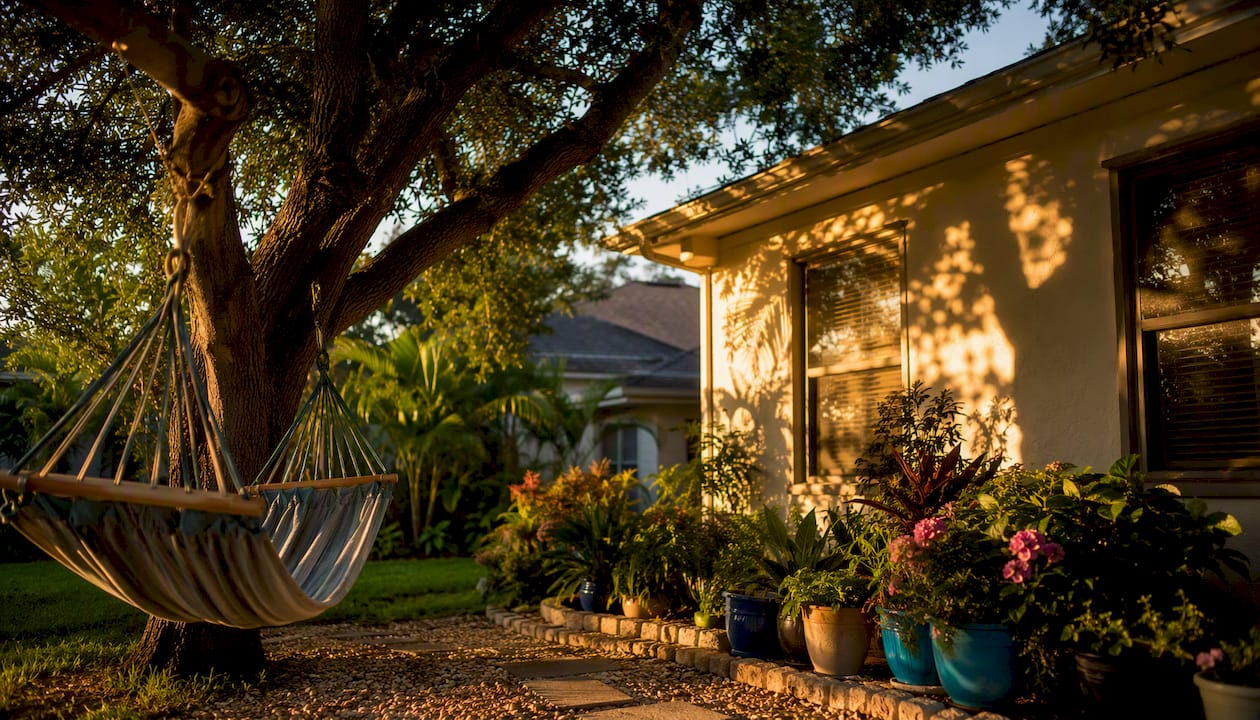
Privacy and noise reduction. Dense evergreen screens along property lines create privacy that buyers in suburban and urban markets pay a premium for. Trees also absorb and deflect road noise, a benefit that rarely shows up in listing descriptions but registers immediately during a showing.
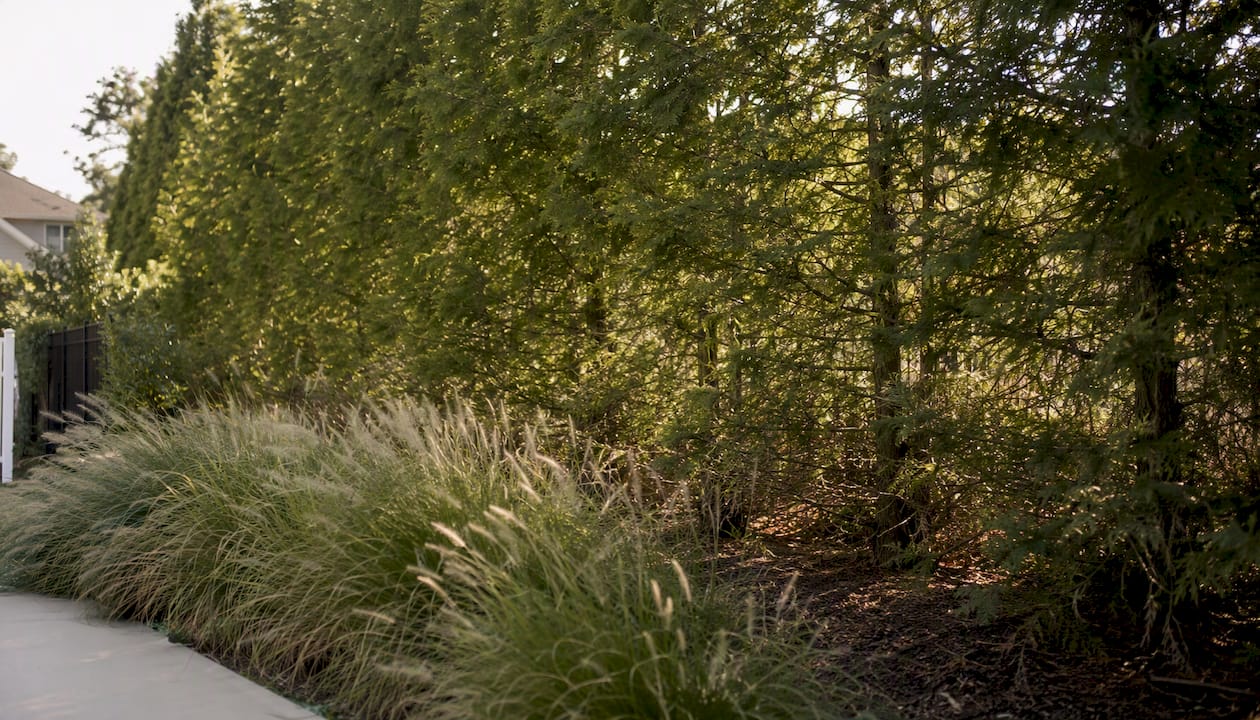
Stormwater management and biodiversity. Tree canopy intercepts rainfall, reducing runoff and erosion. This is partly a neighborhood-level benefit, which explains why the USDA national meta-analysis found off-property canopy often capitalized into home prices at least as strongly as on-property canopy. You benefit from your neighbors’ trees, and they benefit from yours.
The amenity premium. The NBER research frames tree value as a composite: part ecosystem service, part pure amenity. Buyers pay for the “living umbrella” effect even when measured energy savings alone would not justify the premium. That gap between what trees cost to maintain and what buyers pay for them is where the real ROI lives.
Which tree traits add value — and which ones subtract it
Not every tree is an asset. Placement, species, health, and size relative to the structure all determine whether a tree helps or hurts your sale price.
When trees reduce property value: risks and costs buyers factor in
A neglected tree is not a neutral asset. Buyers and their agents discount properties when trees appear to present safety or maintenance liabilities, and that discount often exceeds what the tree would have cost to maintain properly.
Red flags buyers and inspectors commonly flag:
- Dead or hanging limbs over the house, driveway, or neighboring property
- Visible root intrusion lifting sidewalks, driveways, or foundation edges
- Bark damage, large cavities, or fungal conks at the base
- Trees leaning toward structures after a storm
- Dense canopy blocking all natural light from living areas
- Moss or lichen overgrowth obscuring the health of the bark (relevant in humid Florida climates)
The cost math is straightforward. A buyer who sees a large, questionable oak overhanging the roof is not just worried about the tree — they are mentally adding up removal ($800–$2,500+ depending on size and access), stump grinding, and potential roof repair. That mental total comes off their offer. Regular tree maintenance prevents that discounting by keeping trees visibly healthy and structurally sound.
Arborists and realtors consistently recommend pausing before removing a mature, healthy tree. Targeted pruning or cleanup often improves curb appeal more than removal — and removal itself can leave a bare, exposed yard that buyers find less appealing than the original canopy. The decision to remove should follow a professional assessment, not a gut reaction to size or mess.
Pro Tip: A pre-listing arborist inspection costs a fraction of what a buyer’s price reduction would. An arborist report showing clean structural health and a current pruning record is a marketing document as much as a safety record.
How to estimate ROI and timeline for tree investments
Trees are slow investments. That is not a reason to avoid them — it is a reason to start sooner and to pair them with faster-return improvements.
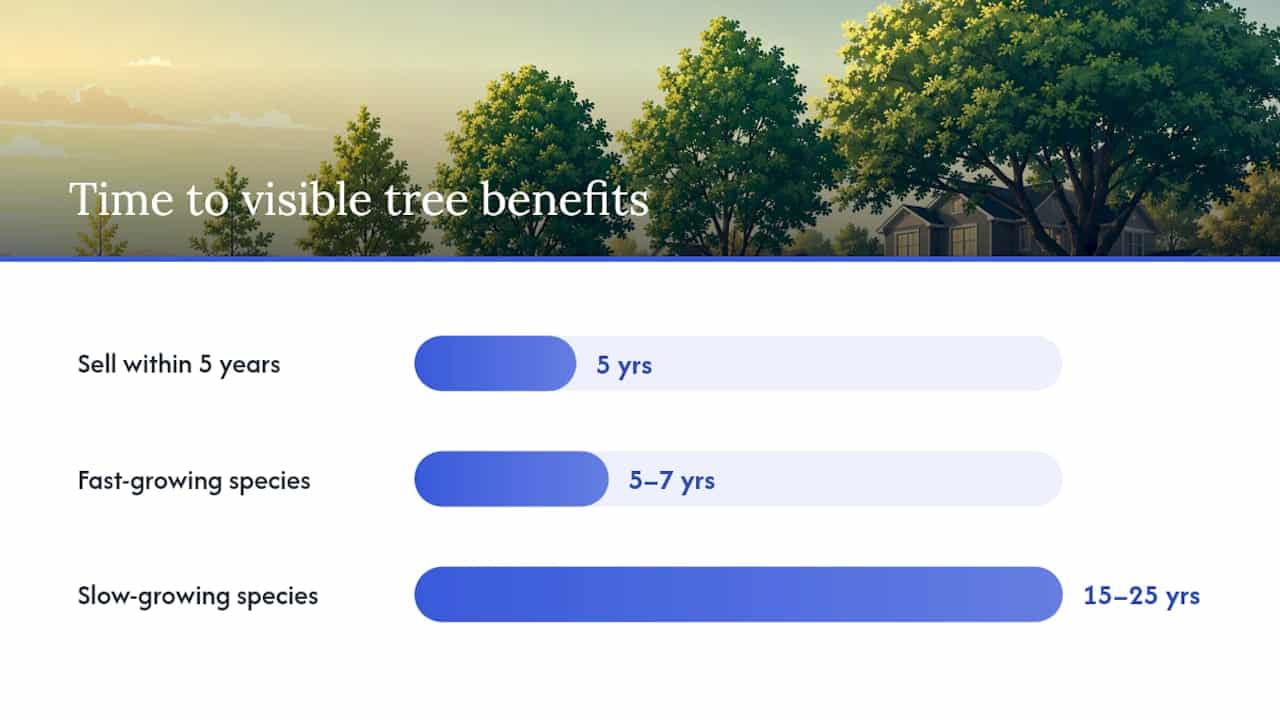
Maturity timelines. Fast-growing species like crape myrtle or river birch can provide meaningful shade and visual impact within 5–7 years. Slower-growing oaks and maples take 15–25 years to reach the canopy size that commands a premium. If you are planning to sell within five years, focus on pruning and maintaining existing trees rather than planting new ones for value.
A conservative dollar estimate. Using a conservative realtor estimate lower bound for home value uplift, on a $400,000 home, a meaningful premium can be realized from mature, healthy trees. That figure assumes the trees are mature, healthy, and well placed. The cost of maintaining two or three established trees through annual pruning and periodic arborist inspections might run $500–$1,500 per year. The math favors maintenance.
| Timeline | Action | Expected Benefit |
|---|---|---|
| Now | Prune existing trees, remove dead limbs, get arborist inspection | Removes buyer anxiety; improves curb appeal immediately |
| Short-term | Plant fast-growing privacy or shade species in strategic positions | Visible growth; privacy screen begins forming |
| Medium-term (3–7 years) | Fast-growing species reach meaningful size; fertilize and monitor | Shade and privacy benefits materialize; energy savings begin |
| Long-term | Slow-growing native species reach mature canopy | Maximum value premium; neighborhood canopy contribution |
Pro Tip: Combine tree investment with complementary exterior upgrades like fresh mulch, defined bed edges, and clean hardscaping. Buyers read the yard as a whole — a beautiful tree next to an overgrown bed reads as neglect, not charm.
When to hire a certified arborist and what to ask them
A certified arborist is not just for emergencies. There are specific moments when a professional assessment protects your investment and your sale price.
Hire an arborist when:
- You are preparing to list the property (pre-listing inspection)
- A tree shows visible signs of disease, decay, or structural failure
- Storm damage has left hanging limbs or a leaning trunk
- A buyer’s inspector flags a tree as a concern
- You are considering removing a large, mature tree
- Roots are visibly lifting pavement or approaching the foundation
What a certified arborist inspects:
- Structural defects: included bark, co-dominant stems, cracks, cavities
- Disease and pest presence: fungal growth, boring insects, canker
- Root zone conflicts: proximity to structures, pavement, utilities
- Overall risk rating: likelihood and consequence of failure
- Canopy health: crown density, dead wood percentage, leaf condition
Questions to ask before hiring:
- Are you ISA-certified (International Society of Arboriculture)? Can I see your credentials?
- Are you licensed and insured in Florida?
- What does the inspection include, and will I receive a written report?
- If you recommend removal, what are the alternatives you considered?
- What are your estimated costs for the recommended work?
A basic arborist inspection typically runs $75–$150 for a single tree assessment; a full written risk report for multiple trees costs more. Remediation costs vary widely by scope. The written report itself has value beyond the inspection: it documents tree condition for buyers, insurers, and your own records.
Pro Tip: Ask specifically for an ISA-certified arborist, not just a “tree service.” The ISA credential requires passing an exam and ongoing continuing education — it is the standard that certified arborist services like those offered by Mcculloughtreeservice are built around.
Key Takeaways
Healthy, well-placed trees maintained by a certified arborist are one of the most cost-effective ways to protect and grow residential property value.
| Point | Details |
|---|---|
| Trees raise resale value | Mature, well-maintained trees can increase resale value by roughly 5–15%, according to real estate professionals. |
| Maintenance prevents discounting | Neglected trees prompt buyer price reductions; regular pruning and arborist inspections remove that anxiety. |
| Placement drives the premium | Trees that frame the home, provide shade, or create privacy add more value than randomly placed ones. |
| Prune before you remove | Targeted pruning often improves curb appeal more than removal and preserves the maturity premium. |
| Mcculloughtreeservice | Certified arborist inspections, trimming, and removal services in Central Florida protect and maximize tree-related property value. |
Trees, property value, and what the evidence actually demands of homeowners
The conventional wisdom says “plant trees, add value.” That is true, but incomplete in a way that costs homeowners money.
The research is clear that condition and placement drive the premium, not tree count. A yard with three well-maintained, strategically placed oaks will outperform a yard with eight poorly placed, neglected trees every time. The buyer is not counting trees — they are reading the yard as a signal of how well the property has been cared for. A dead limb hanging over the roof says “deferred maintenance” louder than a beautiful canopy says “value.”
What the studies also show, and what rarely makes it into homeowner advice, is that neighborhood canopy matters as much as what is on your lot. You are partly investing in a shared resource. That creates a genuine case for community tree programs and HOA landscaping standards, not just individual planting decisions.
The most overlooked move? Getting an arborist inspection before you need one, not after a storm or a buyer’s concern surfaces. A clean arborist report is a marketing asset. It shifts the conversation from “what might be wrong with that tree” to “this tree has been professionally assessed and maintained.” In a competitive market, that documentation can be the difference between a full-price offer and a negotiated discount.
Mcculloughtreeservice helps Central Florida homeowners protect tree value
Healthy trees are a financial asset — but only when they are properly maintained and professionally assessed. Mccullough Tree Service provides certified arborist inspections, professional tree trimming, and tree removal for residential and commercial property owners across Orlando and Central Florida. Every service is performed by licensed, ISA-credentialed professionals who understand both the local species and the local market.
Whether you are preparing to list, dealing with storm damage, or simply want to know which trees on your property are assets and which are liabilities, a professional assessment is the right starting point. Contact Mcculloughtreeservice to schedule a certified arborist inspection and get a clear picture of your trees’ condition and value impact.
Useful sources and further reading
The claims in this article draw on peer-reviewed meta-analyses, USDA Forest Service research, NBER working papers, and practitioner guidance from real estate professionals. The sources below are the primary references.
- Real Estate Experts Reveal How Trees Can Affect Your Property Value
- NBER working paper w32063 (tree amenity and value synthesis)
- The implicit value of tree cover in the U.S.: A meta-analysis of hedonic property value studies
- Tree cover and property values in the United States: A national meta-analysis
- Capitalization of urban tree cover: An internal meta-analysis
- Experts Say Trees Can Add THOUSANDS to Your Property Value
Recommended
- Trees Boosts Property Value: Enhance Your Home’s Worth
- Tree planting: boost property value in Central Florida
- How trees transform Central Florida landscapes and property value
- How tree care boosts property value in Central Florida