By: Shelby McCullough| Published: June 4, 2026
TL;DR:
- Early detection of tree hazard signs such as structural defects, root problems, decay, and dead wood is crucial to prevent property damage and injury. ISA-certified arborists evaluate these signs using a risk matrix to determine appropriate management actions, including pruning, cabling, or removal. Regular inspections and prompt professional assessments are essential for maintaining tree safety and avoiding costly emergencies.
Tree hazard signs are the visible defects and structural symptoms that indicate a tree could fail and cause injury or property damage if left unmanaged. Recognizing these signals early is the difference between a scheduled pruning job and an emergency call after a limb crushes a roof. This guide covers tree hazard signs explained in full, from the primary warning indicators to how ISA-certified arborists use the Tree Risk Assessment Matrix to classify danger, and what you should do when you spot trouble on your property.
What are the primary tree hazard signs and what do they indicate?
The most critical tree safety indicators fall into four categories: structural defects, root zone problems, biological decay, and dead wood. Each category signals a different failure mechanism, and understanding which you are looking at determines how fast you need to act.
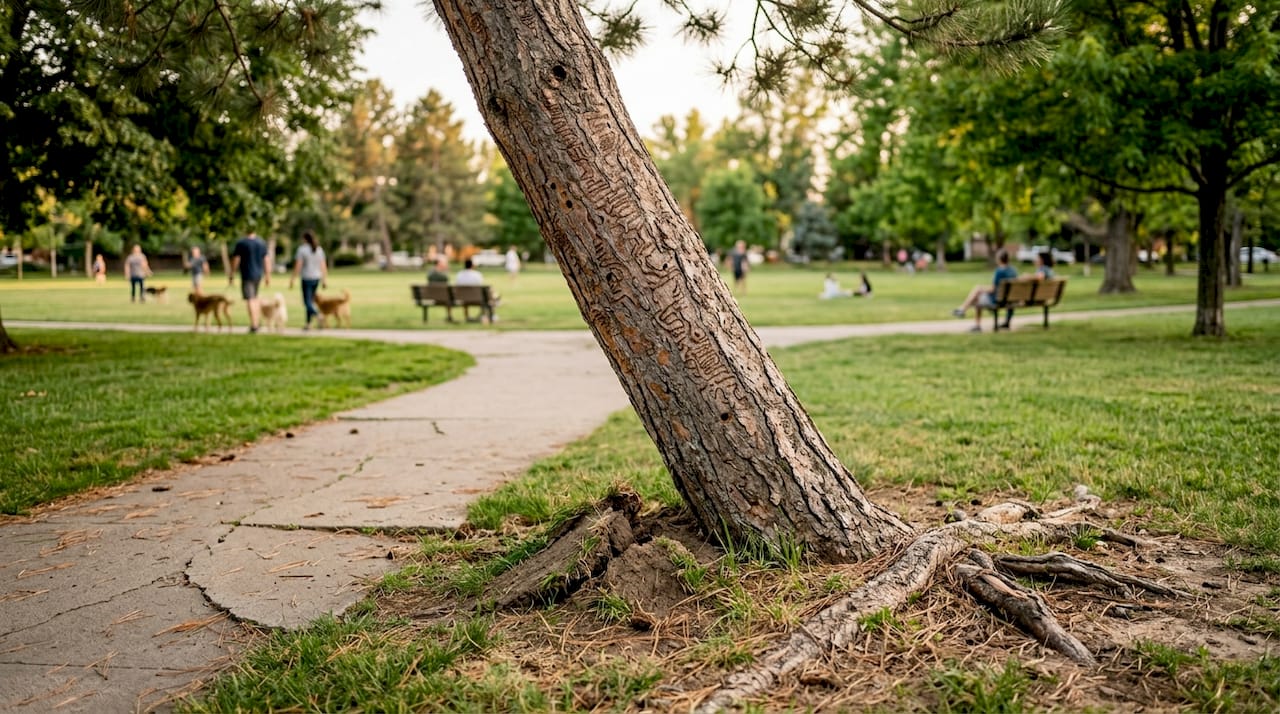
Structural defects are the most immediately visible. A new or rapidly worsening lean is a high-priority warning. A pre-existing lean that has been stable for years is far less concerning than one that has shifted noticeably after a storm or wet season. Vertical trunk cracks and splits indicate internal stress fractures that can propagate quickly under wind load. Co-dominant stems, where two trunks of equal size fork from the same point, create a mechanically weak junction that is prone to splitting.
Root zone problems are easy to miss because most of the damage is underground. Soil heaving and exposed roots on the side opposite the direction of lean signal that the root plate is losing its anchor. Construction damage is a particularly sneaky cause. Symptoms of root zone disturbance from soil compaction or trenching can take 2 to 7 years to appear as visible crown dieback or instability, meaning a tree that looked fine when your driveway was repaved may now be quietly failing.
Biological decay shows up as fungal conks or mushrooms growing at the base of the trunk or along major roots. These fruiting bodies are not the disease itself. They are the external sign of ongoing internal decay that has already been progressing for months or years. The heartwood that gives the trunk its load-bearing strength is being consumed from the inside.
Dead wood is the most urgent category for immediate action. Large dead branches hanging over a house, driveway, or play area are called “widow makers” by arborists for good reason. Hanging dead branches have unpredictable failure timing and are prioritized for emergency pruning or removal above almost any other defect.
- New or worsening lean with soil heaving at the base
- Vertical trunk cracks or splits running along the bark
- Fungal conks, mushrooms, or shelf fungi at the root collar or trunk
- Large dead branches positioned over structures, vehicles, or foot traffic areas
- Exit holes, sawdust-like frass, or damaged bark indicating active pest infestation
- Crown dieback starting at the tips and progressing inward
Pro Tip: Photograph any suspected hazard sign from multiple angles and note the date. A single photo tells you the current condition. A series of photos taken over months tells you whether the problem is stable or accelerating, which is exactly what an arborist needs to make a sound recommendation.
How do professional arborists rate tree risk?
Understanding tree hazard signs is only half the picture. The other half is knowing how those signs translate into a formal risk level. The industry standard is the ISA Tree Risk Assessment Matrix, developed by the International Society of Arboriculture. It calculates risk by multiplying three factors: the probability of failure, the probability that a falling part would strike a target, and the severity of consequences if it does.
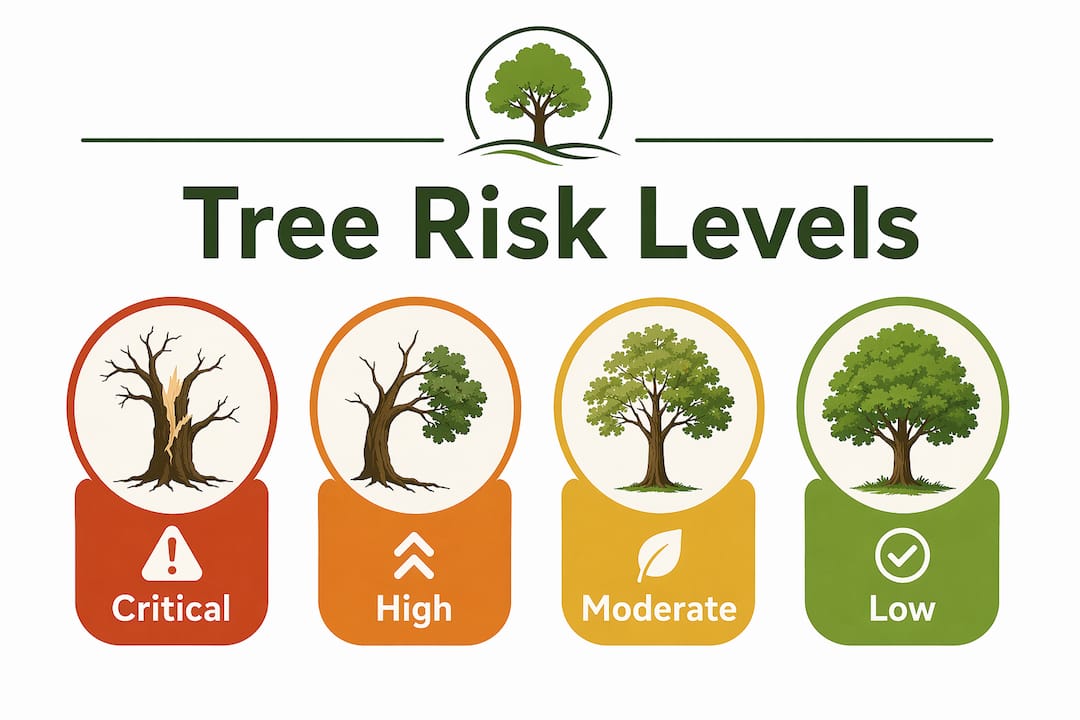
This framework produces four risk classifications: low, moderate, high, and critical. A critical rating means failure is likely, a target is almost always present, and the consequences would be severe. A low rating might apply to a tree with minor decay located in an open field far from any structure or foot traffic. The same tree with the same decay level moved next to a school playground would rate as high or critical. Tree risk is not just tree condition but also proximity to targets, which is a distinction most property owners do not initially grasp.
ISA-certified assessments classify risk as low, moderate, high, or critical and typically take 3 to 5 business days to deliver a formal report. Assessments are recommended every 3 to 5 years under normal conditions, annually for high-risk areas, and immediately after any severe weather event.
| Risk level | Probability of failure | Recommended action |
|---|---|---|
| Low | Unlikely under normal conditions | Monitor at regular inspection intervals |
| Moderate | Possible under storm or stress conditions | Schedule professional evaluation within 30 days |
| High | Likely under moderate stress | Mitigate within days; restrict access to target zone |
| Critical | Imminent or already occurring | Immediate action required; restrict access now |
For defects that are not visible from the outside, ISA-certified arborists use sonic tomographs and resistograph drills to map internal decay without cutting into the tree. These tools send sound waves or a thin probe through the wood and detect density changes caused by rot. Internal decay can be extensive before any external symptom appears, which is why a tree that looks healthy from the street can still carry a high or critical rating after a professional assessment.
Pro Tip: When you receive a formal risk assessment report, ask the arborist to walk you through the specific defects that drove the risk rating. Understanding the reasoning helps you make informed decisions about removal versus mitigation options like cabling or bracing.
Comparing common hazard signs: what each one means for stability
Not all tree warning signs carry equal weight. Some indicate a slow-developing problem you can monitor over a season. Others demand action within days. The table below compares the most common signs by what they reveal about structural integrity and the typical response timeline.
| Hazard sign | Structural implication | Urgency level |
|---|---|---|
| New or worsening lean with soil heaving | Root plate failure in progress | High to critical; restrict access immediately |
| V-shaped crotch with included bark | Mechanically weak union prone to splitting | Moderate; evaluate for cabling or bracing |
| Fungal conks at base or root collar | Active heartwood decay, load capacity reduced | Moderate to high; professional assessment needed |
| Large dead branches over targets | Unpredictable failure timing | High to critical; emergency pruning required |
| Vertical trunk cracks | Internal stress fractures present | Moderate to high; monitor or assess professionally |
| Crown dieback from tips inward | Root damage or systemic disease | Moderate; investigate root zone and soil conditions |
The distinction between V-shaped and U-shaped crotches is one that surprises most property owners. A U-shaped fork distributes load evenly between two limbs. A V-shaped fork with included bark, where bark tissue is trapped between the two stems, creates a wedge that actively pushes the stems apart under load. This is one of the most common critical failure points identified in urban forestry structural failure reports. For a valued shade tree, arborists often recommend steel cabling rather than removal, but the junction needs to be evaluated before the next storm season.
Fungal fruiting bodies deserve special attention because they are frequently misread as cosmetic issues. The mushrooms or shelf fungi you see are the reproductive structures of a fungal organism that has already colonized the heartwood. Fungal brackets at the root zone specifically point to internal rot that compromises the tree’s load-bearing capacity at its most critical point. The extent of internal decay cannot be determined by looking at the fruiting bodies alone. It requires the diagnostic tools described in the previous section.
Pest infestations add another layer of complexity. Bark beetles, emerald ash borers, and similar insects damage the vascular tissue just beneath the bark, cutting off water and nutrient transport. Exit holes, D-shaped or round, combined with sawdust-like frass and sections of dead bark, indicate active infestation. Infested trees decline faster than trees with mechanical defects alone because the biological damage accelerates structural decay simultaneously.
How to identify, document, and respond to tree hazard signs on your property
You do not need to be an arborist to perform a useful preliminary inspection. A systematic walk-around twice a year, plus an inspection after any significant storm, catches most developing problems before they become emergencies. Here is a practical sequence for property owners.
- Set a safe perimeter first. If a tree is visibly leaning toward a structure or has large hanging dead branches, stay at least one full tree-length away until a professional has assessed it. This is not overcaution. Widow makers can fall without warning.
- Inspect from the ground up. Start at the soil line. Look for heaving soil, exposed roots, fungal growth, and any gaps between the root flare and the ground. Move up the trunk checking for cracks, cavities, missing bark, and pest damage. Finish with the canopy, scanning for dead branches, broken limbs still attached, and uneven crown density.
- Document what you find. Photograph each defect with a reference object for scale, such as a hand or a measuring tape. Note the date and location on the tree. Upload photos to a folder labeled by tree and date so you can compare over time.
- Classify urgency before calling. Large dead branches over occupied areas, a new lean with soil movement, or visible fungal conks at the base all warrant a call to an ISA-certified arborist within 24 to 48 hours. Minor crown dieback or a stable crack can be scheduled for the next routine evaluation.
- Schedule regular professional evaluations. For most residential properties, a formal tree inspection every 3 to 5 years is the standard recommendation. Properties with mature trees near structures, pools, or high-traffic areas benefit from annual reviews.
Pro Tip: After any hurricane or tropical storm in Central Florida, schedule a post-storm inspection even if your trees look intact. Wind loading stresses root systems and creates internal cracks that are not visible from outside but significantly increase failure risk during the next weather event.
Preventive maintenance reduces the probability of reaching a high or critical risk rating in the first place. Proper pruning removes dead wood before it becomes a widow maker, reduces wind resistance in the canopy, and eliminates co-dominant stems while the tree is young enough to respond well. Regular tree maintenance is measurably more cost-effective than emergency removal after a failure event.
Key takeaways
Recognizing tree hazard signs early and acting on a formal risk rating is the most reliable way to prevent structural failure from damaging your property or injuring someone on it.
| Point | Details |
|---|---|
| New lean is more urgent than old lean | A stable, pre-existing lean is far less critical than a lean that has recently worsened with soil heaving. |
| Risk depends on targets, not just tree condition | A defective tree in an open field rates low risk; the same tree over a driveway rates high or critical. |
| Fungal growth signals internal decay | Fruiting bodies at the base indicate heartwood rot that cannot be assessed without diagnostic tools. |
| Widow makers require immediate action | Large dead branches over occupied areas have unpredictable failure timing and must be prioritized first. |
| Professional assessments follow ISA standards | The ISA Tree Risk Assessment Matrix produces low, moderate, high, or critical ratings that drive management decisions. |
What 15 years of tree work has taught me about hazard signs
The most common mistake I see property owners make is treating tree hazard signs as a binary problem. Either the tree is fine or it needs to come down. The reality is far more nuanced, and that nuance is where most of the value in a professional assessment lives.
A V-shaped crotch on a 40-year-old live oak does not automatically mean removal. In many cases, steel cabling installed by a certified arborist extends the life of that tree by decades while eliminating the structural risk. Fungal conks at the base of a tree near a fence line might rate as moderate risk, not critical, if the decay is limited and the target consequence is low. The ISA matrix exists precisely because “it looks bad” is not a management plan.
What I find most telling is the pattern of neglect. Trees that receive no attention for 10 or 15 years accumulate multiple defects simultaneously. A co-dominant stem that could have been addressed with a single pruning cut at year three becomes a cabling job at year fifteen, or a removal at year twenty. The cost curve bends sharply upward the longer you wait. Proactive inspections and early intervention are not just safer. They are significantly cheaper over the life of a mature tree.
The other thing worth saying plainly: not every dangerous tree looks dangerous. Internal decay can be extensive before any external symptom appears. If you have mature trees near your home in Central Florida and you have never had a formal assessment, that gap in your knowledge is itself a risk factor worth addressing.
— Mcculloughtreeservice
Protect your property with a professional tree risk assessment
When you spot a hazard sign on your property, the next step is a formal evaluation by an ISA-certified arborist who can assign a risk rating and recommend the right response, whether that is pruning, cabling, or removal.
Mcculloughtreeservice provides certified tree risk assessments, hazardous tree removal, and expert tree trimming for residential and commercial properties throughout Orlando and Central Florida. Our team responds to urgent hazard situations and delivers written assessment reports you can use for insurance documentation or HOA compliance. Contact Mcculloughtreeservice today to schedule your evaluation and get a clear picture of every tree on your property.
FAQ
What are the most urgent tree hazard signs to act on immediately?
Large dead branches hanging over occupied areas, a new or rapidly worsening lean with soil heaving at the base, and visible fungal conks at the root collar all require professional evaluation within 24 to 48 hours. These signs indicate either imminent failure risk or active structural decay that cannot be assessed accurately without diagnostic tools.
How does the ISA Tree Risk Assessment Matrix work?
The ISA Tree Risk Assessment Matrix calculates risk by multiplying the probability of failure, the probability that a falling part strikes a target, and the severity of consequences. This produces a rating of low, moderate, high, or critical that drives the recommended management action.
Can a tree with fungal growth at the base be saved?
Sometimes, yes. The outcome depends on the extent of internal decay, the tree’s species and overall health, and its proximity to structures or high-traffic areas. An ISA-certified arborist using a sonic tomograph or resistograph drill can map the decay and determine whether the remaining sound wood is sufficient to support the tree safely.
How often should property owners schedule tree inspections?
Most residential properties benefit from a formal tree inspection every 3 to 5 years under normal conditions. Properties with mature trees near structures or in high-traffic areas should schedule annual evaluations, and any property in Central Florida should add a post-storm inspection after significant weather events.
Is a leaning tree always a hazard?
A pre-existing lean that has remained stable for years is far less critical than a new or worsening lean. The key indicators that a lean represents active hazard are accompanying soil heaving, exposed roots on the opposite side, or recent change in the angle of lean following a storm or wet season.
Recommended
- Why prioritize tree safety: protect property & prevent risks
- Identify a Dangerous Tree: Signs & Solutions
- Spot Tree Hazards: Real Examples & Solutions for Central Florida
- Signs of Unhealthy Trees: What Every Florida Owner Should Know