By: Shelby McCullough| Published: April 18, 2026
TL;DR:
- Visual green leaves alone do not guarantee tree health; structural integrity and root conditions matter.
- Regular inspections, proper pruning, mulching, and seasonal adjustments are essential for trees in Central Florida.
- Common myths, like over-mulching or topping trees, can harm trees and should be approached with evidence-based practices.
Most property owners assume a green canopy means a healthy tree. It doesn’t. In Central Florida, trees can look full and lush while quietly developing structural failures, root problems, or pest damage that won’t show up until a storm hits or a limb crashes onto your roof. The region’s sandy soils, intense wet seasons, and hurricane exposure create a distinct environment where standard tree advice often falls short. This guide walks you through how to actually assess your trees, what maintenance routines work here, and which popular beliefs are quietly doing more harm than good.
Table of Contents
- Decoding tree health: Key indicators to watch
- Essential practices for maintaining tree health in Central Florida
- Understanding the impact of weather and seasons on tree health
- Common myths and mistakes about tree health
- Why a proactive, evidence-based approach transforms tree health
- How professional expertise makes a lasting difference
- Frequently asked questions
Key Takeaways
| Point | Details |
|---|---|
| Healthy trees need more than green leaves | Structure, root flare, and absence of defects matter as much as canopy color. |
| Proper care boosts storm survival | Routine pruning and smart mulching increase tree resilience during extreme weather. |
| Myths can undermine your efforts | Avoid common mistakes like over-mulching or over-pruning to keep trees thriving. |
| Adapt care to local weather | Adjust tree care routines according to wet and dry seasons in Central Florida. |
Decoding tree health: Key indicators to watch
With a clearer sense of why typical visual checks can be misleading, let’s break down exactly what counts as a healthy tree and how to spot warning signs early.
A truly healthy tree is more than green leaves. Tree health is assessed through structural integrity, crown ratio, canopy vitality, and the absence of visible defects. That means you need to look at the whole picture: the trunk base, branch attachments, root flare exposure, and the density of the canopy, not just whether the leaves are green this week.
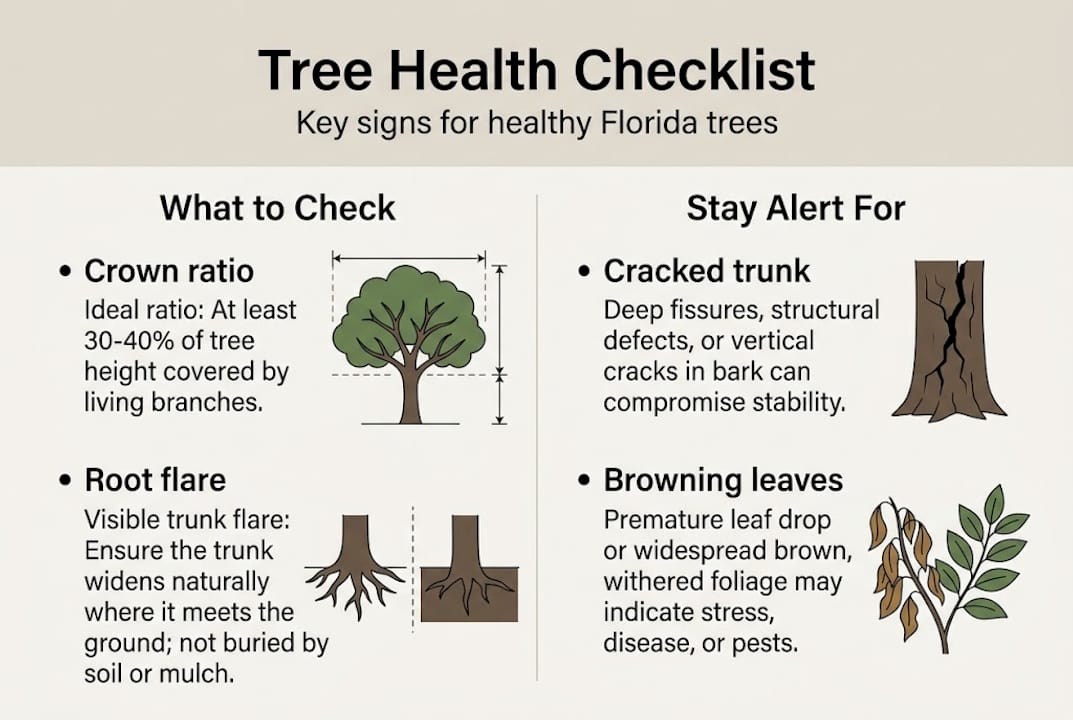
Crown ratio refers to the proportion of the tree’s total height that contains live branches. A healthy tree typically maintains a live crown ratio of at least 60%. When that ratio drops, the tree is struggling to produce enough energy to sustain itself, regardless of how it looks from the street.
Urban forest data gives us a useful benchmark. Gainesville’s urban forest shows roughly 60% of trees in good or excellent condition, while 21% are rated poor or declining. That means about one in five trees in a typical Florida urban setting is already compromised in some way. Your property is not immune to those odds.
Here are the red flags you should watch for during any walkthrough:
- Cracks or splits in the trunk or major limbs
- Weak branch unions where two stems grow at a tight V-angle
- Buried root flare from soil buildup or improper mulching
- Deadwood or dieback in the upper canopy
- Fungal growth at the base or on the bark
- Leaning that has progressively worsened over seasons
- Pest activity such as bark boring or unusual leaf loss
For a quick reference on condition ratings, the table below summarizes what separates good trees from declining ones:
| Condition | Crown ratio | Visible defects | Root flare |
|---|---|---|---|
| Good | 60%+ | None or minor | Visible |
| Fair | 40 to 59% | Moderate | Partially buried |
| Poor | Below 40% | Significant | Buried or damaged |
“Focusing only on leaf color is one of the most common mistakes property owners make. By the time foliage shows stress, internal damage is often already advanced.”
For a deeper walkthrough on what to look for at each stage of a tree’s life, tree care tips for homeowners covers the full spectrum from young plantings to mature specimens. You can also use the maintenance checklist for Central Florida trees to build a seasonal inspection routine tailored to this region.
Essential practices for maintaining tree health in Central Florida
Now that you can recognize a healthy tree, maintaining it requires a routine built on science, not guesswork.
Structural pruning, proper mulching, and smart irrigation are the three pillars of sound tree maintenance in Florida. Each one matters, and each one is commonly misapplied by well-meaning property owners.
Here’s a step-by-step approach to building a solid maintenance routine:
- Start pruning early. Structural pruning should begin when a tree is young, ideally in the first few years after planting. Correcting poor branch structure early costs far less effort than managing a mature tree with co-dominant stems or crossing limbs.
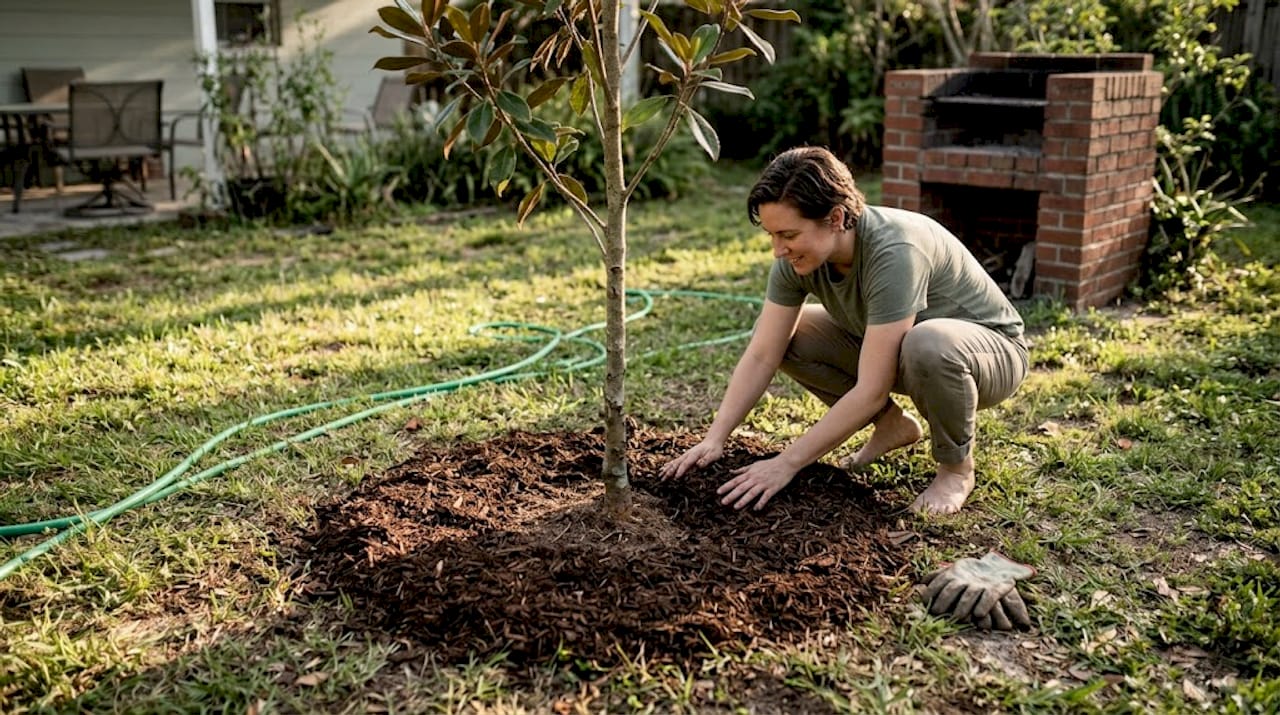
- Apply mulch correctly. Spread a 2 to 3 inch layer of organic mulch in a ring around the tree, keeping it a few inches away from the trunk. Never pile it against the bark.
- Amend sandy soils. Central Florida’s sandy soils drain fast and hold little organic matter. Work on improving organic matter through composting or organic topdressing to support root development.
- Adjust irrigation seasonally. During the dry season (roughly November through May), supplemental watering may be needed for young or recently planted trees. During the wet season, most established trees need little to no added water.
- Monitor for pests and disease after periods of stress, including drought or storm damage.
The mulch issue deserves extra attention. Mulching beyond 4 inches may increase tree mortality, even though research on the exact threshold remains ongoing. What is clear is that “mulch volcanoes,” those piled-up mounds pressed against the bark, trap moisture, invite rot, and encourage girdling roots that can kill a tree over years.
For detailed pruning tips for Florida trees, timing and technique both matter. And for a full look at how your care routine should shift with the seasons, seasonal tree care advice lays out what to prioritize month by month.
Pro Tip: Check soil moisture at 2 to 3 inches deep before and after rainy spells. If the soil feels wet for more than three days after rain, your irrigation schedule may be overwatering, which is just as damaging as drought in compacted or clay-heavy spots.
| Practice | Common mistake | Better approach |
|---|---|---|
| Mulching | Piling against trunk | 2 to 3 inch ring, clear of bark |
| Pruning | Topping or heavy cuts | Selective structural pruning |
| Irrigation | Set-and-forget schedule | Seasonal adjustment based on rainfall |
Understanding the impact of weather and seasons on tree health
In Central Florida, the weather isn’t just atmosphere. It’s a major player in your trees’ health story.
Seasonal monitoring is critical: the dry season is the time to inspect structure and branches, while the wet season demands attention to root health and pest pressure. Swapping those priorities is a mistake most property owners make without realizing it.
Hurricanes and tropical storms are the biggest acute risk. But here’s where conventional wisdom often misleads: aggressively thinning a tree’s canopy before storm season does not necessarily make it safer. Properly pruned trees survive hurricanes at a rate of 73% compared to 47% for unpruned trees, but that improvement comes from structural pruning over time, not emergency canopy stripping right before a storm.
Over-thinning can actually increase the wind load on remaining branches, making failures more likely. The goal is a well-spaced, structurally sound canopy, not a sparse one.
Here’s a year-round seasonal checklist built for Central Florida conditions:
- November to February (dry season): Inspect for cracks, deadwood, and structural defects. This is the best time for major pruning work since pest and disease pressure is lower.
- March to May (transition): Monitor soil moisture, fertilize if needed, and check mulch depth as we head into the warmer months.
- June to September (storm season): Avoid heavy pruning. Watch for signs of root saturation, fungal growth, and pest activity in the wet heat.
- October: Post-storm assessment time. Walk your property and document any new damage or stress signs.
Pro Tip: Schedule a professional structural inspection in April or early May, right before storm season begins. Catching a weak union or crack before the first hurricane watch saves you significant repair costs later.
For a detailed guide on getting ready for hurricane season, hurricane season tree preparation is worth reviewing before June. If you’re planning pruning work specifically for storm readiness, storm trimming preparation covers what actually helps versus what just looks like action.
Common myths and mistakes about tree health
Even armed with good intentions, many property managers and owners fall for common myths. Let’s separate fact from fiction.
The tree care industry has built up a long list of standard recommendations over the decades. Some are solid. Some, it turns out, have weaker evidence behind them than most people assume.
Industry best practices warn against deep mulching and canopy thinning, but research on both practices shows the evidence is often inconclusive or even contradicts the conventional advice. That doesn’t mean you should ignore these guidelines, but it does mean you should apply them with context rather than as rigid rules.
Here are the myths that trip up property owners most often:
- “More mulch is better.” Wrong. Deep mulch suffocates surface roots and invites pests and rot. Keep it at 2 to 3 inches.
- “Thinning the canopy protects trees in storms.” Not automatically. Poorly done thinning can increase wind resistance and create structural weak points.
- “If a tree looks green, it’s fine.” Structural failures and root problems develop internally, often for years before any visual sign appears.
- “Topping a tall tree makes it safer.” Topping is one of the most harmful practices in tree care. It weakens structure, invites disease, and leads to rapid, poorly attached regrowth.
- “You only need to prune when you see a problem.” Reactive pruning is more expensive and less effective than routine structural care from the start.
On the tool question: anvil pruners (which crush the stem) versus bypass pruners (which cut cleanly) does matter for small branches, but it’s far less important than cutting at the right location and angle. Technique beats tool choice every time.
For a clear breakdown of what each type of care actually involves, the trimming vs pruning guide clears up a lot of confusion. And if you’re managing trees on a larger property, knowing which species may be protected under Florida regulations affects what you can legally do without a permit.
Why a proactive, evidence-based approach transforms tree health
Here’s what years of working with Central Florida properties has made obvious to us: most tree problems don’t happen suddenly. They build slowly, across seasons, often in places you can’t see without knowing what to look for.
Property owners who wait for visible symptoms before acting are always playing catch-up. The ones who schedule regular walkthroughs, adjust their mulch and irrigation based on what they observe, and get structural assessments before storm season never face the same costly surprises.
Central Florida’s soil and climate demand more attention than most other regions. Sandy soil loses moisture and nutrients fast. The wet and dry seasons swing hard in both directions. A care routine that works in the Midwest won’t hold up here.
The mindset shift that makes the biggest difference is moving from “my trees look fine” to “let me check what’s actually happening.” Small, consistent observations and prompt responses to early warning signs add years to a tree’s life and real value to your property. For a framework that fits this region, consistent seasonal tree care is where that habit starts.
How professional expertise makes a lasting difference
While these steps can transform your landscape, expert support brings true peace of mind.
Some tree health issues are straightforward enough to manage with good information and consistent effort. Others require trained eyes and the right equipment to assess and address safely. Structural defects, root problems, and storm damage are rarely simple to evaluate from the ground, and getting them wrong can mean real safety and liability risks for your property.
At McCullough Tree Service, our certified arborists work with Central Florida property owners and managers to deliver tailored care, from tree trimming services to full storm preparation and health assessments. Whether you’re unsure about the differences between trimming and pruning or need a complete seasonal plan, we bring the local expertise that makes a real difference. Contact us to schedule an assessment and protect what your landscape is worth.
Frequently asked questions
What are the top signs my tree is unhealthy?
Red flags include major cracks in the trunk, thinning or brown canopy, visible root problems, and decaying branches. Visible structural defects and canopy decline are among the most reliable early indicators of serious trouble.
How often should I prune my trees in Central Florida?
Prune young trees annually and mature trees every 2 to 5 years, always factoring in the wet and dry seasons. Structural pruning starting at planting is one of the most effective long-term investments you can make in tree health.
Is mulching always beneficial for trees?
Mulching helps most trees, but too much, over 4 inches, can cause problems like rot or girdling roots. Mulching deeper than 4 inches may increase tree mortality, and the research on the exact safe threshold is still developing.
Do I need to water trees if it rains frequently?
After heavy rains, check soil dampness at a few inches deep before adding water. Soil management with attention to local conditions is especially important in Central Florida because sandy soils can dry out within a day or two even after significant rainfall.
Recommended
- Tree planting benefits Central Florida properties 2026
- Central Florida tree maintenance checklist 2026
- Tree Planting Guide Central Florida for Homeowners
- Tree preservation: boost health & beauty in Florida