By: Shelby McCullough| Published: August 12, 2026
Most trees in unincorporated Seminole County measuring more than 6 inches in diameter at breast height (DBH) require an Arbor Permit before removal. That threshold is measured 4.5 feet above the ground, and the rule is grounded in Land Development Code Chapter 60. If your property sits inside a city’s limits, the city’s own code applies instead, and the process differs.
Two qualifiers matter immediately. First, your property’s jurisdiction: unincorporated county land falls under county rules, while cities like Winter Park, Sanford, or Casselberry each have their own ordinances. Second, a common homeowner exemption covers developed single-family lots of 3 acres or less that already have a house on them, but wetland areas on those lots are not exempt.
Quick next steps:
- Confirm whether your parcel is in unincorporated Seminole County or inside a city (use the county’s online parcel search)
- Measure the tree’s DBH: wrap a tape around the trunk at 4.5 feet and divide the circumference by 3.14
- If you need a permit, download the county Arbor Permit form or call Development Services at (407) 665-7371
- If the tree is hazardous, contact an ISA-certified arborist before applying
Key Takeaways
In unincorporated Seminole County, any tree over 6 inches DBH requires an Arbor Permit before removal unless a specific exemption applies, and removing one without a permit triggers code enforcement, mandatory mitigation, and per-tree fines.
| Point | Details |
|---|---|
| 6-inch DBH threshold | Trees over 6″ diameter measured 4.5’ above ground are protected and require an Arbor Permit. |
| Homeowner exemption | Developed single-family lots of 3 acres or less with a house are commonly exempt; wetlands are not. |
| FS 163.045 hazard preemption | An ISA-certified arborist’s written risk report can eliminate the permit, fees, and mitigation requirement entirely. |
| Arbor Trust Fund rate | Mitigation payments run $125 per caliper inch when on-site replacement is not fully feasible. |
| Mcculloughtreeservice | Provides ISA-certified arborist reports, permit documentation, and insured removal for Seminole County properties. |
Table of Contents
- Do you need a tree removal permit in Seminole County?
- Which exemptions apply, and what does Florida law preempt?
- What documents does the county require for an Arbor Permit?
- How to apply for a Seminole County Arbor Permit
- What mitigation or replacement does the county require?
- Common reasons permits are granted and how to document them
- What happens after you apply, and what are the penalties?
- How a certified arborist helps with the permit process
- What most applicants get wrong, and how to avoid it
- Mcculloughtreeservice handles permits, arborist reports, and compliant removal
- Sources
Do you need a tree removal permit in Seminole County?
The county’s Arbor Permit requirement applies to unincorporated Seminole County only. If your address falls within a city boundary, stop and check that city’s tree ordinance first. The county rule covers any tree with a trunk diameter greater than 6 inches, measured 4.5 feet above grade. That measurement point is the standard forestry definition of DBH, and getting it right matters because it determines whether your tree is regulated at all.
The 6-inch DBH threshold is the single most important number in a Seminole County Arbor Permit application. Trees at or below that diameter are generally unregulated; trees above it require a permit unless a specific exemption applies.
How to measure DBH correctly
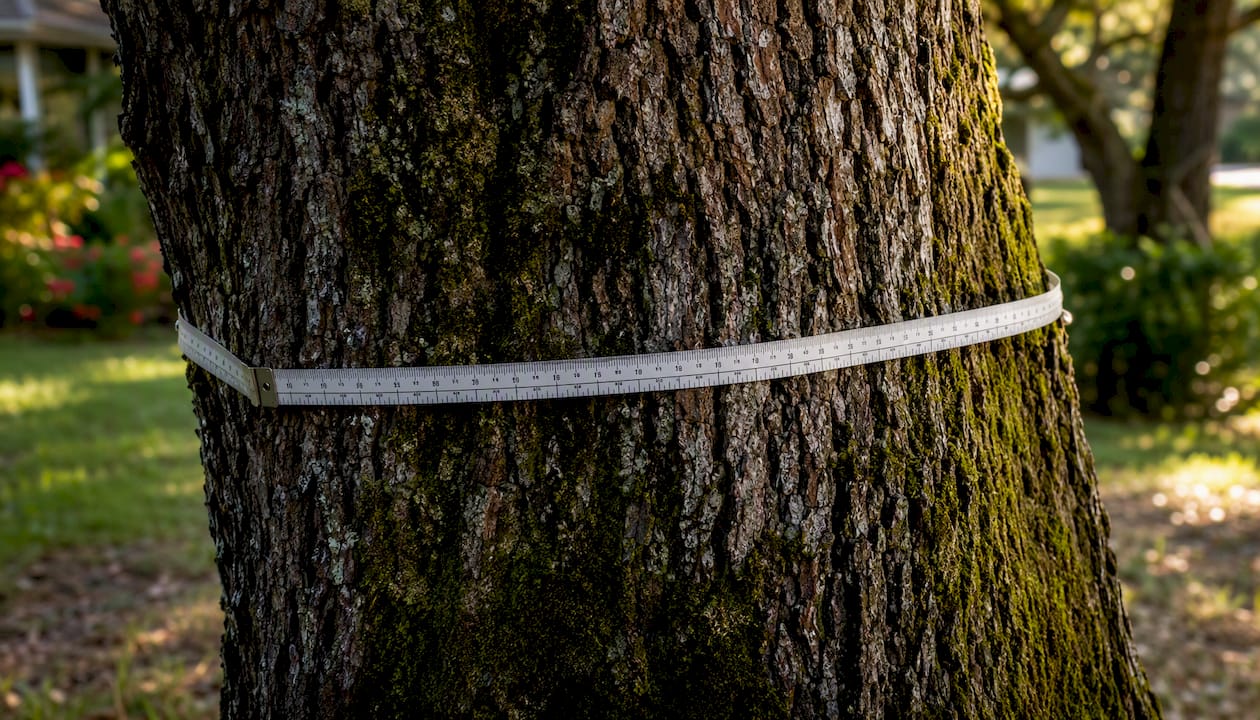
Wrap a flexible tape measure around the trunk at exactly 4.5 feet above the ground on the uphill side. That gives you the circumference. Divide by 3.14 to get the diameter. A DBH tape, available at most hardware stores, skips the math and reads diameter directly. Common mistakes: measuring at the base, measuring on a slope without adjusting for the uphill side, or measuring at a trunk swell or branch union rather than the standard 4.5-foot point.
Before you apply, check your jurisdiction. The county’s parcel search tool at the Seminole County Property Appraiser’s website shows whether your lot is unincorporated. If it is inside a city, the City of Seminole Tree Removal Permit Application is the correct starting form for properties within that city’s limits.
Which exemptions apply, and what does Florida law preempt?
Several categories of property and tree situations fall outside the county’s standard permit requirement. Knowing which one applies to you can save significant time and money.
Standard county exemptions include:
- Developed single-family residential lots of a relatively small size with an existing house (wetland areas on those lots remain subject to separate review)
- Bona-fide agricultural properties under Florida Statute 193.461
- Certain invasive or pest species where the county has designated removal as permitted
The wetland carve-out is the one that surprises most homeowners. Even if your lot is under 3 acres with a house, any tree within a wetland boundary requires separate environmental review. Wetland lines on your property can be identified through a county GIS layer or a site survey.
Florida Statute 163.045 is a statewide preemption that overrides local permit requirements for hazardous residential trees. When an ISA-certified arborist or Florida-licensed landscape architect documents in writing that a tree poses an unacceptable risk, the county cannot require a permit, charge fees, or mandate mitigation for its removal.
That preemption is powerful, but the documentation has to be specific. The arborist’s written report should identify the tree’s species and location, describe the failure hazard in detail (dead wood, root damage, lean, structural defect), assign a risk rating, and include the professional’s ISA credential number or Florida license number. A vague note saying “tree looks dangerous” will not satisfy the standard. For more on Florida’s protected tree regulations, the rules around documentation and species coverage are worth reviewing before you assume an exemption applies.
What documents does the county require for an Arbor Permit?
The county’s official checklist is the safest guide to a complete first submission. Missing any item typically means a resubmission delay.
| Required Document | What It Must Show |
|---|---|
| Completed Arbor Permit application | Property address, owner info, contact, reason for removal |
| Written statement of reason for removal | Specific justification tied to county criteria |
| Tree preservation statement | Which trees on site will be retained and how they will be protected |
| Site plan | Structures, grading, easements, all trees ≥6″ DBH labeled with species and DBH |
| Wetland delineation (if applicable) | Wetland lines and buffer zones shown on the site plan |
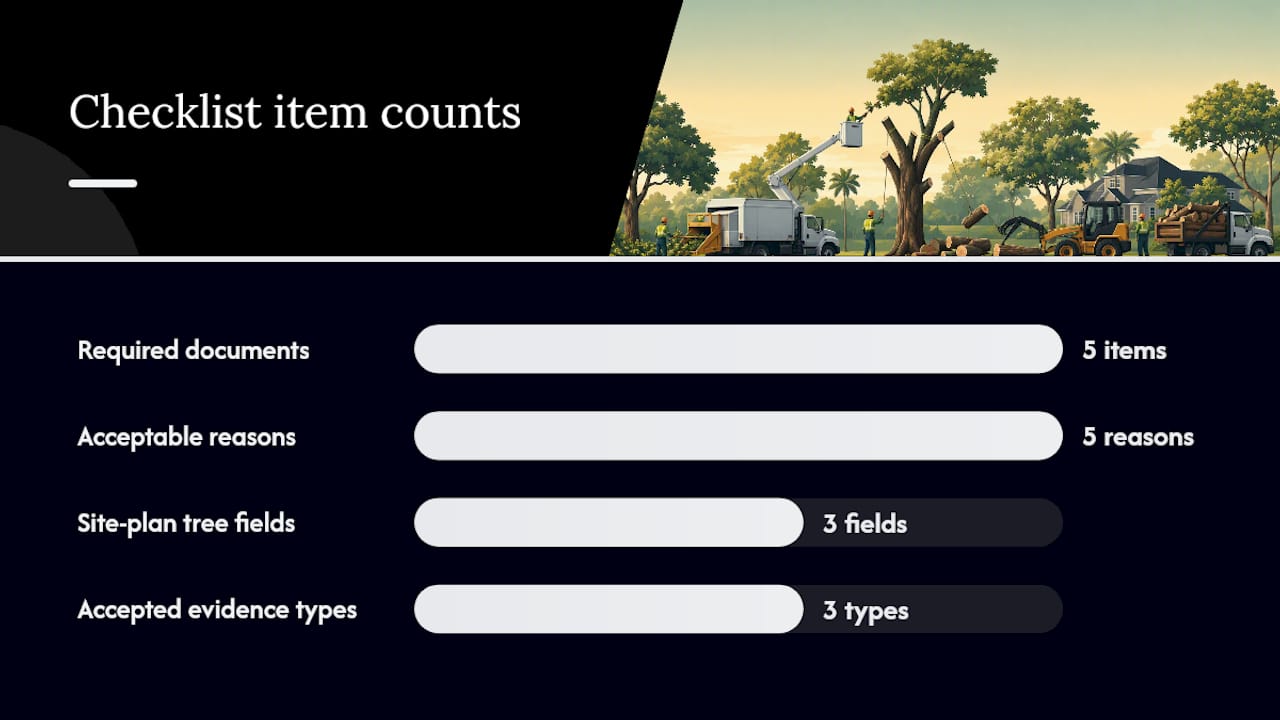
Site plan specifics matter. Every regulated tree on the property must appear on the plan with a label showing its species, DBH, and status: retained, removed, relocated, or replaced. Wetland lines, if present, must be drawn on the plan. For development projects, the site plan must tie to the subdivision or site plan application already on file with the county.
Acceptable written reasons for removal, per the county’s own guidance, include:
- The tree sits in a buildable area required for a permitted structure or improvement
- The tree is diseased, injured, or dying and poses a hazard
- The tree creates a danger to pedestrians, vehicles, or structures
- The tree interferes with utility lines or underground infrastructure
- The tree obstructs required sight distance at a driveway or intersection
Each reason should be supported by evidence: photos, an arborist assessment, or a site plan showing the proposed improvement that conflicts with the tree’s location.
How to apply for a Seminole County Arbor Permit
The application process is straightforward when your documents are complete before you start.
- Confirm jurisdiction. Verify your parcel is in unincorporated Seminole County using the county’s property search. If you are inside a city, use that city’s form instead.
- Download the application. The county Arbor Permit page at seminolecountyfl.gov hosts the current form. For properties inside the City of Seminole, use the Tree Removal Permit Application PDF directly.
- Prepare your full packet. Assemble the application, written reason, tree preservation statement, and site plan before submitting. Incomplete packets are the most common cause of delays.
- Submit to Development Services. The county accepts submissions at the Development Services permit center. Call (407) 665-7371 to confirm current submission options (in-person, online portal, or mail) and whether a review fee applies to your specific project type.
- Follow up. After submission, track your application status through the county’s online permit portal or by contacting the permit center directly.
Submission tips that reduce back-and-forth:
- Label every tree on the site plan with a number that matches a legend listing species and DBH
- Write the removal reason in plain language tied directly to one of the county’s stated criteria
- Include dated photographs of the tree from at least two angles
- Note any utility lines, structures, or improvements within 20 feet of the tree
For a broader look at tree permits across Central Florida, the county-by-county differences in threshold and exemption rules are worth understanding before you assume Seminole’s rules match a neighboring jurisdiction.
What mitigation or replacement does the county require?
When the county approves a removal, it typically requires replacement trees or a mitigation payment. The county measures mitigation in caliper inches, which for replacement trees refers to the trunk diameter measured 6 inches above the ground at planting.
The county’s Arbor Trust Fund is the mechanism for situations where full on-site replacement is not feasible. Seminole County accepts payments into the fund at a rate of $125 per caliper inch when on-site replacement cannot satisfy the full mitigation requirement. The fund supports county planting projects in parks and public spaces.
Example calculation: A 20-inch DBH live oak is approved for removal. The county determines 20 caliper inches of mitigation are required. If you cannot plant 20 caliper inches of replacement trees on-site, you pay 20 × $125 = $2,500 into the Arbor Trust Fund. Partial on-site replacement reduces the payment proportionally: plant 10 caliper inches on-site and pay $1,250 for the remaining 10.
Pro Tip: On-site replacement is almost always cheaper than the fund payment when you have the space. A 3-inch caliper replacement tree from a nursery typically costs far less than $375 (3 × $125). Get a nursery quote before deciding to pay into the fund.
When replacement trees are required, the county’s LDC Chapter 60 specifies that the landscape plan must list each tree’s common and botanical name, caliper or height at planting, and spacing.
Common reasons permits are granted and how to document them
The county’s Arbor Permit page lists the reasons reviewers most commonly approve, and framing your application around one of them specifically is the fastest path to approval.
Permitted reasons and supporting evidence:
- Buildable area conflict: Show the proposed structure footprint on the site plan overlapping the tree’s root zone or canopy; include the building permit application number if one exists
- Disease or injury: Provide an arborist’s written assessment with photos showing the condition; a lab report for fungal or pest diagnosis strengthens the case
- Hazard to people or structures: An ISA-certified arborist risk assessment using the International Society of Arboriculture’s Tree Risk Assessment Qualification (TRAQ) methodology carries the most weight
- Utility interference: A letter or diagram from the utility provider showing the conflict, combined with photos of the encroachment
- Sight-distance obstruction: A site plan or survey showing the tree’s location relative to a driveway or intersection, with measurements to the sight triangle
For DBH measurement on the site plan, record each tree’s diameter to the nearest inch. A 14.3-inch DBH tree is recorded as 14 inches. Caliper inches for replacement trees are measured differently (6 inches above ground at planting), so keep the two measurements distinct in your documentation.
What happens after you apply, and what are the penalties?
Review timelines for straightforward residential Arbor Permit applications are typically measured in days to a few weeks, depending on Development Services workload and whether the application is complete at submission. Development-linked applications tied to active site plans or subdivision reviews can take longer, as they move through a coordinated review process with other county departments.
Once approved, the permit authorizes removal within a defined window. If removal is delayed past that window, contact Development Services about an extension before the permit expires. Letting a permit lapse and then removing the tree anyway creates the same enforcement exposure as never having applied.
Removing a protected tree without a valid Arbor Permit is a code violation in Seminole County. The county’s Code Enforcement Division can issue citations, require replacement or mitigation at the violator’s expense, and impose per-tree fines. Enforcement actions are documented and can affect future permit applications on the same property.
If your permit is denied: The county’s permit process includes an appeals pathway. Request a written denial with the specific reason, then address that reason directly in a revised submission or appeal to the appropriate county board. An ISA-certified arborist’s report often resolves the most common denial reasons, particularly those involving hazard or condition claims.
How a certified arborist helps with the permit process
Hiring an ISA-certified arborist before you apply is the single most effective way to avoid delays, denials, and enforcement exposure. Here is what to look for and what their involvement covers.
When hiring an arborist, confirm:
- Active ISA certification (verifiable at the ISA’s online credential lookup)
- Experience with Seminole County Arbor Permit submissions specifically
- Willingness to provide a written report, not just a verbal opinion
- Errors and omissions insurance for professional reports
What a qualified arborist’s report should include for a FS 163.045 hazard claim:
- Tree species, location, and DBH
- Observed structural defects, disease indicators, or root damage with photographs
- Risk rating using a recognized methodology (ISA TRAQ or equivalent)
- Professional’s conclusion that the tree poses an unacceptable risk
- ISA credential number or Florida landscape architect license number
- Signature and date
Beyond hazard documentation, a certified arborist adds value throughout the permit process: accurate DBH measurement, properly labeled site plans, credible written reasons for removal, and mitigation calculations that match county standards. For development projects removing multiple trees, that expertise reduces the back-and-forth with county reviewers considerably. McCullough Tree Service’s certified arborist services cover all of these documentation needs for Seminole County properties.
What most applicants get wrong, and how to avoid it
The most common application mistakes are not about the trees. They are about the paperwork. Site plans submitted without DBH labels, written reasons that say “tree is old” rather than citing a specific county criterion, and applications submitted to the wrong jurisdiction (county form for a city lot, or vice versa) account for the majority of resubmissions.
A few practices that consistently produce cleaner applications: photograph the tree from at least four angles, including one showing its proximity to the nearest structure or utility line. Keep a written log of when you first noticed the condition, any neighbor concerns, and any utility company communications. Check for overhead and underground utilities before scheduling removal, because a utility conflict discovered after permit approval can delay the job and require a permit amendment.
Get a formal arborist report even when you believe you qualify for the homeowner exemption. If the lot has any wetland area, if the tree is near a property line, or if a neighbor has expressed concern, a written professional assessment protects you from enforcement action regardless of whether a permit was technically required.
Mcculloughtreeservice handles permits, arborist reports, and compliant removal
Navigating a Seminole County Arbor Permit is faster with a team that already knows the county’s checklist, measurement standards, and reviewer expectations. Mccullough Tree Service provides ISA-certified arborist reports that satisfy FS 163.045 hazard documentation requirements, accurate DBH measurement and site-plan labeling, and fully insured tree removal that complies with county rules from permit to stump.
If you are pursuing the hazard-tree exemption, the process starts with an on-site assessment and a written arborist report. If you need a standard Arbor Permit, the team can prepare the full submittal packet. Either way, you get a single point of contact from measurement through removal. Request an on-site assessment at mcculloughtreeservice.com or call to schedule an arborist visit before your next step.
Sources
Use the links below to access the primary documents and code references for Seminole County tree removal permits. The county Arbor Permit page is the starting point for unincorporated properties; the City of Seminole PDF applies only to properties inside that city’s limits.
- Arbor Permit
- Tree Removal Permits — Seminole County, FL | CityRuleLookup
- Chapter 60 – ARBOR REGULATIONS | Land Development Code | Seminole County, FL | Municode Library
- With change, Seminole County developers can pay into tree fund instead of replacing trees
For properties inside other municipalities such as Winter Park, check that city’s development services department directly, as the threshold, exemptions, and application process may differ from the county’s rules.
Recommended
- Tree Permits in Central Florida: What Owners Must Know
- Tree Permits in Central Florida – What Homeowners Need to Know
- Tree removal safety steps Central Florida homeowners need
- Proper Tree Removal: Protecting Safety and Property