By: | Published: April 22, 2026
TL;DR:
- Tree risk assessments evaluate tree failure probability without relying on appearance.
- Proper pruning and regular inspections significantly reduce storm-related tree failures.
- No tree is completely risk-free; ongoing management is essential for safety and property protection.
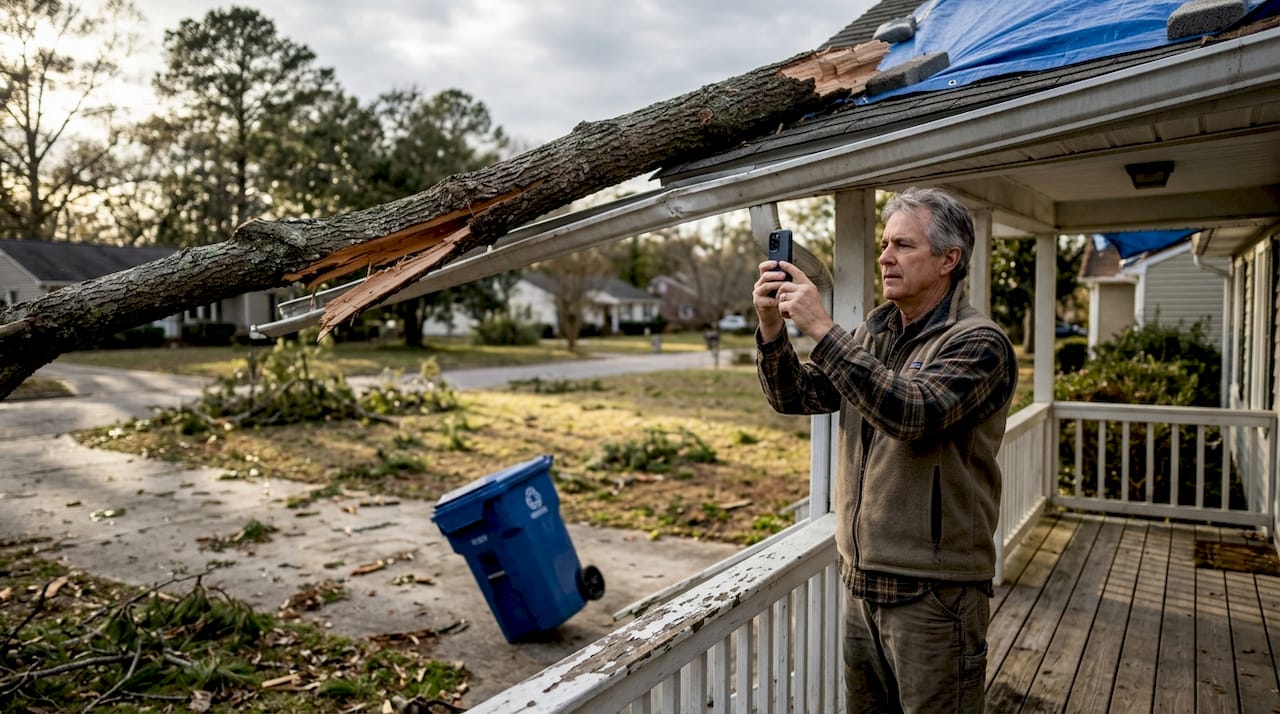
A tree can look perfectly healthy from your driveway and still be one strong gust away from crushing your roof. Central Florida property owners face this reality every hurricane season, and the consequences of ignoring it are severe. Post-storm studies from Florida’s 2004 and 2005 hurricane seasons, which evaluated 281 trees, confirm that even well-maintained trees fail under the right conditions. A professional tree risk assessment changes the equation. It tells you which trees are genuinely dangerous, which can be saved with care, and which need to come down before they cause real harm. This guide walks you through exactly how that process works.
Table of Contents
- What is tree risk assessment and why does it matter?
- Core tree risk assessment process: Methods and matrix explained
- Local benchmarks: What Central Florida hurricane events reveal
- Mitigation: Practical steps you can take for safer trees
- The uncomfortable truth about tree risk—what experts rarely tell you
- How McCullough Tree Service helps protect your property
- Frequently asked questions
Key Takeaways
| Point | Details |
|---|---|
| Risk assessment saves property | Proper tree risk evaluation minimizes storm damage and liability for Central Florida property owners. |
| Empirical benchmarks matter | Hurricane data reveals which trees are most vulnerable and how professional care improves resistance. |
| Mitigation options are diverse | Pruning, cabling, and removal each play a unique role in risk reduction, depending on tree type and site. |
| Continuous care beats one-time fixes | Regular assessments and expert intervention are essential for ongoing safety—not just after storms. |
| Balance safety and preservation | There is no risk-free tree, so ongoing management by qualified professionals ensures best outcomes. |
What is tree risk assessment and why does it matter?
Tree risk assessment is a structured evaluation that determines how likely a tree is to fail, what it might hit if it does, and how serious the consequences would be. The key insight most property owners miss is that appearance is not a reliable indicator of risk. A tree can have full, green foliage while quietly rotting from the inside. Cracks, leaning trunks, and dead wood are obvious warning signs, but fungal decay in the root system or internal cavities are invisible to anyone without training.
Risk assessment solves this problem by giving arborists a repeatable, evidence-based framework. They use the ISA assessment methodology, developed by the International Society of Arboriculture, to score trees across multiple dimensions rather than relying on a quick visual check. This methodology is the same standard used by municipalities, golf courses, and universities to manage their trees.
Why does this matter for your property specifically? Three reasons stand out:
- Safety: A failing tree can kill. Storm-season failures account for a significant number of property fatalities in Florida every year.
- Liability: If a tree on your property falls and damages a neighbor’s home or injures someone, you may be held legally responsible, especially if you ignored known risks.
- Property value: Healthy, well-managed trees add value. Dangerous, poorly maintained ones do the opposite and can complicate insurance claims or home sales.
- Storm preparedness: Mitigation options like pruning reduce storm damage significantly, making regular assessment a practical investment, not just a precaution.
Routine inspections by a qualified arborist catch problems early, before they escalate into emergencies. Using a tree hazard evaluation guide specific to Florida conditions makes this process even more targeted.
“Trees pruned by professionals before storms consistently outperform unpruned trees in wind resistance tests. The difference is not marginal. It is substantial.”
Now that you know why tree risk assessment is essential, let’s break down how experts actually perform these assessments.
Core tree risk assessment process: Methods and matrix explained
The assessment process follows a clear sequence. Knowing what happens during an evaluation helps you ask better questions and understand the report you receive.
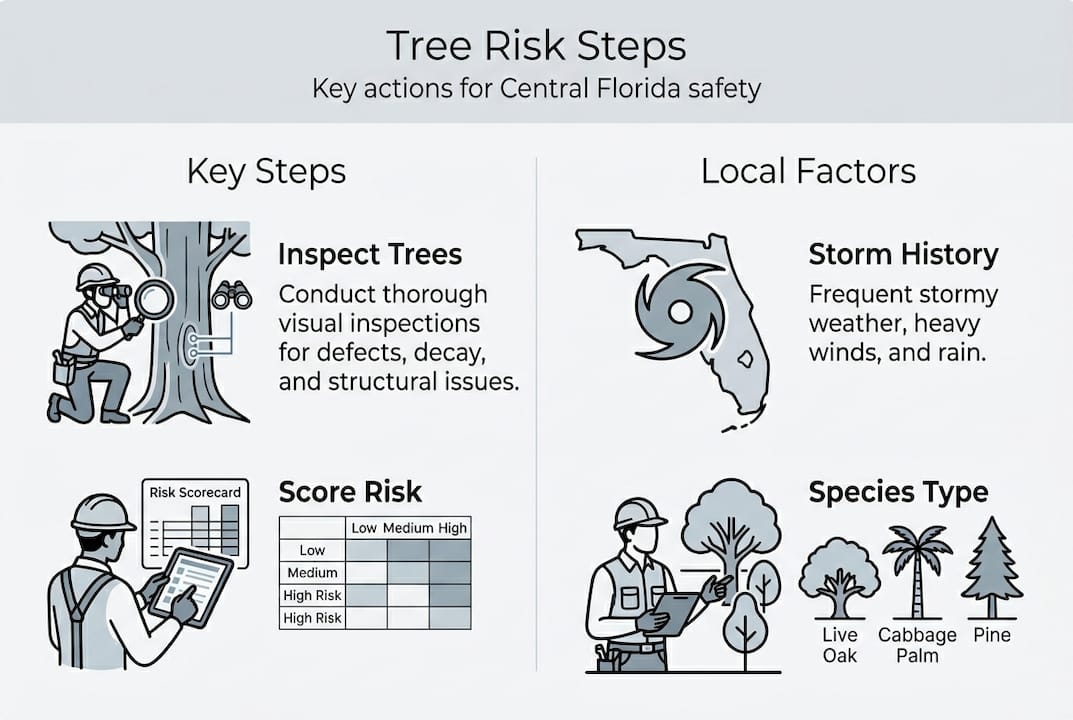
- Visual inspection: The arborist walks the tree, examining the root zone, trunk base, main stem, major branches, and crown. They look for structural defects, signs of disease, pest damage, and environmental stress.
- Defect scoring: Each identified defect is rated by severity. A co-dominant stem (two main trunks competing) scores differently than a single cavity near the base.
- Likelihood of Failure (LoF): Using the ISA risk matrix framework, the arborist rates how likely the tree or a part of it is to fail under typical or storm conditions. Scores range from improbable to imminent.
- Likelihood of Impact (LoI): This rating measures the chance that a failing part would actually hit something, based on where the tree sits relative to targets like structures, vehicles, or pedestrian paths.
- Consequences of Failure: The arborist weighs what the impact would mean. A tree falling into an empty field is a different risk category than one leaning toward a school playground.
- Risk categorization: Combining all three scores produces an overall rating: Low, Moderate, High, or Extreme.
| Risk level | Description | Typical action |
|---|---|---|
| Low | Failure unlikely; minimal targets | Monitor annually |
| Moderate | Some defects; targets present | Prune or cable; recheck |
| High | Significant defects; likely impact | Immediate mitigation or removal |
| Extreme | Imminent failure; critical targets | Emergency removal |
Both species and site conditions factor into the scoring. A live oak rated moderate in an open yard becomes high-risk when planted three feet from a bedroom window. Storm risk insights from UF/IFAS confirm that site context consistently shapes outcomes as much as species ratings.
Pro Tip: Always ask whether your arborist holds TRAQ (Tree Risk Assessment Qualification) certification. This credential, issued by the ISA, means the arborist is trained specifically in risk evaluation, not just general tree care. Certified arborists with TRAQ certification deliver more reliable, defensible assessments. Understanding the arborist service benefits before you hire helps set realistic expectations.
With the process clear, let’s see how local hurricane data and species ratings inform these assessments for Central Florida properties.
Local benchmarks: What Central Florida hurricane events reveal
Florida’s hurricane history provides a rare data set that most states simply do not have. After the brutal 2004 and 2005 storm seasons, researchers evaluated 281 trees across affected areas. The findings reshaped how arborists approach risk in high-wind environments.
| Finding | Detail |
|---|---|
| Trees evaluated post-storm | 281 across FL hurricane zones |
| Pruned trees vs. unpruned | Pruned trees showed significantly lower failure rates |
| Species wind ratings expanded | ML model expanded ratings to 418 species at 91% accuracy |
| Top performing species | Live oak, southern magnolia, crape myrtle |
| Higher failure risk species | Laurel oak, sand pine, water oak |
Key takeaways from local hurricane data:
- Species selection matters, but maintenance history matters just as much.
- Trees with proper crown thinning fail at lower rates than dense-canopied, unpruned trees.
- Root zone health, often compromised by construction or soil compaction in Central Florida neighborhoods, is a major predictor of failure.
- Mature trees in poor structural condition are not automatically safer just because they have survived previous storms.
“No tree is risk-free. Every assessment is about understanding probability, not guaranteeing outcomes. Safety comes from ongoing management, not a single inspection.”
Following tree care best practices specific to Florida’s climate reduces the cumulative risk buildup that makes trees dangerous over time. Consistent professional trimming is not just aesthetic maintenance. It directly reduces wind resistance and removes the weak, dead wood most likely to become a projectile during a storm.
Armed with local data, property owners can apply practical risk mitigation strategies to protect their trees and investments.
Mitigation: Practical steps you can take for safer trees
Knowing a tree is risky is only half the job. The other half is deciding what to do about it. Mitigation is not a one-size-fits-all decision, and the right option depends on the tree’s risk rating, its species, your property layout, and your goals.
- Pruning: The most common mitigation tool. Removing dead, crossing, or structurally weak branches reduces wind resistance and eliminates the most likely failure points. Understanding the difference between trimming vs. pruning helps you communicate clearly with your arborist about what the tree actually needs.
- Cabling and bracing: Structural support systems that reinforce weak branch unions or co-dominant stems. These are installed by arborists and allow you to retain a tree that would otherwise need removal.
- Root zone management: Addressing soil compaction, improving drainage, and avoiding grade changes near the root flare can dramatically extend a tree’s useful life and structural integrity.
- Removal: When a tree’s risk rating is high or extreme and mitigation options cannot adequately reduce the hazard, removal is the responsible choice. Delaying this decision rarely ends well.
- Monitoring: Low-risk trees still need annual check-ins. Conditions change. A tree that scored low last year can shift categories after a drought, pest outbreak, or nearby construction.
Expert mitigation advice from UF/IFAS consistently emphasizes that regular inspections reduce storm damage far more than reactive emergency work after the fact.
Pro Tip: Schedule your assessment in March or April, before hurricane season officially begins in June. This gives you time to act on recommendations without emergency pricing or scheduling delays. Arborists also follow strict trimming safety protocols that protect your property during the work itself.
Practical tips from arborists who work Central Florida properties every season:
- Never top a tree as a storm-prep strategy. It creates multiple weak regrowth points that fail faster in wind.
- Species that naturally drop branches, like laurel oak, need more frequent assessment than naturally strong-wooded species.
- Trees near power lines require coordination with your utility company before any mitigation work begins.
Even with solid mitigation and ongoing assessment, there are some deeper truths that most guides overlook.
The uncomfortable truth about tree risk—what experts rarely tell you
Here is something most tree care articles will not say directly: there is no such thing as a zero-risk tree. Property owners sometimes ask us to inspect a tree and give them certainty that it will never fall. That is not something any honest arborist can provide.
What we can tell you is that the risk on your property can be understood, categorized, and actively managed. The goal is not elimination. It is reduction to an acceptable level given the targets involved. A massive live oak over an empty lawn carries different weight than the same tree over your guest bedroom.
The other truth is that the most dangerous trees are often the ones owners feel most attached to. A 100-year-old oak has real sentimental and ecological value. But when its root system is failing and it leans toward occupied space, that value must be weighed honestly.
We also see property owners rely on a single inspection done years ago as permanent peace of mind. Trees change. Disease progresses. Soil conditions shift. What was low-risk in 2022 may be moderate or high today. Tree inspections and compliance are ongoing responsibilities, not one-time checkboxes. Working with a certified arborist on a scheduled basis is the only reliable way to stay ahead of risk rather than react to it.
How McCullough Tree Service helps protect your property
At McCullough Tree Service, we work with Orlando and Central Florida property owners year-round to assess, manage, and mitigate tree risk before it becomes a crisis.
Our TRAQ-qualified arborists use the same ISA methodology described in this guide to give you a clear, honest picture of every tree on your property. Whether you need a full assessment, seasonal tree trimming services, or complete tree removal services, we handle it with the care and professionalism your property deserves. Not sure where to start? Our trimming vs. pruning guide breaks down the options so you can make an informed decision. Contact us today to schedule your assessment before hurricane season.
Frequently asked questions
How often should I get a tree risk assessment in Central Florida?
Annual assessments are recommended, especially before hurricane season or following major storms. Regular inspections consistently reduce storm damage by catching developing hazards before they escalate.
What is the best mitigation option for high-risk trees?
Pruning and cabling are often the first choice, but removal may be necessary depending on severity. Mitigation decisions should always factor in site conditions, species, and proximity to structures.
Do all tree species have equal storm resistance?
No. Wind resistance varies considerably by species, and UF/ISA wind ratings now cover more than 400 species to guide selection and management in high-wind areas like Central Florida.
Is tree risk assessment only needed after storms?
Assessments before storm season are actually more valuable because they allow time to act. Pre-season evaluations consistently reveal hidden threats that calm weather conceals and that storms expose catastrophically.
What qualifications should my arborist have for risk assessment?
Look for TRAQ-qualified arborists who follow ISA standards for matrix scoring and evaluation. TRAQ certification signals the arborist is trained specifically in risk evaluation, not just general tree maintenance.
Recommended
- Tree risk assessment tips for Central Florida owners
- Tree Health Assessment Guide for Central Florida Owners
- Tree Hazard Evaluation Explained: A Guide for FL Owners
- Spot Tree Hazards: Real Examples & Solutions for Central Florida