By: Shelby McCullough| Published: May 21, 2026
TL;DR:
- An ISA Certified Arborist is an individual who has met strict experience and exam requirements, ensuring professional knowledge. They perform comprehensive tree health assessments, pruning, risk evaluation, and safe removal to protect your property and trees. Verifying their certification through the ISA’s online directory guarantees qualified, accountable tree care practices.
Not every person with a chainsaw and a truck is qualified to touch your trees. That distinction matters more than most homeowners realize, and it comes down to one credential: the ISA Certified Arborist. If you’ve ever asked what is an ISA Certified Arborist and whether it actually matters who you hire, you’re asking exactly the right question. Understanding this credential could save your trees, protect your property, and keep you from paying for work that does more harm than good.
Table of Contents
- Key takeaways
- What is an ISA Certified Arborist?
- What does an ISA Certified Arborist do?
- ISA certification vs. other arborist credentials
- How to verify an ISA Certified Arborist before hiring
- My honest take on ISA certification and what it really means
- Work with certified arborists who know Central Florida trees
- FAQ
Key takeaways
| Point | Details |
|---|---|
| ISA certification is individual | Companies cannot hold ISA certification; only individual arborists earn and maintain it. |
| Experience and testing are required | Candidates need 3+ years of field experience and must pass a 200-question professional exam. |
| Certification is a baseline, not a ceiling | Advanced credentials like ISA TRAQ exist for specialized work such as tree risk assessment. |
| Verification is your responsibility | You can look up any arborist’s certification status on the ISA’s public directory before hiring. |
| Certified arborists protect your investment | Proper diagnosis, pruning, and treatment planning preserve tree health and prevent costly damage. |
What is an ISA Certified Arborist?
The International Society of Arboriculture, known as the ISA, is the globally recognized professional organization for the tree care industry. An ISA Certified Arborist is an individual who has met specific experience requirements, passed a rigorous written exam, and committed to ongoing education to maintain their credential. This is not a participation award. It represents a documented, tested baseline of professional knowledge in arboriculture.
To qualify for the exam, a candidate must complete 3+ years of eligible field work in arboriculture, or hold a related degree that reduces the experience requirement. The exam itself covers 200 questions across a broad range of topics including tree biology, soil science, pruning techniques, tree risk assessment, and pest and disease management. Passing that exam demonstrates that the arborist understands not just how to use equipment, but why specific practices matter for tree health.
The ISA certification is accredited by ANSI and conforms to ISO 17024, which is the international standard for personnel certification programs. That accreditation puts ISA Certified Arborists in the same credentialing category as other licensed professionals who must prove their knowledge before practicing.
Certified arborists must also agree to follow the ISA’s Code of Ethics, which holds them to standards of honesty, safety, and responsible practice. This is not a formality. It creates accountability that a random tree trimmer with no credentials simply does not have.
Maintaining the certification requires ongoing education credits, and exam fees are $295 for ISA members and $369 for non-members. The cost and time commitment filter out those who are not serious about the profession.
Pro Tip: When someone calls themselves a “certified arborist,” ask specifically for their ISA Certified Arborist number. This lets you verify their credential directly on the ISA’s public online directory before any work begins.
What does an ISA Certified Arborist do?
Understanding the role of ISA Certified Arborists helps you see why their training translates to better outcomes for your property. They do far more than trim branches. Their scope of work covers the full health and safety lifecycle of trees on residential and commercial properties.
Here is what a certified arborist is trained to handle:
- Tree health diagnosis. Certified arborists identify diseases, insect infestations, and nutrient deficiencies that cause decline, and they create treatment plans based on scientific knowledge rather than guesswork.
- Pruning and structural training. They know how and when to prune to encourage healthy growth, improve structure, and reduce storm risk without damaging the tree.
- Tree risk assessment. They evaluate trees for structural weakness, root problems, and hazard potential near structures or utilities.
- Pest and disease management. They recommend and apply treatments that are effective without causing collateral damage to surrounding vegetation or soil.
- Planting recommendations. They advise on species selection, planting depth, and placement to give new trees the best chance of long-term success.
- Tree removal decisions. They assess whether removal is necessary and, if so, how to carry it out safely.
This range of expertise is what separates a certified arborist from a general laborer doing yard work. If you own mature trees, large canopies near your house, or live in a storm-prone area like Central Florida, having someone with this knowledge on your property is not optional. It is how you protect a major landscape investment.
Regular tree maintenance, when done correctly by someone who understands tree biology, also prevents the expensive emergency calls that come from years of neglect or poor cutting practices. You can learn more about why routine tree care matters for long-term property value.
ISA certification vs. other arborist credentials
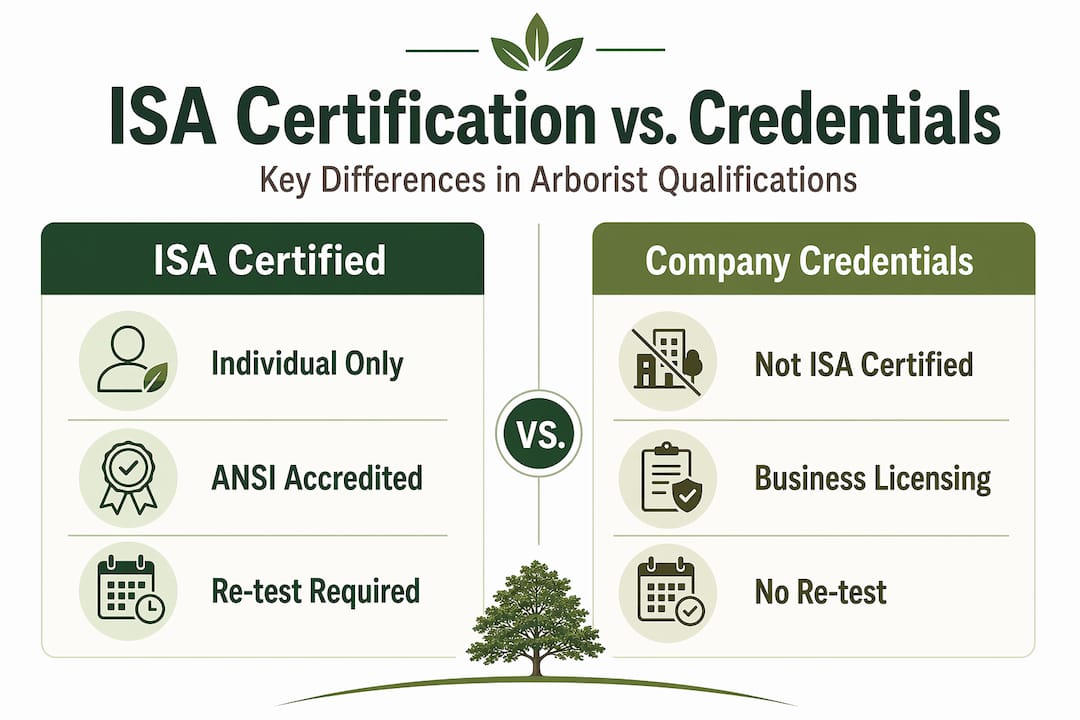
One thing that confuses homeowners is the relationship between ISA certification and other credentials in the industry. Here is a clear breakdown.
| Credential | Who holds it | What it means | Re-test required |
|---|---|---|---|
| ISA Certified Arborist | Individual only | Passed 200-question exam, 3+ years experience | No, but ongoing CEUs required |
| ISA Board Certified Master Arborist | Individual only | Advanced exam, highest ISA credential | Yes, periodic renewal |
| ISA TRAQ | Individual only | Specialized tree risk assessment qualification | Yes, every 5 years |
| Company “certification” claim | N/A | Not a recognized ISA credential | N/A |
The most important line in that table is the last one. Companies cannot be ISA certified. Only individual arborists earn and hold that credential. When a company says “we are certified,” they may mean that some of their employees hold individual ISA credentials. Ask for the specific individual who will be working on your trees and verify that person’s credential.
The Board Certified Master Arborist credential sits above the standard ISA Certified Arborist designation. Fewer than 2% of all ISA Certified Arborists hold it, which tells you just how demanding the requirements are. This credential is worth seeking out for complex situations involving historic trees, large-scale tree management plans, or expert witness work.
The ISA TRAQ qualification focuses specifically on tree risk assessment and requires retraining and re-testing every five years. If you have a large tree near your home that you are worried about after a storm or disease event, hiring someone with TRAQ qualification gives you a higher level of assurance on the risk assessment.
Pro Tip: ISA certification is a baseline professional qualification, not a guarantee of mastery in every area of tree care. Matching the arborist’s credentials to the specific task you need is how you get the best outcome for your trees.
How to verify an ISA Certified Arborist before hiring
Knowing what the credential means is one thing. Making sure the person standing in your yard actually holds it is another. Here is a practical process to follow before you agree to any significant tree work.
- Ask for the arborist’s ISA certification number. Any legitimate ISA Certified Arborist will provide this without hesitation. The number is not sensitive information. It is proof of their standing.
- Verify their status on the ISA’s online directory. The ISA maintains a publicly searchable database at isa-arbor.com where you can confirm that the credential is current and active.
- Confirm insurance coverage. Ask for proof of general liability insurance and workers’ compensation. If a worker is injured on your property and the company carries no coverage, you may bear the financial risk.
- Request a written assessment and quote. A certified arborist should be able to give you a written explanation of what they observed, what work they recommend, and why. Verbal-only quotes with no explanation are a red flag.
- Get a second opinion for major decisions. For any large-scale tree work, including removal of mature trees or significant structural pruning, a second certified arborist’s opinion is worth the time.
The reasons why use ISA certified arborists come down to this: you are hiring someone whose knowledge has been tested, whose credentials are verifiable, and who is accountable to a professional code. That stands in sharp contrast to an uncertified contractor whose only qualification is showing up with equipment. You can review a detailed arborist hiring checklist to make sure you cover all the bases before signing any agreement.
Understanding what certified arborist benefits look like in practice for homeowners can also help you set the right expectations going into the hiring process.
My honest take on ISA certification and what it really means
I’ve worked closely with tree care professionals long enough to see both sides of this credential. And here is what I’ve learned: ISA certification is absolutely worth requiring from any arborist you hire. But treating it as a rubber stamp of perfection is a mistake.
What I’ve seen is that the certification tells you someone has put in real time, studied the science, and passed a legitimate exam. That matters. The difference between a certified arborist and an uncertified one is often the difference between a tree that thrives for another 20 years and one that slowly fails because of improper pruning cuts or a missed disease diagnosis.
At the same time, I’ve seen homeowners assume that a single credential covers every possible tree situation. It does not. Certification is a baseline qualification. The real value comes when you combine a certified arborist’s foundational knowledge with their specific experience in your tree type, your climate, and your particular situation. In a place like Central Florida, where the tree species, storm patterns, and soil conditions are unlike much of the country, local experience matters as much as the credential itself.
The pitfall I see most often? Homeowners who skip verification entirely because the company sounds professional on the phone. Ask for the individual certification number every single time. It takes 30 seconds and can save you thousands in damage caused by unqualified work.
— Mcculloughtreeservice
Work with certified arborists who know Central Florida trees
At Mccullough Tree Service, every tree assessment and service recommendation comes from ISA Certified Arborists who understand the specific demands of Orlando and Central Florida properties. Our team handles everything from expert tree trimming that promotes healthy structure to full tree removal carried out with the safety protocols that only certified professionals follow. Whether you have a mature oak showing signs of stress, overgrown canopies threatening your roof line, or storm damage that needs immediate attention, our certified arborists are ready to give you an honest assessment and a clear plan. Contact Mcculloughtreeservice today to schedule your on-site evaluation.
FAQ
What qualifications does an ISA Certified Arborist need?
An ISA Certified Arborist must have at least three years of eligible field experience in arboriculture and pass a 200-question written exam covering tree biology, pruning, risk assessment, and more.
Can a tree care company be ISA certified?
No. ISA certification is an individual credential only, and companies cannot hold it. When evaluating a tree service, ask for the specific arborist’s certification number rather than accepting a company-level claim.
What is the difference between an ISA Certified Arborist and an ISA TRAQ?
The ISA Certified Arborist credential is the baseline professional qualification, while ISA TRAQ is a specialized qualification focused on tree risk assessment that requires retraining and re-testing every five years.
How do I verify an arborist’s ISA certification?
Ask the arborist for their certification number and search the ISA’s public online directory at isa-arbor.com to confirm their credential is current and active before any work begins.
Why should I hire an ISA Certified Arborist instead of a general tree trimmer?
Certified arborists have tested knowledge in tree biology, disease diagnosis, and safe pruning practices, which means they make decisions based on science rather than convenience, protecting both your trees and your property.
Recommended
- Arborist certifications 2026: Essential guide for Central Florida
- Certified Arborist in Orlando & Central Florida
- Arborist Certification: Why It Matters in Central Florida
- Why Hire Certified Arborists for Safe Tree Care