By: Shelby McCullough| Published: March 27, 2026
A single fallen branch during a Florida storm can trigger a lawsuit, spike your insurance premiums, and close a parking lot for days. For commercial property managers and business owners across Central Florida, neglected trees are not just an eyesore. They are a measurable liability. Proper pruning reduces risks from falling branches, prevents injuries, and protects your property from storm-related damage. This guide breaks down everything you need to know about commercial tree pruning, from safety and compliance to cost savings and the right questions to ask your arborist.
Table of Contents
- Commercial tree pruning: More than just curb appeal
- How proper pruning improves tree health and energy savings
- Pruning standards: Getting compliance and best practices right
- Types of commercial tree pruning every property manager should know
- Timing, technique, and pitfalls: What most property managers miss
- DIY vs. professional: The real risk of improper commercial pruning
- Get expert commercial tree pruning for safer, stronger properties
- Frequently asked questions
Key Takeaways
| Point | Details |
|---|---|
| Reduces safety risks | Professional pruning lowers the risks of falling branches and liability claims. |
| Improves tree health | Scheduled pruning promotes growth, prevents disease, and extends tree life. |
| Boosts property value | Well-pruned trees enhance curb appeal and protect your investment. |
| Saves on costs | Pruning can reduce energy bills and prevent expensive emergency removals. |
| Requires expert care | Professional standards and timing are essential for safe, effective results. |
Commercial tree pruning: More than just curb appeal
Most property managers think about tree pruning when a branch is already hanging over a walkway or when a tenant complains. By that point, the risk has been sitting there for months. The importance of tree pruning goes far beyond keeping things tidy. It is a core part of risk management for any commercial site.
Central Florida’s hurricane season runs from June through November, and overgrown trees become projectiles in high winds. If a branch falls on a customer’s car or injures a visitor, your business could face a negligence claim. Courts have consistently held property owners responsible when hazardous trees were left unaddressed. That exposure is real, and it is avoidable.
Well-maintained trees also increase property value and signal professionalism to clients, tenants, and partners. First impressions happen at the curb, and overgrown or dead-limbed trees send the wrong message fast.
Here is what is actually at stake when pruning gets skipped:
- Falling branches causing personal injury or vehicle damage
- Structural damage to buildings, signage, and utilities
- Increased insurance premiums or denied claims after storm events
- Code violations from municipalities with commercial landscaping requirements
- Loss of tenants or customers due to poor property appearance
“Commercial tree pruning enhances property safety by reducing risks from falling branches, especially in storm-prone Central Florida, preventing injuries, property damage, and liability issues.”
How proper pruning improves tree health and energy savings
Pruning is not just about removing what looks bad. It is about giving the tree what it needs to stay structurally sound and biologically healthy. Removing dead or diseased branches improves airflow, increases light penetration, and stops decay from spreading through the canopy. A tree that breathes well grows well.
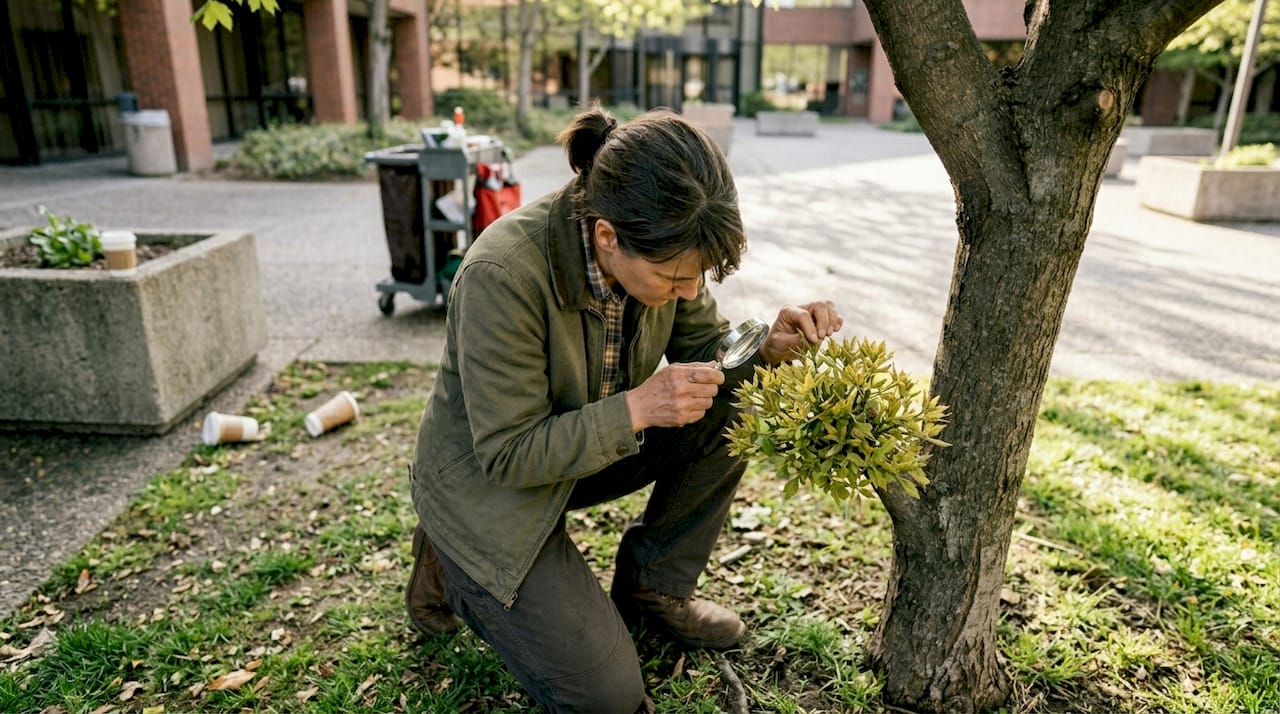
For commercial properties, healthy trees also deliver a financial return that most managers overlook. Shade trees positioned near buildings reduce the heat load on HVAC systems. In Florida’s climate, that matters year-round. Urban trees in Gainesville save roughly $1.9 million annually in residential energy costs through shading and cooling effects. Commercial shade trees deliver comparable benefits at scale.
Beyond energy, well-pruned trees extend the life of nearby infrastructure. Roots from stressed or overgrown trees crack pavement and damage building foundations. Canopies that are too dense trap moisture against walls and accelerate surface deterioration. Regular tree maintenance benefits your entire property, not just the trees themselves.
Key health benefits of proper commercial pruning include:
- Elimination of dead, diseased, and crossing branches before they fail
- Improved canopy structure that resists wind loading during storms
- Better light distribution that supports turf and understory plantings
- Reduced pest pressure by removing entry points and weakened tissue
- Extended tree lifespan, which protects your long-term landscape investment
Healthy trees are infrastructure. Treat them like it.
Pruning standards: Getting compliance and best practices right
Not all pruning is equal. The industry standard for professional tree care is ANSI A300, a set of guidelines developed by the American National Standards Institute. ANSI A300 requires the three-cut method, preservation of the branch collar, and strict limits on foliage removal, no more than 25% per year. It also prohibits topping, lion-tailing, stub cuts, and flush cuts.
For property managers, understanding these compliance basics is not about becoming an arborist. It is about knowing what to ask and what to reject. If a contractor shows up and starts topping your trees, that is a red flag with long-term consequences.
| Practice | ANSI A300 compliant | Risk if ignored |
|---|---|---|
| Three-cut method | Yes | Bark tearing, decay entry |
| Preserving branch collar | Yes | Wound closure failure |
| Topping | No | Weak regrowth, structural failure |
| Flush cuts | No | Large decay wounds |
| Removing more than 25% foliage | No | Tree stress, dieback |
| Lion-tailing (stripping inner branches) | No | Wind sail effect, branch failure |
Pro Tip: Before hiring any tree service for your commercial property, ask directly whether they follow ANSI A300 standards and whether their crew includes an ISA-certified arborist. A reputable company will answer without hesitation.
Types of commercial tree pruning every property manager should know
Different pruning types serve different purposes. Knowing the terminology helps you communicate clearly with your arborist and make sure the work matches your property’s actual needs.
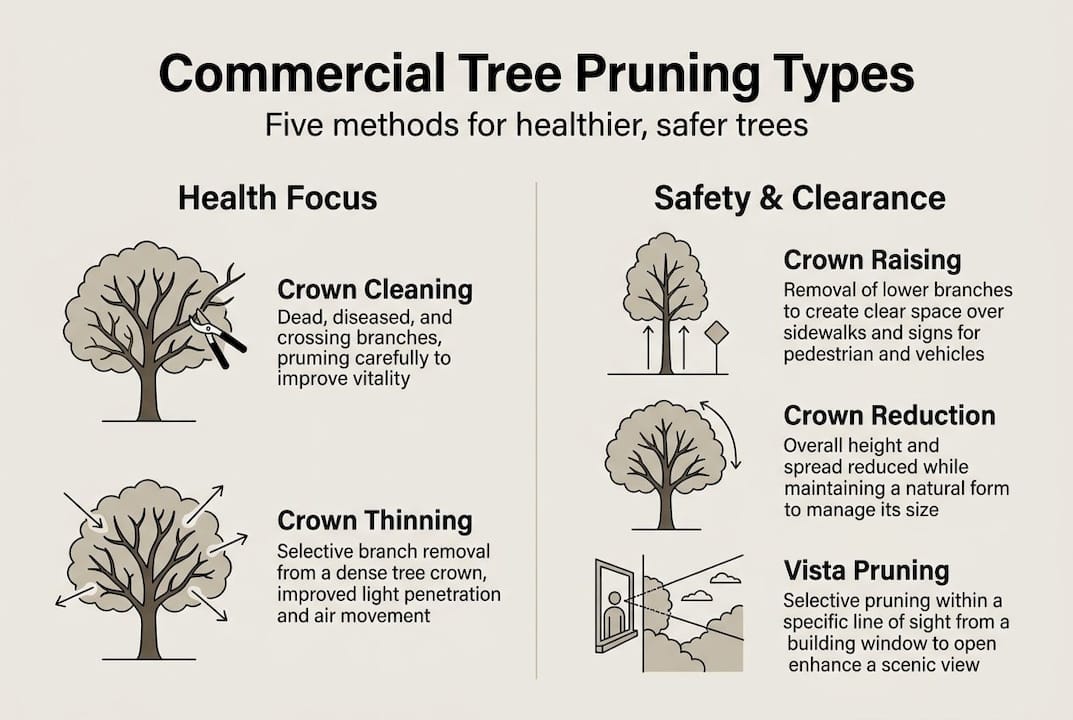
The five main types used in commercial settings are crown cleaning, crown thinning, crown raising, crown reduction, and structural pruning. Each one targets a specific outcome.
| Pruning type | Primary goal | Common commercial use |
|---|---|---|
| Crown cleaning | Remove dead, dying, diseased wood | Routine safety maintenance |
| Crown thinning | Improve airflow and light | Dense canopies near buildings |
| Crown raising | Increase ground clearance | Sidewalks, parking lots, signage |
| Crown reduction | Reduce overall tree size | Utility lines, building clearance |
| Structural pruning | Develop strong branch architecture | Young trees on new developments |
Here is how to approach the conversation with your arborist:
- Describe the specific problem first, such as low branches blocking signage or a dense canopy shading solar panels.
- Ask which pruning type addresses that problem without over-removing foliage.
- Request a written scope of work that references the pruning type and ANSI A300 compliance.
- Confirm the crew will not remove more than 25% of the canopy in a single visit.
- Schedule a follow-up inspection 60 to 90 days after work is completed to assess tree response.
Timing, technique, and pitfalls: What most property managers miss
Even the right pruning type can cause damage if the timing is wrong. Overpruning beyond 25 to 30%, cutting at the wrong time of year, topping, and flush cuts are the most common and costly mistakes in commercial tree care. Each one weakens the tree and increases your liability exposure.
In Central Florida, timing matters more than most managers realize. Fall pruning minimizes decay compared to spring cuts, which can open wounds during peak disease and pest activity. For storm preparation, pruning should be completed before June, giving trees time to compartmentalize wounds before hurricane season hits.
Prescription pruning is a targeted approach where a certified arborist assesses each tree individually and writes a specific pruning plan based on species, condition, and site context. It is the most precise method available and the one most likely to produce lasting results without unintended damage.
Common mistakes to avoid on your commercial property:
- Scheduling pruning in spring without considering disease pressure for your specific species
- Allowing contractors to top trees to reduce height quickly
- Skipping how to trim commercial trees guidance and letting crews work without a written scope
- Pruning too frequently without allowing trees to recover between sessions
- Ignoring the pruning process guide and relying on visual judgment alone
Pro Tip: Build your pruning schedule around Central Florida’s weather calendar. Aim for late fall or early winter cuts to minimize disease risk and maximize wound closure before the next growing season.
DIY vs. professional: The real risk of improper commercial pruning
Some property managers try to cut costs by handling tree work in-house or hiring the cheapest crew available. On a commercial site with high foot traffic, that decision carries serious consequences. Improper cuts lead to decay and structural failure, and in a high-traffic commercial environment, a failing tree is a lawsuit waiting to happen.
One bad cut can compromise a tree’s structural integrity for years. Decay spreads inward from improperly made wounds, weakening the trunk and major limbs invisibly. By the time the damage is visible from the outside, the tree may already be a hazard.
The risks of non-professional pruning on commercial properties include:
- Personal injury to untrained workers without proper equipment or fall protection
- Property damage from uncontrolled branch drops near buildings and vehicles
- Insurance claim denials when work was not performed by a licensed contractor
- Long-term tree decline that leads to expensive removal and replacement
- Legal liability when a tree fails after documented improper maintenance
“Professionals ensure compliance and safety in high-traffic commercial areas in ways that untrained crews simply cannot replicate.”
The importance of professional tree pruning is not just about technique. It is about accountability. Certified arborists carry the credentials, insurance, and knowledge to protect your property and your business. There are clear reasons to hire a professional tree service that go beyond the work itself, including documentation, compliance, and liability protection.
Get expert commercial tree pruning for safer, stronger properties
You now know what is at stake, what standards apply, and what separates a good pruning job from a costly mistake. The next step is making sure your Central Florida property gets the professional attention it needs before the next storm season.
McCullough Tree Service works with commercial property managers and business owners across Orlando and Central Florida to deliver certified, ANSI A300-compliant pruning that protects your trees, your tenants, and your bottom line. Our ISA-certified arborists assess each tree individually and develop a pruning plan built around your property’s specific needs. Explore our tree trimming services to see the quality of work we deliver, or learn the difference between trimming vs. pruning so you can make informed decisions. Contact McCullough Tree Service today to schedule a commercial consultation and get a free estimate.
Frequently asked questions
How often should commercial trees be pruned?
Most commercial trees benefit from professional pruning every one to three years, depending on species, growth rate, and site conditions. Trees near high-traffic areas or utilities may need more frequent attention to stay safe and compliant.
What regulations apply to commercial tree pruning in Florida?
Professional pruning should follow ANSI A300 standards, and many Central Florida municipalities have specific codes governing tree work on commercial properties. Always verify local ordinances before scheduling major pruning or removal.
Why is improper pruning a risk for my business?
Improper pruning creates structurally weak trees that are more likely to fail during storms or under their own weight, leading to injury, property damage, and legal liability. Improper cuts cause decay that spreads internally and may not be visible until the tree is already dangerous.
Does commercial tree pruning actually save money?
Yes. Proper pruning reduces storm damage repair costs, prevents premature tree removal, and urban trees save significant energy costs through shading and cooling. For commercial properties, those savings add up across every billing cycle.
Recommended
- The Importance of Tree Pruning
- Commercial tree maintenance: Boost property value by 20%
- Tree Pruning Importance: Key Benefits Explained
- How to Trim Commercial Trees for Safety and Curb Appeal