By: | Published: April 17, 2026
TL;DR:
- Modern tree assessments follow ISA BMP 3rd Edition 2025 and ANSI A300 standards for accuracy.
- TRAQ-qualified arborists evaluate risk with nuanced ratings, not just safe or unsafe labels.
- Proper preparation, documentation, and adherence to current standards are essential for effective tree safety management.
A single storm can turn a healthy-looking oak into a liability overnight, and in Central Florida, that risk is real every hurricane season. Many property owners assume their trees are fine based on a quick glance, but outdated assessment practices and old Florida law references expose you to safety hazards, property damage, and even legal consequences you may not see coming. This guide walks you through exactly how modern tree health assessments work, what standards actually matter in 2026, and how to use a field-tested workflow to protect your property, your neighbors, and your peace of mind.
Table of Contents
- Understanding tree health assessment standards
- Preparation: What you need before an assessment
- Step-by-step tree health assessment workflow
- Common mistakes and post-assessment actions
- A professional’s perspective: The realities behind assessments
- Get expert help with your Central Florida tree health
- Frequently asked questions
Key Takeaways
| Point | Details |
|---|---|
| Always use updated standards | ISA BMP 3rd ed. 2025 and TRAQ are essential for valid tree health assessments. |
| Prepare thoroughly | Gather records, tools, and documentation before beginning an assessment. |
| Follow a proven workflow | A clear step-by-step process helps spot risks overlooked by casual checks. |
| Document and act promptly | Good recordkeeping and timely action after assessments can prevent costly damage. |
| Seek certified expertise | Certified arborists provide peace of mind and ensure compliance with the latest practices. |
Understanding tree health assessment standards
Most homeowners and property managers assume any tree inspection counts as a legitimate assessment. That assumption can be costly. Standards in this field shift regularly, and the gap between a cursory visual check and a true professional evaluation is much wider than most people realize.
The industry’s current benchmarks are the ISA Best Management Practices (BMP) 3rd Edition 2025 and the ANSI A300 standards. These are not suggestions. They define how trees should be evaluated, documented, and managed. As noted by industry professionals, current standards align with ISA BMP 3rd ed. 2025 and ANSI A300, while many Florida law references remain outdated and create a false sense of compliance. Relying on older benchmarks puts your property at risk and could affect insurance claims or legal disputes.
Then there is the TRAQ qualification, which stands for Tree Risk Assessment Qualification. This credential, issued by the International Society of Arboriculture, means an assessor has been specifically trained to assign nuanced risk ratings rather than simple pass-or-fail labels. TRAQ-qualified professionals evaluate probability of failure, probability of impact, and consequences of failure all together. That is a far more useful output than someone telling you a tree looks “okay.”
Here is what separates a legitimate modern assessment from a generic inspection:
- Uses ISA BMP 3rd Edition 2025 as the methodological foundation
- Follows ANSI A300 for documentation and management recommendations
- Completed or supervised by a TRAQ-qualified certified arborist
- Assigns a rated risk level, not just a binary verdict
- Produces written findings with supporting photos
“A tree assessment is only as reliable as the standard it follows. Ask your assessor which edition of ISA BMP they use. If they can’t answer, that’s your answer.”
Knowing these standards also helps you ask better questions when hiring tree care professionals. Referencing tree care best practices before you schedule an assessment gives you a useful baseline for what a qualified team should deliver.
Preparation: What you need before an assessment
A strong assessment starts well before anyone looks at a tree. The quality of your preparation directly affects the accuracy of the findings and the usefulness of the report you get back.
Certified arborists rely on the latest assessment methods and need accurate background information to work efficiently and accurately. Without that, even the best arborist is working with incomplete data.
Here is a quick-reference table of what to gather before your assessment:
| Item | Why it matters |
|---|---|
| Property map or site plan | Identifies tree locations and proximity to structures |
| Prior maintenance records | Reveals past pruning, removals, or treatments |
| Recent storm event notes | Flags newly introduced stressors or damage |
| Camera or smartphone | Documents current conditions before the assessor arrives |
| Personal protective equipment (PPE) | Required if you’re walking the site with the arborist |
| Local contact info for utilities | Confirms safe zones around power lines |
Beyond documents, local knowledge matters more than most people expect. Knowing which trees flood during rainy season, which ones have had pest problems before, and which ones neighbors have complained about gives your assessor critical context. That context shapes the risk rating.
For tree health tips in Orlando, local species knowledge also plays a role. Central Florida has a mix of native and invasive species that behave very differently under stress. Your arborist should know the difference between a water-stressed live oak and one showing signs of laurel wilt disease. You can help by noting any changes you’ve observed over the past year.
Pro Tip: Schedule your assessment during daylight hours and within two weeks after a major storm. Post-storm assessments catch damage that may not yet show visible symptoms, and daylight allows canopy inspection without artificial lighting gaps.
Also worth noting: do not prune or disturb any trees in the weeks before your assessment. Fresh cuts and changed canopy structure can mask existing issues and affect how your arborist interprets what they see.
Step-by-step tree health assessment workflow
With preparations done, here is the proven workflow that certified arborists follow during a proper field assessment. You can use this to understand what should happen during a professional visit, or to conduct a basic preliminary review on your own before calling in an expert.
- Preliminary scan from a distance. Walk the perimeter of the property and observe each tree from at least 30 feet away. Look for leaning, dead sections, root heave, or visible fungal growth at the base.
- Trunk inspection up close. Examine the lower trunk for cracks, cavities, discoloration, or signs of boring insects. Note any bark loss or unusual swelling.
- Root zone evaluation. Check the soil around the base for lifted roots, soil cracks, or erosion patterns. Root problems are often the first sign of structural failure.
- Canopy analysis. Look upward for dead branches, hanging limbs, asymmetric growth, or thinning foliage. These can indicate disease, drought stress, or prior damage.
- Pest and disease check. Look for discolored leaves, premature leaf drop, sawdust near the base, or gall formations. Photograph anything unusual.
- Risk level assignment. Using TRAQ protocols, assign a likelihood and consequence rating to any findings. This produces a final risk level: low, moderate, high, or extreme.
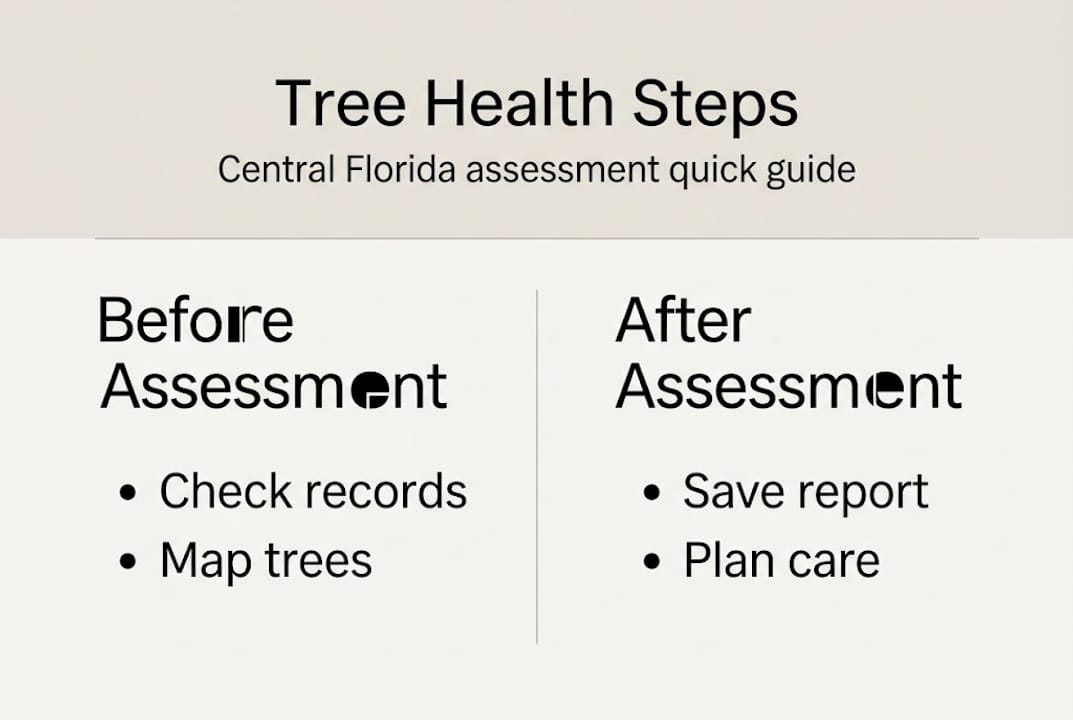
Here is a simplified summary of each step and what triggers a professional follow-up:
| Step | What to look for | Call a pro if… |
|---|---|---|
| Preliminary scan | Lean, dead sections, root heave | Any visible lean toward structures |
| Trunk inspection | Cracks, cavities, insect signs | Cavities deeper than 1/3 trunk width |
| Root zone check | Lifted roots, erosion, soil cracks | Roots severed near the base |
| Canopy analysis | Dead limbs, thinning, asymmetry | Large hanging limbs over structures |
| Pest/disease check | Discoloration, sawdust, galls | Spread across multiple trees |
| Risk rating | Low, moderate, high, extreme | Moderate or above near targets |
Pro Tip: The best assessment workflow uses TRAQ protocols for nuanced findings. Simple “safe or unsafe” labels are not sufficient under current standards and can leave you exposed legally and financially.
Once findings are documented, cross-reference them against regular tree maintenance history to see whether issues are worsening. For compliance considerations, review your notes alongside tree inspection compliance requirements that apply to your property type.

Common mistakes and post-assessment actions
Even property owners who take tree assessments seriously often make avoidable errors that reduce the value of what they learn. Knowing these pitfalls in advance puts you ahead.
The most frequent mistakes include:
- Skipping documentation. Not photographing trees before and after the assessment means you have no baseline for future comparisons.
- Accepting outdated reports. An assessment using pre-2025 ISA BMP standards or Florida law references may miss current risk criteria.
- Relying on surface appearance. Trees that look healthy above ground can have severe root decay or internal cavities. Visual health is not structural health.
- Ignoring moderate-risk ratings. Moderate doesn’t mean safe. It means the risk is manageable now but needs monitoring and a timeline for action.
- Not retaining records. Without a paper trail, you lose leverage in insurance claims, neighbor disputes, or municipal permit reviews.
“Failing to follow latest BMP or skipping nuanced ratings can leave properties exposed to risk and regulatory issues that property owners never anticipated.”
Once you have your assessment results, here is how to act on them effectively. Low-risk findings call for routine seasonal care and an annual check-in schedule. Moderate-risk results mean you should schedule follow-up monitoring within six months and consider targeted treatments or structural support. High or extreme ratings require urgent professional action, sometimes within days, particularly if a large tree sits near your home, a walkway, or a neighboring structure.
For long-term tree health, invest in ongoing records. Keep a folder, digital or physical, with every assessment report, photo set, treatment log, and storm observation. This record is your evidence of due diligence. It supports boosting property value by showing prospective buyers or insurers that the trees on your property are actively managed, not ignored.
A professional’s perspective: The realities behind assessments
Here is something many property owners learn too late: the quality of a tree assessment depends almost entirely on the standard it follows, not on how thorough the assessor appears. We have seen polished reports using outdated Florida law references that missed critical structural failures. We have also seen handwritten field notes from TRAQ-qualified arborists that caught issues no one else had flagged for years.
The uncomfortable truth is that a quick visual check, even from someone who looks the part, is not a risk assessment. It’s an observation. And in Florida, where wind loads from tropical storms routinely test trees that looked “fine” the week before, that distinction matters enormously.
Property owners should demand that assessors reference ISA BMP 3rd ed. 2025 and use TRAQ evaluations, because simple declarations of “safe or unsafe” miss critical risks. Advanced TRAQ methods have helped prevent costly storm losses and legal claims that a binary verdict would have overlooked completely.
As a team that provides arborist expertise in Florida, our advice is simple: ask your assessor directly what edition of ISA BMP they follow and whether they hold TRAQ qualification. Their answer tells you everything you need to know about the reliability of what follows.
Get expert help with your Central Florida tree health
Now that you know what a proper tree health assessment involves, you don’t have to navigate it alone. McCullough Tree Service brings certified arborist expertise directly to residential and commercial properties across Central Florida.
Our team uses current ISA BMP and TRAQ protocols to deliver risk ratings that actually mean something, not just a quick look and a thumbs-up. Whether you need a one-time tree health assessment in Orlando or ongoing care from certified arborist services, we make it easy to get started. From routine tree trimming service to post-storm evaluations, we handle the full scope of what your trees need. Reach out today for an estimate and take the guesswork out of tree safety.
Frequently asked questions
How often should I have my trees assessed in Central Florida?
Schedule professional tree health assessments at least once a year and always after major storms. Central Florida’s storm climate means that ISA BMP recommends routine intervals matched to local risk levels.
What’s the difference between a certified arborist and a regular tree service?
Certified arborists hold credentials requiring ongoing education and follow ISA BMP and TRAQ protocols, while regular tree services may only offer basic labor without standardized assessment methods.
What documents or photos should I keep after a tree health assessment?
Keep every inspection report, photo set, risk rating, and treatment record in one place. Proper documentation supports insurance claims, compliance reviews, and future assessments.
Why isn’t a simple safe/unsafe tree verdict enough anymore?
Because TRAQ protocols and nuanced ratings account for probability of failure, impact likelihood, and consequence severity in ways that a binary label simply cannot capture.
Recommended
- Tree risk assessment tips for Central Florida owners
- Tree Planting Guide Central Florida for Homeowners
- Municipal Tree Maintenance Checklist: Central Florida Guide
- Central Florida tree maintenance checklist 2026
- Qualified & Fully Insured Arborist – True Roots