By: | Published: April 20, 2026
TL;DR:
- Effective municipal tree policies rely on detailed inventories, risk assessments, and proactive maintenance cycles.
- Proper species selection, site preparation, and pruning are essential for long-term storm resilience and health.
- Planning pre- and post-storm actions ensures safer recovery and reduces legal and infrastructure liabilities.
Municipal trees in Central Florida do more than shade sidewalks. They reduce stormwater runoff, cool urban heat islands, and absorb the first punch of a hurricane. But when maintenance lapses, those same trees become liabilities. A single failed canopy near a school or arterial road can trigger lawsuits, close infrastructure for days, and cost more to clean up than years of routine care. For planners managing growing cities with tighter budgets, the pressure to get tree maintenance right has never been higher. This guide walks you through policies, planting standards, pruning cycles, and storm response strategies built specifically for Central Florida’s urban environment.
Table of Contents
- Establishing effective municipal tree maintenance policies
- Key requirements for tree planting and establishment
- Pruning, risk assessment, and ongoing maintenance
- Storm preparation and recovery strategies for municipalities
- An expert perspective: Why proactive municipal tree care outperforms reactive approaches
- Get professional support for municipal tree maintenance in Central Florida
- Frequently asked questions
Key Takeaways
| Point | Details |
|---|---|
| Set clear canopy goals | Use data-driven benchmarks and phased inventories to guide urban tree policies. |
| Prioritize careful establishment | Select resilient species and follow strict early watering, mulching, and spacing guidelines. |
| Commit to cyclical pruning | Regular, moderate pruning and risk assessments are vital for safety and long-term tree health. |
| Prepare and recover smartly | Implement pre-storm clearances and phased recovery to reduce public risk and tree mortality. |
| Proactive strategy wins | A proactive, scheduled maintenance program outperforms crisis-driven responses for municipal trees. |
Establishing effective municipal tree maintenance policies
Every resilient urban forest starts with policy. Without clear benchmarks and structured cycles, maintenance becomes reactive, and reactive tree care is always more expensive.
The 3-35-300 canopy benchmark is one of the most practical frameworks available: every resident should see at least 3 trees from their home, neighborhoods should achieve 35% canopy cover, and no resident should live more than 300 meters from a green space. Tarpon Springs and Fort Lauderdale both target 33 to 35% canopy goals, with inventories built to prioritize hazardous trees and guide maintenance action plans phased over three years.
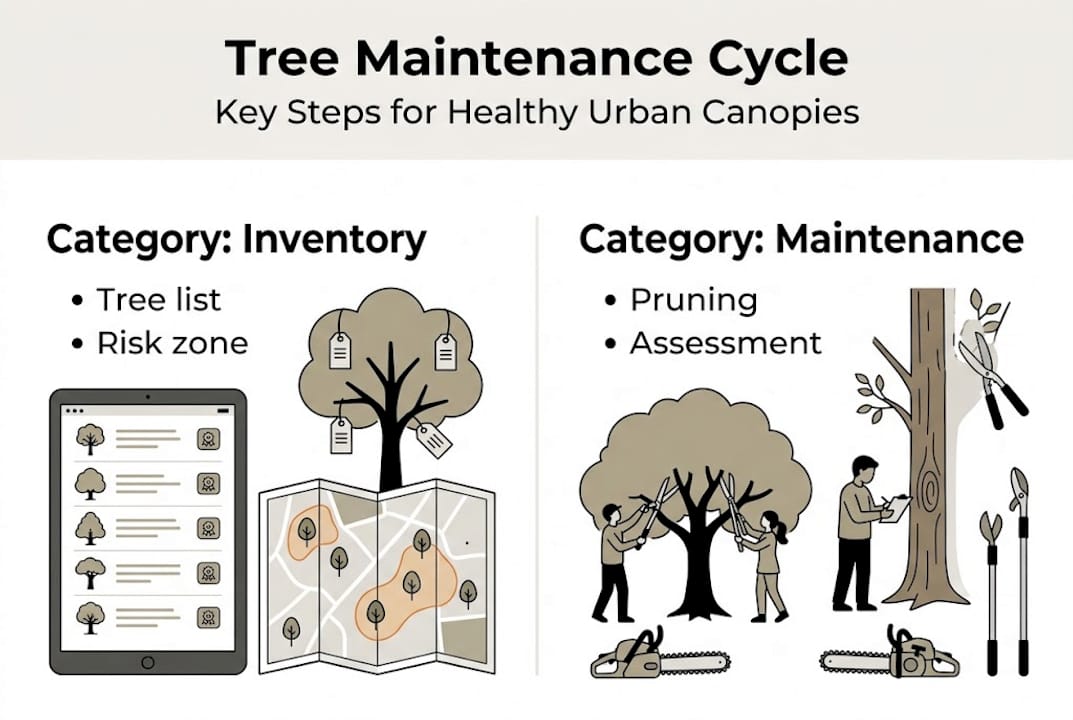
A tree inventory is the foundation. Without knowing what you have, where it sits, and what condition it is in, you cannot prioritize effectively. Inventories should classify trees by species, diameter, structural condition, and proximity to high-value targets like roads and public buildings.
Here is a snapshot of how key policy elements compare across program types:
| Policy element | Reactive program | Proactive program |
|---|---|---|
| Inspection cycle | As-needed or complaint-driven | Scheduled annually or biannually |
| Replacement ratio | 1:1 after failure | 1:1 to 5:1 for heritage trees |
| Inventory updates | Irregular | Every 3 to 5 years |
| Risk prioritization | Post-incident | Pre-season and post-storm |
| Budget predictability | Low | High |
For municipalities just starting out, a phased approach keeps the workload manageable:
- Phase 1: Complete a baseline inventory of all trees near roads, utilities, and public spaces
- Phase 2: Identify high-risk trees and develop a mitigation action plan
- Phase 3: Implement replacement and stewardship programs with measurable targets
Stewardship programs that engage residents and neighborhood groups extend your team’s reach without expanding payroll. Volunteers trained in basic tree care can handle mulching, watering, and early defect reporting.
Pro Tip: Build your tree maintenance checklist around your inventory data. Prioritizing by risk zone and maintenance history will give you a defensible, budget-ready action plan from day one.
For guidance on species selection and spacing aligned with Florida’s climate, the tree selection guidelines from UF/IFAS are an essential policy reference. Pairing that with urban tree care best practices for Central Florida ensures your policies reflect local conditions, not generic national standards.
Key requirements for tree planting and establishment
After setting robust policies, municipalities must next ensure each new tree gets the right start for decades of canopy growth.
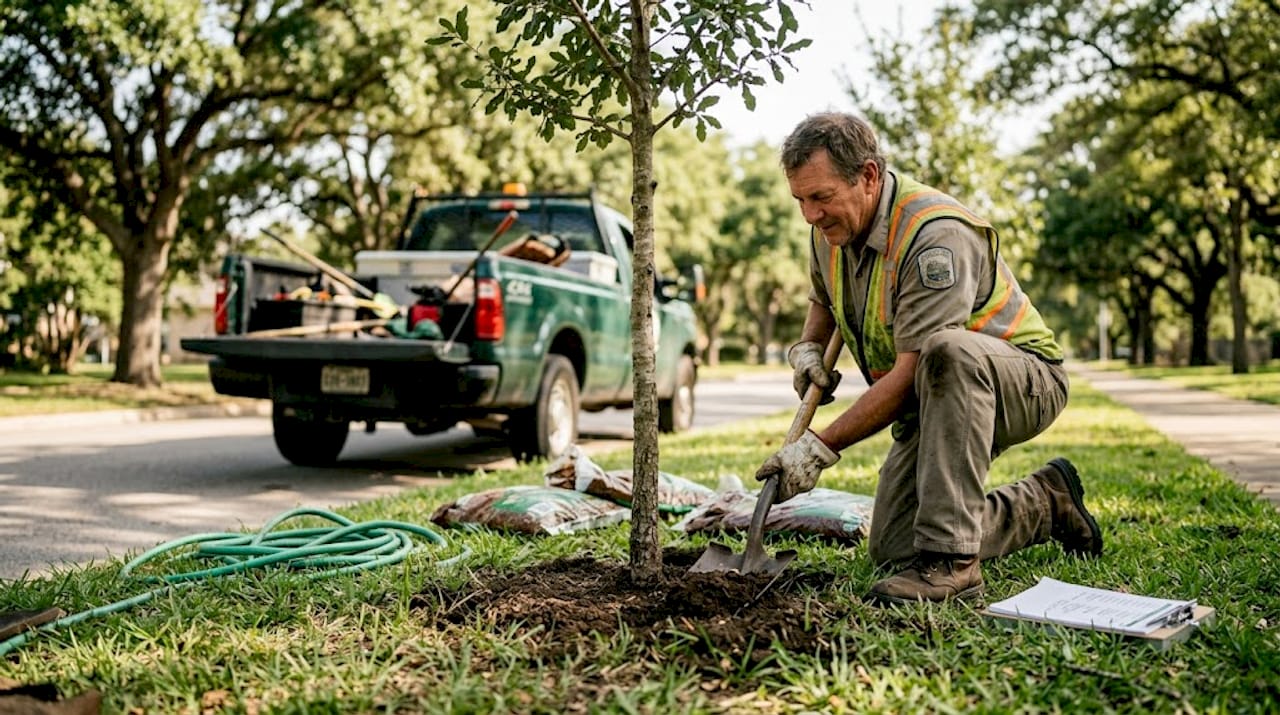
Species selection is the single biggest lever you control at planting time. Choose wrong and no amount of watering or mulching fixes a tree that fails at maturity. UF/IFAS recommends the “right tree, right place” approach, which accounts for hardiness zone, soil type, overhead utility conflicts, pest pressure, and maintenance capacity. Establishment irrigation runs 3 to 6 months for most species in Florida’s climate.
For street-level planting, here is how common species compare:
| Species | Storm resilience | Root behavior | Establishment ease |
|---|---|---|---|
| Live oak | High | Wide lateral spread | Moderate |
| Bald cypress | High | Non-invasive | Easy |
| Crape myrtle | Moderate | Contained | Easy |
| Laurel oak | Moderate | Moderate | Easy |
| Slash pine | Moderate | Deep taproot | Moderate |
Beyond species, site preparation determines long-term success. Follow these steps for every new planting:
- Confirm adequate soil volume and drainage before planting
- Plant at grade or slightly above, never below, to prevent root rot
- Apply 3 inches of mulch in a wide ring, keeping it 6 inches away from the trunk
- Follow the Orlando tree care instructions for watering schedules tied to establishment stages
- Inspect staking and ties monthly, removing them no later than 12 months post-planting
For landscape buffers, Citrus County’s ordinance requires a minimum of 2 trees per 100 linear feet and a minimum buffer width of 5 feet, with trees at least 6 feet tall at installation. Dead or declining plants must be replaced as part of ongoing maintenance obligations.
The most common planting mistakes to avoid:
- Volcano mulching: Piling mulch against the trunk traps moisture and invites fungal rot
- Shallow planting: Burying the root flare cuts off oxygen to the root zone
- Overwatering after establishment: Encourages shallow roots and weakens storm anchoring
- Inadequate spacing: Competing root systems and canopy conflicts reduce long-term health
Pro Tip: Prioritize native species with proven Central Florida performance for your tree establishment checklist. Live oaks and bald cypress consistently outperform exotic species in both storm resilience and long-term maintenance cost.
Pruning, risk assessment, and ongoing maintenance
Newly planted trees thrive with careful establishment, but managing mature canopies requires a disciplined approach to pruning and safety.
Structural pruning is not just cosmetic. It shapes how a tree distributes weight and responds to wind load. According to UF/IFAS, a structural pruning plan should establish a dominant leader, space scaffolding branches evenly, and limit crown removal to no more than 25% of foliage at any single session. Young trees benefit from pruning every two years up to 25 years old. Never remove more than 25 to 40% of live crown at once, regardless of the reason.
Here is the recommended pruning sequence for municipal trees:
- Remove dead, dying, and diseased wood first
- Remove crossing or rubbing branches that create wound entry points
- Establish or reinforce the dominant leader
- Space lateral scaffolds to distribute wind load evenly
- Raise the canopy to meet road and sidewalk clearance standards
- Document all work in your inventory system with dates and photos
For more detail on technique, the pruning tips from our certified arborists break down cut placement and timing by species. You can also review this structural pruning video for a visual walkthrough, and explore the importance of tree pruning for the broader case behind scheduled cycles.
Risk assessment should run parallel to pruning cycles. The Florida Urban Forestry Council recommends evaluating trees for codominant stems, included bark, decay, and root damage, then scoring risk against target value. A large dying tree in a park with no foot traffic scores differently than the same tree over a school entrance.
Trees near roads, schools, and high-traffic public spaces carry the highest target value and should be inspected and reassessed at least annually.
For internal defect detection, tomography and microdrilling give you data that visual inspection cannot. These tools pay for themselves when they prevent a wrongful-death lawsuit.
Pro Tip: Use resistograph microdrilling on any tree with a DBH (diameter at breast height) over 18 inches that shows external signs of decay. The data provides defensible documentation if removal decisions are ever challenged.
Storm preparation and recovery strategies for municipalities
No municipal tree maintenance program is complete without a plan tailored to Central Florida’s frequent storms.
Preparation starts before hurricane season. Your pre-season checklist should include:
- Complete a pre-storm inspection of all high-risk trees in your inventory
- Trim trees to maintain 13.5 ft road clearance and 10 ft sidewalk clearance
- Document current canopy conditions with photos for post-storm comparison
- Coordinate with utilities for right-of-way pruning near power lines
- Pre-position emergency response contracts with qualified arborists
After a storm, the sequence of recovery actions matters as much as the actions themselves:
- Conduct a rapid safety sweep within 24 to 48 hours for road blockages and structural hazards
- Remove debris from primary and secondary roads before assessing individual trees
- Flag leaning, partially uprooted, or cracked trees for professional evaluation
- Wait before pruning: a 2 to 6 month wait allows accurate deadwood identification and lets stressed trees signal whether they will recover
- Re-assess root-heaved trees individually. Post-rainfall soil saturation significantly raises root heave risk, especially for shallow-rooted species
- Document all removals with photos, species IDs, and GPS coordinates for FEMA reimbursement eligibility
Palms recover substantially slower than hardwoods after storm events. Do not judge a palm’s fate for at least three months post-storm.
Here is a simplified storm response timeline:
| Phase | Timeframe | Key actions |
|---|---|---|
| Pre-storm | 60 to 90 days before season | Inspect, trim to clearance, contract arborists |
| Immediate response | 0 to 48 hours post-storm | Safety sweep, road clearing |
| Early recovery | 2 to 4 weeks post-storm | Debris removal, hazard flagging |
| Assessment window | 2 to 6 months post-storm | Deadwood ID, root evaluation |
| Replanting | 6 to 12 months post-storm | Species selection, replacement planting |
For a step-by-step breakdown, review the storm tree trimming preparation guide, the emergency storm recovery steps, and the hurricane season prep guide built specifically for Central Florida conditions.
An expert perspective: Why proactive municipal tree care outperforms reactive approaches
After years of working with Central Florida municipalities, the pattern is clear: cities that shift from crisis-response to scheduled maintenance cycles spend less, fail less, and recover faster.
Tampa’s move toward proactive area management cycles reduced emergency call-outs and improved canopy condition scores across high-traffic zones. Volunteer stewardship programs backed by UF/IFAS research multiply municipal impact without multiplying payroll, a critical advantage when urban forestry budgets are perpetually underfunded.
The trap most cities fall into is budget politics. After a major storm, elected officials want visible action. That pressure often leads to aggressive over-pruning that weakens trees for the next storm event. Removing more than 25% of live crown, regardless of how dramatic the aftermath looks, sets trees up to fail within three to five years.
The cities doing this right treat urban forestry as infrastructure, not landscaping. They fund it accordingly, cycle it annually, and engage neighborhoods through stewardship programs that build public support and extend maintenance reach. For planners serious about long-term canopy resilience, studying urban tree care insights from field-tested programs is a far better investment than waiting for the next storm to set the agenda.
Get professional support for municipal tree maintenance in Central Florida
Implementing these strategies at scale requires more than policy documents. It requires certified arborists with the equipment, credentials, and local knowledge to execute the work safely and efficiently.
McCullough Tree Service supports Central Florida municipalities with routine canopy maintenance, hazard assessments, and rapid-response storm cleanup. Whether you need a team for scheduled municipal tree trimming services, post-storm storm clean up, or a full emergency tree cleanup workflow, our ISA-certified arborists are equipped to keep your city’s canopy safe and your residents protected. Contact us to discuss a maintenance program built around your municipality’s specific inventory, risk profile, and budget.
Frequently asked questions
What are the biggest mistakes municipalities make in tree maintenance?
Over-pruning beyond the 25% live crown limit, skipping annual risk assessments, and allowing inventories to go stale are the most common mistakes, and each one compounds storm damage risk and legal exposure.
How often should municipal trees be pruned in Central Florida?
Young trees benefit from structural pruning every two to three years. For mature trees, proactive management cycles that raise canopy clearance and remove deadwood on a three-year rotation work well for most Central Florida species.
What is the ideal street tree watering schedule for new plantings?
Newly planted street trees need 10 gallons of water daily for the first two months, tapering gradually as the root system establishes, with weekly watering sufficient after 18 months in most conditions.
How should municipalities prioritize hazardous tree removal?
Use inventory data and risk assessment scores to rank trees by likelihood of failure multiplied by target value, focusing first on trees near roads, schools, and high-traffic public spaces.
Why delay post-storm pruning?
Waiting 2 to 6 months post-storm gives stressed trees time to signal recovery or decline, ensures accurate deadwood identification, and prevents unnecessary removal of trees that would have survived with patience.
Recommended
- Municipal Tree Maintenance Checklist: Central Florida Guide
- Commercial tree maintenance: Boost property value by 20%
- Central Florida tree maintenance checklist 2026
- Municipal tree management in Central Florida: expert guide