By: Shelby McCullough| Published: April 30, 2026
TL;DR:
- Native trees in Central Florida require less water, fertilizer, and maintenance than non-natives.
- They support local ecosystems by providing food, shelter, and fostering native wildlife relationships.
- Proper selection and planting of natives ensure long-term landscape health, resilience, and ecological value.
Not every tree does the same job. Many Central Florida homeowners and property managers plant whatever looks good at the nursery, assuming any tree improves their landscape. But native trees in Central Florida are adapted to local sandy soils, humid climate, and rainfall patterns, requiring far less water, fertilizer, and maintenance once established compared to non-natives. That single difference changes everything about how your property looks, functions, and costs you over time. This article breaks down why native trees outperform the alternatives and gives you a practical roadmap for getting it right.
Table of Contents
- What makes native trees uniquely valuable?
- Environmental benefits: Healthier ecosystems and resilient landscapes
- Practical advantages: Less maintenance, more value
- How to plant native trees for success
- Our perspective: Why native-first is the overlooked landscape upgrade
- Tree care experts in Central Florida: Ready to help
- Frequently asked questions
Key Takeaways
| Point | Details |
|---|---|
| Superior adaptation | Native trees thrive in Central Florida’s unique climate and soils with minimal resources and care. |
| Wildlife support | Only native trees provide essential resources for local pollinators and songbirds. |
| Lower maintenance costs | After establishment, native trees require less irrigation, fertilizer, and upkeep than non-natives. |
| Eco-friendly landscapes | Planting natives boosts air and water quality, reduces stormwater issues, and increases property value. |
| Simple planting success | Correct timing, placement, and care are key to native tree survival and long-term landscape resilience. |
What makes native trees uniquely valuable?
Not all trees are created equal, and in Central Florida, the gap between native and non-native choices is wider than most people realize.
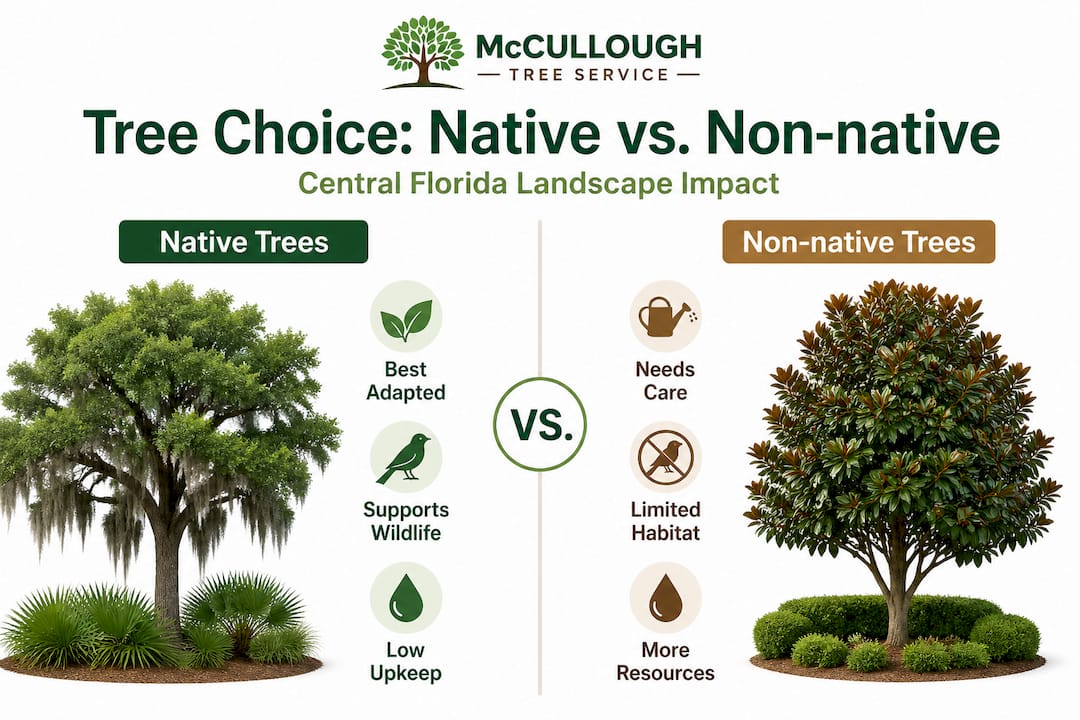
A native tree is one that evolved naturally in a specific region over thousands of years, developing relationships with local soils, insects, birds, and weather patterns. A non-native tree was introduced from another region or country, and while it may survive here, it lacks those deep ecological connections. Some non-natives become invasive, spreading aggressively and crowding out native species. The Florida Exotic Pest Plant Council (FLEPPC) maintains a list of Category I and II invasive species that property owners should actively avoid.
What sets native trees apart in Central Florida is how thoroughly they fit the environment. Our region features sandy, nutrient-poor soils, intense summer humidity, unpredictable storms, and a dry season that can stress poorly adapted trees. Native species evolved to handle all of this without extra help from you.
The property benefits of native trees go well beyond aesthetics. Native trees are the backbone of local food webs. They provide nectar, fruits, seeds, and nuts that local wildlife depends on. They offer nesting sites and shelter for birds and beneficial insects. Most critically, they serve as host plants for native butterflies and pollinators that simply cannot complete their life cycles on non-native species. Native trees support local biodiversity by providing food, shelter, and coevolved relationships that non-natives fundamentally lack.
When selecting native trees for your property, it helps to understand exactly how they compare to non-natives at a glance.
| Attribute | Native trees | Non-native trees |
|---|---|---|
| Soil adaptation | Optimized for Central Florida’s sandy soils | Often requires soil amendment |
| Water needs | Low after establishment | Moderate to high ongoing |
| Fertilizer requirements | Minimal | Regular applications often needed |
| Pest and disease resistance | Naturally resilient to local threats | More vulnerable, higher pesticide use |
| Biodiversity value | High, supports local food webs | Low to none for native wildlife |
| Maintenance after year 1 | Significantly reduced | Ongoing and costly |
| Invasive risk | None | Varies, some are FLEPPC listed |
The contrast is stark. Choosing a non-native tree often means committing to years of supplemental care just to keep it alive, while a native tree is essentially working with your landscape rather than against it. Sustainable landscaping practices, like those promoted through Florida sustainable landscaping programs, consistently point to native plantings as the most durable long-term investment.
Environmental benefits: Healthier ecosystems and resilient landscapes
Understanding how native trees fit the environment is one thing. Seeing their concrete ecological impact on your property and your neighborhood is another.
Planting native trees enhances landscape health through soil stabilization, erosion control, water filtration, stormwater reduction, urban heat island mitigation, air quality improvement, and carbon sequestration. That is a remarkable range of benefits from a single planting decision. In Central Florida, where summer storms regularly dump several inches of rain in a matter of hours, stormwater management alone makes native trees worth every penny.
Here is what native trees specifically do for your property and the broader ecosystem:
- Stormwater absorption. Deep root systems hold soil in place and pull water downward, reducing runoff and flooding risk on your property.
- Erosion control. Root networks stabilize slopes and lakefront edges, which matters enormously for waterfront properties throughout Orlando and surrounding counties.
- Urban heat reduction. A mature native canopy can lower surface temperatures by 10 to 20 degrees Fahrenheit compared to paved or lawn-covered areas, cutting cooling costs.
- Air quality improvement. Native trees filter particulate matter and absorb carbon dioxide at rates that contribute meaningfully to neighborhood air quality over time.
- Water filtration. Leaf litter and root systems filter nutrients and pollutants before they reach groundwater or nearby water bodies.
Non-natives and invasives compete with natives, spread aggressively, increase maintenance and pest risks, and property owners should actively avoid FLEPPC Category I and II species. Invasive trees like camphor and Brazilian pepper are familiar examples in Central Florida. They crowd out native understory plants, reduce habitat quality, and create long-term removal costs that dwarf the original savings.
“A landscape planted with native trees does not just look good today. It builds ecological value year after year, becoming more resilient and more supportive of wildlife over time.”
Proper tree selection and site planning is essential before you commit to any species. And understanding common planting pitfalls early can save you from costly mistakes down the road.
Pro Tip: Group native trees in clusters of three to five rather than planting single specimens scattered across your yard. Clusters create wildlife corridors, improve pollinator habitat, and make your landscape far more resilient to drought and storm stress than isolated trees ever could.
Practical advantages: Less maintenance, more value
Beyond environmental payoffs, what do native trees mean for your time, budget, and property appeal?
The short answer is: a lot. Native trees adapted to Central Florida’s soils and climate require less water, fertilizer, pesticides, and maintenance once established compared to non-natives. That translates directly into lower monthly and annual costs for homeowners and commercial property managers alike.
Here is what you can realistically expect to reduce after the first establishment year:
- Irrigation costs. Native trees tap into natural rainfall cycles and do not need supplemental watering beyond dry spells in year one.
- Fertilizer spending. Native species thrive in poor sandy soils where non-natives would starve without regular feeding.
- Pesticide applications. Because native trees coevolved with local insects, they have natural defenses that reduce the need for chemical intervention.
- Emergency tree work. Native species are better adapted to Florida’s storm conditions, meaning fewer catastrophic failures after hurricanes and tropical storms.
The economic case extends to property value as well. Mature, healthy trees can increase residential property values by 10 to 15 percent, and native trees that require minimal intervention are far more likely to reach maturity without costly removal or replacement. You can learn more about tree value for properties and how smart planting decisions pay off over a property’s lifetime.
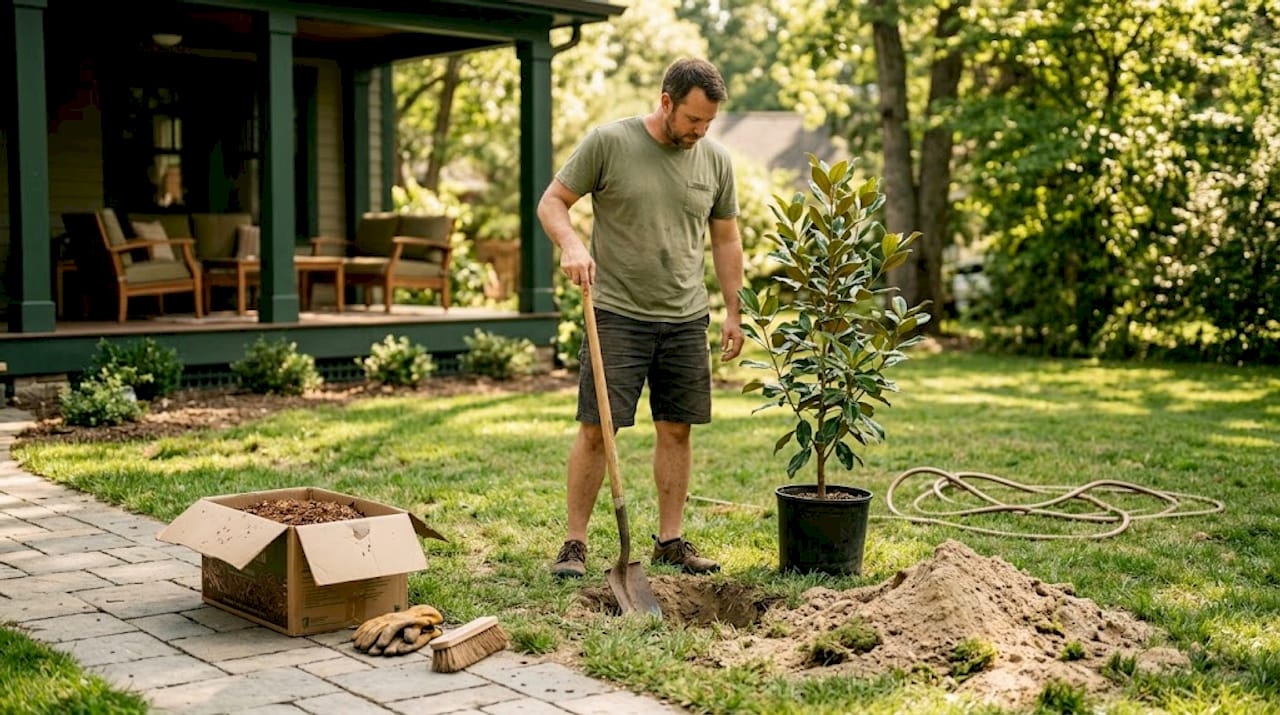
For proper establishment, UF/IFAS native planting recommendations are clear: plant from October through March, dig the hole two to three times the root ball width at the same depth, keep the root flare at or above grade, apply a two to three inch mulch ring away from the trunk, water deeply through the first year, and use minimal fertilizer. Following these mechanics correctly is what separates a thriving native tree from a struggling one.
Pro Tip: Never bury the root flare. Planting too deep is one of the most common and damaging mistakes in tree establishment. If the base of the trunk disappears into the soil, the tree is too deep. Expose the root flare and you will dramatically improve its long-term survival odds.
A step-by-step planting guide can walk you through each stage in detail, and lasting planting tips from experienced arborists will help you avoid the most expensive errors.
How to plant native trees for success
You are convinced of the benefits. Now here is how to get planting right in Central Florida.
The guiding principle from UF/IFAS is “Right Tree, Right Place.” Florida-Friendly Landscaping principles emphasize low-input, wildlife-supporting designs that consistently outperform traditional lawn-heavy approaches. That means matching the species to your specific site conditions before you ever dig a hole.
Follow this process for the best results:
- Assess your site. Note sun exposure, soil drainage, proximity to structures and power lines, and whether the area floods seasonally. A live oak needs very different conditions than a bald cypress.
- Choose the right species. Match the mature size and root spread of your chosen tree to the available space. A tree that outgrows its spot becomes a liability, not an asset.
- Plant during the right season. October through March gives your tree the cool, wet season to establish roots before summer heat arrives.
- Dig the correct hole. Two to three times the width of the root ball, but no deeper. The root flare must sit at or slightly above grade.
- Mulch correctly. Apply two to three inches of mulch in a ring around the base, keeping it several inches away from the trunk to prevent rot.
- Water deeply and consistently. Deep watering once or twice a week through the first year encourages roots to grow downward rather than staying shallow and vulnerable.
- Stake only if necessary. If the tree cannot stand on its own in light wind, stake it temporarily. Remove all stakes after one year, no exceptions.
Planting in groups and clusters rather than as isolated specimens creates wildlife corridors and improves landscape resilience. Deep planting accounts for roughly 50 percent of establishment failures, so this is the single most important technical detail to get right. Coastal properties also need to account for salt and wind tolerance when selecting species.
Common mistakes to avoid include:
- Choosing species based on looks alone without checking mature size
- Planting invasive or FLEPPC-listed species by mistake
- Overwatering after the first year, which promotes shallow roots
- Spacing trees too close together, creating competition and crowding
- Ignoring drainage, which can drown even drought-tolerant natives in poorly draining clay pockets
For commercial property managers, tree survival tips tailored for larger-scale projects and urban care best practices can help you manage multiple trees across a property efficiently and cost-effectively.
Our perspective: Why native-first is the overlooked landscape upgrade
Here is something we have observed after years of working with Central Florida properties: most landscape decisions are made for immediate visual impact, not long-term performance. Homeowners choose the tree that looks showiest at the nursery. Commercial managers pick whatever fits the budget this quarter. Native trees rarely win those first-impression contests, and that is exactly why they are so consistently undervalued.
The misconception that native-focused designs look plain or uninteresting is simply wrong. A mature live oak draped with Spanish moss is one of the most dramatic landscape features in the South. A cluster of native wildflowers and understory trees buzzing with pollinators is more visually alive than any manicured ornamental bed. The difference is that native landscapes reveal their value gradually, deepening and improving season after season rather than peaking in the first spring and then demanding constant upkeep to maintain that look.
What we have seen repeatedly is that the properties with the most impressive long-term landscapes are the ones where early decisions were grounded in ecology, not just aesthetics. A deep-dive planting guide can help you think through those decisions systematically before you commit.
The uncomfortable truth is that choosing non-native ornamentals or fast-growing exotics often feels like a win in year one and becomes a problem by year five. Invasive roots, pest vulnerabilities, storm damage, and replacement costs pile up. Meanwhile, a well-chosen native tree planted correctly in 2026 will still be improving your property, your air quality, and your local ecosystem decades from now. That is the kind of return on investment that no quick-fix landscape solution can match.
Native-first is not a trend or an environmental statement. It is simply the smarter long-term choice for any Central Florida property owner who wants a landscape that works harder, costs less, and looks better with age.
Tree care experts in Central Florida: Ready to help
Planting native trees is one of the best decisions you can make for your Central Florida property, and getting that investment off to the right start matters enormously.
At McCullough Tree Service, our certified arborists work with homeowners and commercial property managers throughout Orlando and Central Florida to select, plant, and care for native trees the right way. Whether your landscape needs professional tree trimming to shape an established canopy, expert tree removal of a poorly chosen non-native, or guidance on tree care basics to keep your new plantings thriving, our team brings the expertise and licensing to handle it all. Contact us today to schedule a consultation and start building a landscape that performs for decades.
Frequently asked questions
What are some popular native trees for Central Florida landscapes?
Live oak, bald cypress, and southern magnolia are three popular native choices for Central Florida landscapes, offering shade, wildlife value, and year-round visual interest.
How does planting native trees support wildlife?
Native trees provide essential food and shelter for region-specific insects, birds, and pollinators through coevolved relationships that non-native species simply cannot replicate.
Do native trees really need less maintenance and water?
Yes, native trees adapted to Central Florida need significantly less irrigation, fertilizer, and pest control after the first establishment year compared to non-native alternatives.
When is the best time to plant native trees in Central Florida?
Plant native trees from October through March to give roots time to establish during cooler, wetter conditions before summer heat arrives.
How can I avoid common native tree planting mistakes?
Avoid planting too deep, group trees in clusters rather than planting them in isolation, and only stake trees temporarily, removing all stakes after one year.
Recommended
- Tree Planting Guide Central Florida for Homeowners
- How trees transform Central Florida landscapes and property value
- Tree Planting for Central Florida Developers: 50% Survival Boost
- Tree planting: boost property value in Central Florida
- Enhance your property value with expert landscaping