By: Shelby McCullough| Published: March 29, 2026
Up to 50% of homeowner trees fail within three years when planted without proper methods. That’s a costly mistake most Central Florida homeowners don’t see coming. A well-placed tree does far more than add curb appeal. It can lower your energy bills, boost your property value, support local wildlife, and even clean the air around your home. This guide walks you through everything you need to know about tree planting in Central Florida, from choosing the right species to smart placement and aftercare that actually works.
Table of Contents
- Why tree planting matters in Central Florida landscaping
- Choosing the right tree: native vs. non-native species
- Site preparation essentials for healthy tree establishment
- Best practices for planting and aftercare
- Smart placement for maximum benefits
- Take your Central Florida landscape to the next level
- Frequently asked questions
Key Takeaways
| Point | Details |
|---|---|
| Benefit beyond beauty | Properly planted trees improve energy savings, property value, and air quality. |
| Choose the right species | Native trees are best for most Central Florida sites due to resilience and low maintenance. |
| Site prep is crucial | Careful site assessment and correct planting depth prevent most failures. |
| Strategic placement pays off | Position trees for maximum shade and storm safety for the biggest return. |
| Professionals make a difference | Certified arborists help ensure success, compliance, and tree health. |
Why tree planting matters in Central Florida landscaping
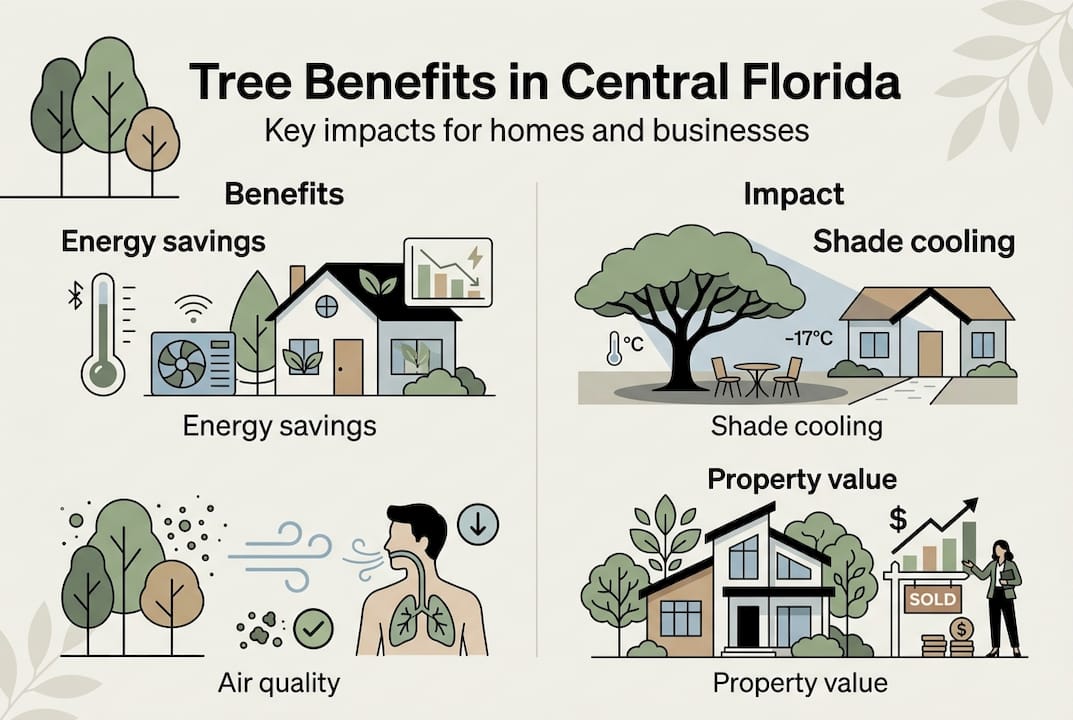
Tree planting is one of the highest-return investments you can make in your property. The benefits go well beyond looks. Tree planting enhances aesthetics, provides shade, supports wildlife, reduces energy costs, improves air quality, and increases property value all at once. That’s a lot of value from a single decision.
Central Florida’s climate makes trees especially powerful tools for managing heat and energy use. Strategically placed trees can cut cooling costs significantly during the brutal summer months. And the environmental impact adds up fast at a community level.
Gainesville’s urban trees remove 390 tons of pollutants every year, a benefit valued at $2 million annually. The same trees generate $1.9 million in energy savings for the city.
Here’s a quick look at the tangible benefits trees deliver for Central Florida property owners:
| Benefit | Impact |
|---|---|
| Energy savings | Reduced cooling costs by shading west and south walls |
| Air quality | Removal of pollutants and carbon dioxide |
| Property value | Increased resale appeal and appraised value |
| Wildlife habitat | Food and shelter for native birds and pollinators |
| Stormwater control | Reduced runoff through root absorption |
When you explore the full range of tree planting benefits for Central Florida properties, it becomes clear that this is not just a landscaping choice. It’s a long-term financial and environmental strategy.
Key reasons tree planting improves your landscape:
- Shade and comfort: Mature trees dramatically reduce surface temperatures around your home
- Privacy: Dense canopies and evergreen species create natural screens
- Storm buffering: Properly placed trees reduce wind impact on structures
- Noise reduction: Tree groupings absorb and deflect traffic and neighborhood noise
- Ecosystem support: Native trees attract pollinators and birds that keep your yard healthy
Our tree planting service is designed to help you capture every one of these benefits from day one.
Choosing the right tree: native vs. non-native species
Knowing the big picture is helpful, but making the right planting choice starts with selecting the right species for your space. This is where many homeowners go wrong.
Native species like Live Oak, Southern Magnolia, and Dahoon Holly are more resilient to Central Florida conditions. They evolved here, so they handle the heat, sandy soils, and heavy rain cycles far better than most imports. That said, natives can sometimes struggle in man-made ecosystems where invasive species compete aggressively for resources.
| Factor | Native species | Non-native species |
|---|---|---|
| Resilience | High in natural settings | Varies widely |
| Maintenance | Generally lower | Often higher |
| Water needs | Low once established | Moderate to high |
| Storm resistance | Strong | Depends on species |
| Aesthetic variety | Moderate | High |
| Regulatory risk | Low | Can be restricted |
Common native species worth considering for Central Florida yards:
- Live Oak: Long-lived, wide canopy, excellent shade and storm resistance
- Southern Magnolia: Evergreen, fragrant blooms, strong structure
- Dahoon Holly: Smaller size, great for wildlife, tolerates wet areas
- Bald Cypress: Ideal near water features or low-lying spots
- Sweetbay Magnolia: Semi-evergreen, works well in partial shade
The Florida Trees selection tool from UF/IFAS is a practical resource for matching species to your specific site conditions. It factors in soil type, sun exposure, mature size, and proximity to utilities.
Non-natives are not always the wrong choice. Some offer design variety or fill specific aesthetic roles that natives cannot. The key is knowing what you’re committing to in terms of long-term care. Our tree planting guide covers species selection in detail for Central Florida conditions.
Pro Tip: Near utility lines or in tough, compacted soil areas, always default to native species. They require less intervention and are far less likely to cause infrastructure problems as they mature.
Always check local ordinances before planting. Some Florida municipalities restrict or prohibit certain non-native species, especially those with invasive potential. Review tree planting considerations before you finalize your selection.
Site preparation essentials for healthy tree establishment
After picking the right tree, preparing your site is crucial to set it up for long-term success. Skipping this step is one of the most expensive mistakes a property owner can make.
Here are the essential steps to prepare your site before planting:
- Test your soil. Central Florida’s sandy soils drain fast and are often low in nutrients. A basic soil test tells you what amendments, if any, are actually needed.
- Check drainage. Standing water after rain is a red flag. Most trees need well-drained soil to establish healthy roots.
- Map your sun and shade. Observe the planting area at different times of day. Some species need full sun; others prefer partial shade.
- Identify underground utilities. Call 811 before you dig. Root systems can damage pipes and cables over time.
- Assess mature tree size. Think about where the tree will be in 20 years, not just today.
- Check for root and structure conflicts. Driveways, sidewalks, and foundations are all vulnerable to root pressure.
Assess soil, drainage, sunlight, utilities, and mature tree size carefully, and always maintain at least 15 feet of clearance from structures. That buffer protects both your home and the tree as it grows.
Deep planting is the top failure cause in Central Florida. Burying the root flare, the point where the trunk meets the roots, even a few inches too deep can suffocate a tree within years. In sandy yards, amend soil sparingly. Over-amending creates a “bathtub effect” where roots circle inside the amended zone instead of spreading outward.
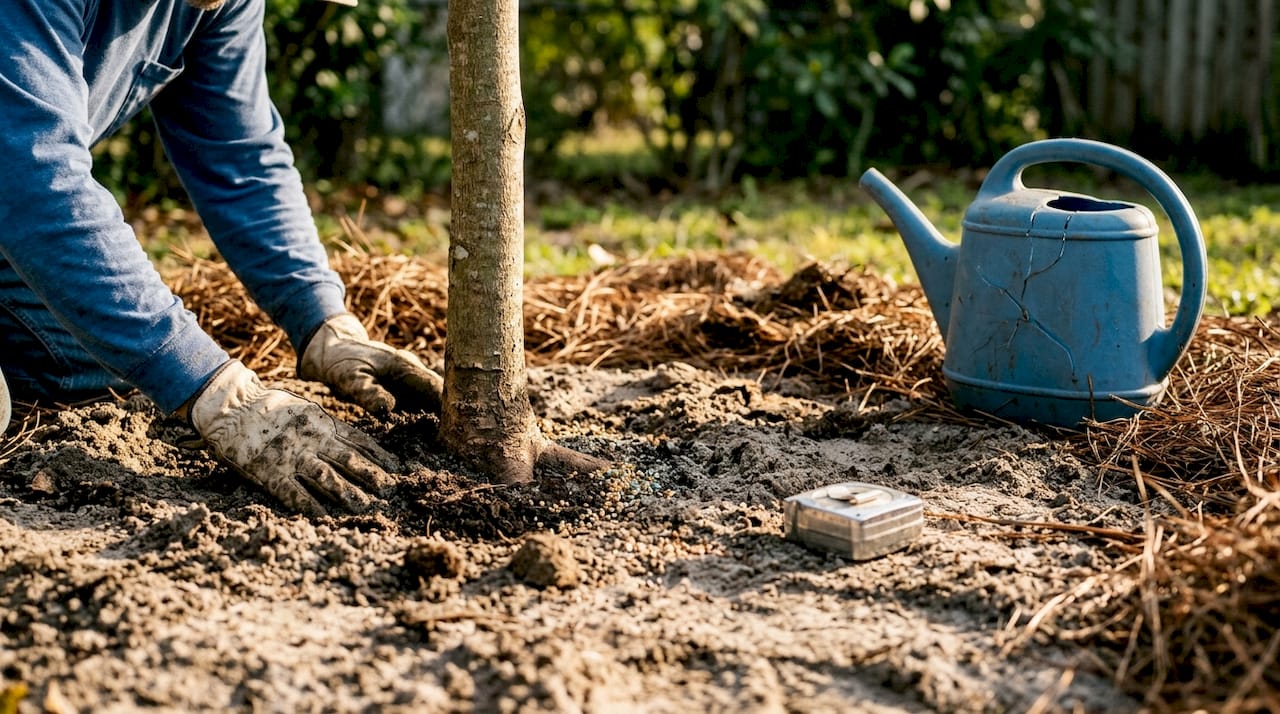
Pro Tip: Never plant closer than 15 feet to your home or any major structure. Large-canopy trees need room to grow without threatening your foundation, roof, or underground systems.
Good site prep is the foundation of your landscaping return on investment. Follow the steps for lasting results to avoid costly corrections later. For a deeper look at site assessment best practices, UF/IFAS offers detailed guidance tailored to Florida conditions.
Best practices for planting and aftercare
With the site prepped, planting and aftercare is where it all comes together for lasting impact. Getting the mechanics right at planting time sets the tone for the next decade.
Follow these steps for a successful planting:
- Dig the right hole. Make it two to three times wider than the root ball but no deeper than the root ball height.
- Set the root flare at grade. The flare should sit at or slightly above the soil surface, never buried.
- Backfill with native soil. Use the soil you removed. Avoid heavy amendments in sandy Florida soils.
- Mulch properly. Apply two to three inches of mulch in a wide ring, keeping it away from the trunk.
- Water immediately. Soak the root zone thoroughly right after planting.
- Stake only if needed. Tall or wind-prone trees may need temporary staking, but remove stakes within six to twelve months.
Optimal planting time is October through March. Cooler temperatures reduce transplant stress and give roots time to establish before summer heat arrives. The root flare must sit at grade, and mulch should be applied correctly to retain moisture without smothering the base.
Aftercare tips for the first year:
- Water consistently: Irrigate with 2 to 3 gallons per inch of trunk diameter every other day for the first few weeks, then taper off gradually
- Mulch refresh: Replenish mulch as it breaks down, keeping the ring wide and the trunk clear
- Minimal pruning: Only remove dead or damaged branches in year one. Let the tree focus energy on root growth
- Monitor for pests: Check leaves and bark regularly for early signs of disease or insect activity
- Avoid fertilizing too soon: Wait at least one full growing season before applying fertilizer
Pro Tip: Resist the urge to stake every new tree. Over-staking prevents the trunk from developing the natural flex it needs to grow strong. Only stake trees that are visibly unstable or planted in high-wind areas.
Working with a certified arborist ensures your planting meets local regulations and follows best practices. ISA-certified arborists help cut the 50% failure rate significantly by catching mistakes before they become expensive problems. Learn more about why arborist certification matters for your property. For additional tree planting tips specific to Florida homeowners, this resource is worth bookmarking.
Smart placement for maximum benefits
Proper planting is only half the battle. Placement determines how much you actually gain from your investment.
Smart placement strategies that maximize your return:
- West and south sides for shade: Trees on these sides block the harshest afternoon sun, cutting cooling costs the most
- Away from driveways and sidewalks: Root systems will eventually lift concrete. Give hardscapes plenty of clearance
- Group plantings for wildlife: Clusters of native trees create corridors that attract birds, butterflies, and beneficial insects
- Windbreaks on the north and west: Rows of dense evergreens reduce wind exposure and protect structures during storms
- Pool area placement: Shade trees near pools reduce water temperature and evaporation, but choose low-litter species
Trees on west and south sides maximize summer shade, and large canopy trees can yield $120 to $150 per year in measurable property benefits. That adds up to thousands of dollars over the life of a single tree.
The “right tree, right place” principle is not just a catchy phrase. It’s the difference between a tree that enhances your property for decades and one that causes damage, liability, or removal costs. Poor placement is one of the leading reasons mature trees get removed prematurely.
For commercial property owners, strategic tree placement also signals professionalism and care to clients and tenants. Explore how boosting value with trees works for commercial landscapes in Central Florida. The tree energy savings data from UF/IFAS makes a compelling case for treating placement as a financial decision, not just an aesthetic one.
Take your Central Florida landscape to the next level
Every tree you plant is a long-term investment in your property, your comfort, and your community. But the difference between a tree that thrives and one that fails often comes down to the decisions made before the first shovel hits the ground.
At McCullough Tree Service, our certified arborists handle everything from species selection and site assessment to installation and ongoing care. Whether you need a full tree planting service installation, routine tree trimming to keep your existing trees healthy, or tree removal to make room for better options, we bring the expertise to get it right the first time. Contact us today to schedule a professional assessment and start building a landscape that works as hard as you do.
Frequently asked questions
What are the best trees to plant in Central Florida landscaping?
Live Oak, Southern Magnolia, and Dahoon Holly are top native choices due to their resilience and low maintenance needs in Central Florida’s climate.
When should I plant new trees in Central Florida?
The best planting season is October through March, when cooler temperatures reduce transplant stress and support strong root development before summer arrives.
How far should I plant trees from my house or other structures?
Plant trees at least 15 feet from buildings to prevent root and branch problems as the tree reaches full maturity.
What’s the number one reason new trees fail in Central Florida?
Planting too deep and over-amending sandy soil cause most failures within the first three years. Keep the root flare at or above grade.
Do native trees need less water and fertilizer than non-natives?
Yes. Native trees require less irrigation and fertilizer once established, making them a lower-maintenance and more sustainable choice for Central Florida yards.
Recommended
- Tree Planting for Central Florida Developers: 50% Survival Boost
- Central Florida tree planting guide: steps for lasting results
- Tree Planting Guide Central Florida for Homeowners
- Tree Planting Considerations for Central Florida Homes